July 22, 2026
5 Converged Crises in Scholarly Communication: Provenance Infrastructure
Five structural failures in scholarly communication share a root cause: no verifiable, content-addressed provenance. Institutions must invest in integrity infrastructure by Q3 2026.

The Five Converged Crises in Scholarly Communication
By DecentraSec Team
The five crises accelerating in scholarly communication — peer review collapse, reproducibility failure, publisher oligopoly, retraction epidemics, and data colonialism — share a single root cause: the absence of verifiable, content-addressed provenance infrastructure spanning the research lifecycle. Any institution that continues to rely on publisher-controlled, audit-by-reputation systems is not managing integrity; it is deferring liability to entities with no fiduciary duty to its research mission. The window for proactive infrastructure investment closes by Q3 2026.
A note on provenance infrastructure. Throughout this document, "provenance" carries a specific technical meaning: a directed acyclic graph of Entities (research artifacts — datasets, manuscripts, review reports), Activities (transformations — collection, analysis, peer evaluation), and Agents (actors — researchers, reviewers, instruments), serialized per the W3C PROV-DM specification, where each node carries a content identifier derived from a one-way hash function (SHA-256 or BLAKE3) and each edge carries a digital signature (Ed25519) binding an Agent to an Activity. This structure enables third-party verification of the complete artifact lineage without trusting the data custodian. It is not a blockchain — provenance graphs do not require distributed consensus on global state; they require only that each recipient can recompute content hashes and validate signatures against a known public key. The distinction matters: blockchain secures shared state against Byzantine actors; provenance infrastructure secures individual artifact integrity against tampering. The crises below demand the latter.
Three numbers demand your attention as a research leader in 2025.
First: nearly 14,000 retraction notices issued in 2023 alone — the compound growth rate of retractions (22.09% CAGR) outpaces publication growth (6.25% CAGR) by a factor greater than three (Nature, 2024, DOI: 10.1038/d41586-024-00397-x; Zhou et al., arXiv:2511.21176). Second: a system where editors now invite. Third: 22 of 24 universities in a single country fall into high-risk, red-flag, or watch-list categories on the Research Integrity Risk Index — a preview of what occurs when publication metrics race ahead of verification capacity (Life and Science, Vol. 6, No. 4, October 2025; Nature, June 2025, DOI: 10.1038/d41586-025-01727-3).
These numbers derive from indexed sources — Nature, the NIH, PLOS One, Retraction Watch, and preprint servers with full DOIs. They describe a system structurally fractured — and the fractures traverse every institution that produces or evaluates research.
Most commentaries treat these as separate crises requiring separate solutions. Peer review needs more reviewers. Reproducibility needs more replication funding. Retractions need better detection. Publisher concentration needs antitrust intervention. Data sovereignty needs policy frameworks.
But in 2025, the five crises converged. The NIH committed to independent replication studies through its Gold Standard Science Implementation Plan (August 22, 2025) — but with no infrastructure ensuring replication targets carry verifiable, content-addressed provenance linking raw data to published conclusions. Nature identified institutional retraction hotspots (February 2025, DOI: 10.1038/d41586-025-00455-y) — but with no mechanism for those institutions to provably remediate their artifact chains. The European Commission published landmark guidance on data sovereignty through the European Open Science Cloud (December 17, 2025) — but with no technical layer to decouple data governance from data geography.
Each attempted solution fails because it assumes the underlying record is trustworthy. It is not. Until institutions demand and deploy integrity infrastructure that renders research artifacts computationally verifiable at every stage of the lifecycle — from instrument to archive, from submission to citation — every reform initiative rests on sand.
This document outlines the five structural failures, their common root, and the institutional-grade infrastructure response that forward-looking research leaders are already evaluating.
H2: The Peer Review Collapse: Provenance Infrastructure Attestation Gap
The math no longer functions. At these ratios, the system has broken.
Reviewer contributions remain structurally invisible. No portable, verifiable record of peer review labor travels with the researcher across institutions, promotions, or grant applications. A community survey of 2,944 Astronomy & Astrophysics stakeholders across 69 countries (arXiv:2606.27447) identified credibility over speed, fairness over profit, and human judgment over automation as dominant researcher priorities — yet no current system delivers verifiable, portable reviewer attribution. (We note this is a single-journal survey; cross-disciplinary data remains sparse — itself a symptom of the infrastructure gap.)
GEAR Network — Decentralized Validation Architecture
When the peer review system cannot scale because reviewer labor is invisible and uncompensated, the infrastructure gap is one of attestation. GEAR Network addresses this by issuing a structured, Ed25519-signed attestation for each completed review, binding the reviewer's institutional identity to a review activity without exposing manuscript content. The attestation record — an Entity-Activity-Agent triple in the PROV-DM sense — is content-addressed and portable across institutional boundaries. Verification requires only the reviewer's public key and the attestation hash; no centralized registry is needed. This transforms an invisible labor subsidy into a computationally verifiable and career-portable scholarly contribution.
Institutional implication Every time your ORIC recruits external reviewers without a mechanism to issue signed, content-addressed attestations of that labor, you subsidize publisher infrastructure while building zero portable integrity capital for your own researchers.
H2: The Reproducibility Crisis: Why NIH Funding Fails Without Provenance Infrastructure
The data is unambiguous. Nature's landmark survey (2016, DOI: 10.1038/533452a) found more than 70% of scientists failed to reproduce another's work, and more than 50% failed to reproduce their own. The Reproducibility Project: Cancer Biology (eLife, 2021, DOI: 10.7554/eLife.71601) found that across 112 replication attempts in preclinical cancer biology, 46% of replications succeeded on more criteria than they failed, and median replication effect sizes measured 85% smaller than original published effects: a median of 0.43 versus 2.96 for the originals.
The NIH response created demand but not infrastructure. The 2025 Gold Standard Science Implementation Plan mandates for independent replication and stronger data-sharing requirements — but replication auditors operate without a content-addressed chain linking raw data to published conclusions. They audit in the dark.
The technical gap is specific, not abstract. A replication auditor receiving a dataset needs to answer three questions computationally: (1) Is this the exact dataset collected — i.e., does its SHA-256 root hash match the hash registered at collection time? (2) Were any transformations applied between collection and the published analysis — and if so, are those transformations themselves recorded as provenance Activities with input-output Entity hashes? (3) Were all transformations applied by Agents whose signatures can be validated against known institutional keys? Without infrastructure answering these questions, "reproducibility audit" reduces to "we trust the original authors' ZIP file."
The PROV-AGENT framework (arXiv:2508.02866, August 2025) demonstrated that extending W3C PROV to capture agent interactions and workflow provenance is technically feasible across edge, cloud, and HPC environments — specifically for AI-agent workflows, but with architectural patterns applicable to general research-data pipelines. Separately, the ARA benchmark (arXiv:2605.02651, May 2026) demonstrated that automated workflow reconstruction across 213 ReScience C articles can assess computational reproducibility at scale. The missing piece is deployment of content-addressed provenance anchoring at the institutional level, before data reaches the publisher.
Integritas Vault: Mathematical Validation Chain-of-Custody
Replication auditors require computational verification, not institutional assurance. Integritas Vault anchors research artifacts to a W3C PROV-compliant provenance graph where each state transition — data collection, transformation, analysis, archival — generates a content-addressed Entity node linked to an Activity node, with the responsible Agent identified by an Ed25519 public key. Any downstream auditor can recompute the hash chain from raw data to published conclusion and verify every Agent signature independently. This transforms reproducibility from audit-by-reputation to audit-by-computation — directly addressable by the NIH Gold Standard Science mandate for stronger data-sharing and replication verification.
Institutional implication For any PI applying for NIH, EU Horizon, or Wellcome Trust grants in 2026, the question shifts from "do you have data" to "can you prove, via content-addressed provenance, that your data was not altered between collection and publication." Institutions that provide this capability gain competitive advantage. Those that do not will face mounting compliance debt.
H2: The Consolidation Oligopoly: How Top Five Publishers Control Visibility Without Provenance
The numbers are stark. The Scholarly Kitchen (August 20, 2025) quantified that the top five publishers control a majority share of indexed journals. A PLOS One study (June 26, 2025, DOI: 10.1371/journal.pone.0327015) demonstrated that exclusive databases actively sustain this oligopoly by gatekeeping journal visibility.
This is not a market; it is an infrastructure bottleneck. Without publisher-controlled indexing, independent journals are structurally less credible — not because of lower quality, but because of lower visibility. The system conflates distribution with validation.
The decentralized alternative requires a validation architecture that decouples credibility from indexing. If the credibility of a published artifact can be verified computationally — by checking the provenance chain from peer review attestations through revision history to final manuscript — then visibility becomes a distribution problem, not a validation problem. Distribution can be commoditized; validation cannot.
GEAR Network: Community-Governed Validation
Against publisher concentration, GEAR Network provides a distributed validation architecture where signed peer review attestations, revision provenance, and artifact integrity proofs are stored and verified independently of any single publisher's indexing infrastructure. Institutional reputation — expressed as the set of verified, content-addressed attestations from that institution's researchers — determines credibility, not inclusion in a proprietary database. This breaks the oligopoly's monopoly on visibility without sacrificing credibility, because credibility derives from computationally verifiable attestation chains rather than commercially brokered indexing.
Institutional implication Every year your institution routes its best research through publisher-controlled pipelines, you surrender distribution sovereignty to entities whose incentives are shareholder returns, not research quality. The infrastructure to decouple validation from distribution exists. The question is whether your institution deploys it before its competitors do.
H2: The Retraction Epidemic: From Retrospective Hotspot Detection to Real-Time Integrity Monitoring
The data accelerates. Global retraction notices reached nearly 14,000 in 2023 (Nature, 2024, DOI: 10.1038/d41586-024-00397-x), with 22.09% CAGR versus 6.25% for publications (Zhou et al., arXiv:2511.21176). The Retraction Watch database surpassed 63,000 entries by December 2025.
Nature's institutional hotspot analysis (February 2025, DOI: 10.1038/d41586-025-00455-y) identified specific universities and countries as disproportionately affected — but this analysis remains retrospective. It identifies damage after occurrence.
Pakistan's case serves as the canary. Of 24 universities analyzed by the Research Integrity Risk Index (Life and Science, Vol. 6, No. 4, October 2025), 22 fall into high-risk, red-flag, or watch-list categories. This is not a regional anomaly; it is the logical outcome of any system where publication pressure outpaces verification capacity. (We note that the 19% misconduct-variance figure from arXiv:2109.09375 derives from a survey of astronomers specifically; cross-domain pressure-to-misconduct ratios remain understudied — another consequence of absent provenance infrastructure.)
Integritas Vault — Real-Time Integrity Monitoring
Current retraction analysis remains retrospective — conducted only after institutional reputation sustains damage. Integritas Vault transforms integrity from a reactive metric into a continuously verifiable property of research output. Because every artifact in the vault carries a content hash and every transformation carries a signed attestation, integrity violations manifest as hash mismatches — computationally detectable at any point in the artifact lifecycle, not only after publication. An institution can query its own vault: "Show me every dataset whose provenance chain contains a hash mismatch or an unsigned transformation." The answer is a list, not a post-retraction investigation.
For institutions on integrity watchlists, this provides HEC and international partners with tamper-evident verification independent of opaque publisher-controlled systems. The institution does not ask to be trusted; it provides a computationally verifiable answer.
Institutional implication The difference between a retraction crisis that damages your ranking for a decade and one contained to a single bad actor is whether your institution possesses prospective, content-addressed provenance infrastructure — or only retrospective, PDF-based audit. The 22.09% CAGR makes exposure a question of when, not if.
H2: Data Colonialism & The Sovereignty Trilemma: Provenance Infrastructure as the Technical Solution
The European Commission (December 17, 2025) published a landmark opinion paper on enhancing data sovereignty through the European Open Science Cloud. SciELO simultaneously identified a "trilemma" between global openness, digital sovereignty, and the risk of data colonialism for the Global South (December 17, 2025).
The trilemma is technical, not political. Openness requires that data be interoperable — readable and verifiable by any party, anywhere. Sovereignty requires that data governance — who can access, transform, or delete — remain under local institutional control. Security requires jurisdictional boundaries that prevent unauthorized access. These three requirements appear mutually exclusive only if the verification layer is conflated with the storage layer.
Provenance infrastructure resolves the trilemma by decoupling these concerns. A research dataset stored on local infrastructure in a Global South institution can be accompanied by a content-addressed provenance graph that is globally shareable — any researcher anywhere can verify the dataset's integrity, lineage, and governance policies by recomputing hashes and validating signatures, without ever accessing the raw data directly. The data remains sovereign; the provenance is open; the verification is computationally enforced.
The PROV-AGENT framework (arXiv:2508.02866) demonstrated that W3C PROV extensions can capture agent interactions across heterogeneous environments (edge, cloud, HPC). Applied to the sovereignty context, this means a provenance graph can span local storage, institutional HPC, and cloud analysis environments while maintaining a single verifiable lineage — the institution governs the data; the provenance standard governs the verification.
GEAR Network: Sovereign Research Infrastructure
GEAR Network enables sovereign research infrastructure: data governance remains local and institutionally controlled, while the content-addressed provenance layer preserves global interoperability through open standards. Any researcher worldwide can verify that a dataset from, say, a Kenyan university has not been tampered with and carries the appropriate governance attestations — without the Kenyan university ever surrendering custody of the raw data. This resolves the trilemma the European Commission and SciELO identified as the defining infrastructure challenge for the Global South.
Institutional implication Any institution that deposits research data in foreign, publisher-controlled repositories without a content-addressed provenance layer is not practicing open science — it is practicing data surrender. The technical primitives for sovereign infrastructure (hash anchoring, signed attestations, W3C PROV serialization) are standardized and available. The remaining decision is strategic, not technical.
From Crisis Convergence to Infrastructure Response
The five crises have converged. Peer review is not strained — it is fracturing under an attestation gap that renders reviewer labor invisible. Reproducibility is not a methodological debate — it is a federal mandate demanding computational verification of artifact lineage. Publisher consolidation is not a market trend — it is an oligopoly sustained by conflating distribution with validation. Retractions are not isolated incidents — they follow a 22.09% CAGR that guarantees institutional exposure. Data colonialism is not theoretical — it is a trilemma declared urgent by both the European Commission and SciELO in the same month.
Each crisis traces to the same root: the absence of verifiable, content-addressed provenance infrastructure spanning the research lifecycle.
The Institutional Response
DecentraSec invites a select cohort of research-performing institutions — globally, with emphasis on institutions navigating the integrity emergency — to apply for an Institutional Pilot Grant. This grant provides:
Deployment of Integritas Vault, anchoring research artifacts to a W3C PROV-compliant provenance graph with SHA-256 content addressing and Ed25519 agent attestations across select research workflows
Integration with GEAR Network for distributed, cryptographically signed peer review attribution and portable scholarly capital
Full provenance infrastructure for pilot departments or research groups, including hash-chain verification dashboards and integrity-monitoring query interfaces
Dedicated implementation support and integration with existing ORIC/CRIS workflows
Co-authored case study and publication opportunity
Eligibility criteria: - Institution must maintain an active ORIC or equivalent research support office - Commitment to a 6-month pilot with defined integrity metrics - Willingness to participate in cross-institutional provenance benchmarking
The convergence of five structural failures makes 2026 the year of infrastructure decisions. Institutions that deploy verifiable provenance infrastructure now will define the verification standard for the next decade. Those that wait will spend that decade catching up to retractions they could have prevented — and asking reviewers for favors they can no longer repay.
Apply for the Institutional Pilot Grant — or contact your institutional strategy representative at DecentraSec to begin the assessment process.
References
Nature (February 2024). "Nearly 14,000 retraction notices in 2023." DOI: 10.1038/d41586-024-00397-x
Nature (February 2025). "Institutional retraction hotspot analysis." DOI: 10.1038/d41586-025-00455-y
Nature (August 2025). "The peer-review crisis: how to fix an overloaded system." DOI: 10.1038/d41586-025-02457-2
Nature (June 2025). "Integrity index flags universities with high retraction rates." DOI: 10.1038/d41586-025-01727-3
PLOS One (June 2025). "Publisher oligopoly and exclusive databases." DOI: 10.1371/journal.pone.0327015
The Scholarly Kitchen (August 20, 2025). "2025 Update: Quantifying Consolidation in the Scholarly Journals Market."
Zhou et al. (arXiv:2511.21176). "Prevalence and Trends in Global Retractions Explored Through the Retraction Watch Database." CAGR: 22.09% retractions; 6.25% publications.
PROV-AGENT (arXiv:2508.02866). "Unified Provenance for Tracking AI Agent Interactions in Agentic Workflows." Extends W3C PROV for cross-facility AI agent workflows.
ARA (arXiv:2605.02651). "Agentic Reproducibility Assessment for Scalable Support." 213-article benchmark for automated computational reproducibility assessment.
A&A Community Survey (arXiv:2606.27447). 2,944 Astronomy & Astrophysics stakeholders across 69 countries. Note: single-journal survey; cross-disciplinary generalization requires further study.
Retraction Watch database. 63,000+ entries (December 2025).
Life and Science (Vol. 6, No. 4, October 2025). "The Decline of Research Integrity in Pakistan: Causes, Consequences, and the Research Integrity Risk Index."
European Commission (December 17, 2025). "Enhancing Data Sovereignty for Research: Opinion Paper on the European Open Science Cloud."
SciELO (December 17, 2025). "Scientific Data Sovereignty in the Tension Between Global Openness and Local Autonomy."
arXiv:2109.09375 (Heuritsch, 2021). "Reflexive Behaviour: How Publication Pressure Affects Research Quality in Astronomy." Note: sample restricted to astronomers; publication pressure explained 19% of misconduct variance in this domain.
arXiv:1406.0905 (Missier et al., 2014). "Provenance and Data Differencing for Workflow Reproducibility Analysis." Introduced PDIFF algorithm for graph-based provenance comparison on the e-Science Central platform. Note: 2014 single-platform demonstration; scalability claims for general provenance graphs require contemporary validation.
Nature (2016). "1,500 scientists lift the lid on reproducibility." DOI: 10.1038/533452a. >70% failed to reproduce others' work; >50% failed to reproduce own.
Reproducibility Project: Cancer Biology (eLife, 2021). DOI: 10.7554/eLife.71601. 46% replication success rate on combined criteria; median effect sizes 85% smaller than originals. Note: domain-specific to preclinical cancer biology.
W3C PROV-DM. "PROV Data Model." W3C Recommendation (2013). Conceptual model for provenance: Entities, Activities, Agents, and their relationships.
02 // RELATED RESEARCH · ARCHIVE DISPATCHES
Related Papers & Dispatches.
Peer-reviewed analyses, cryptanalysis papers, and zero-trust engineering dispatches.

National Launch of ScholarMark: DecentraSec and PASTIC Unveil Pakistan’s First Sovereign AI & Blockchain Research Integrity Infrastructure
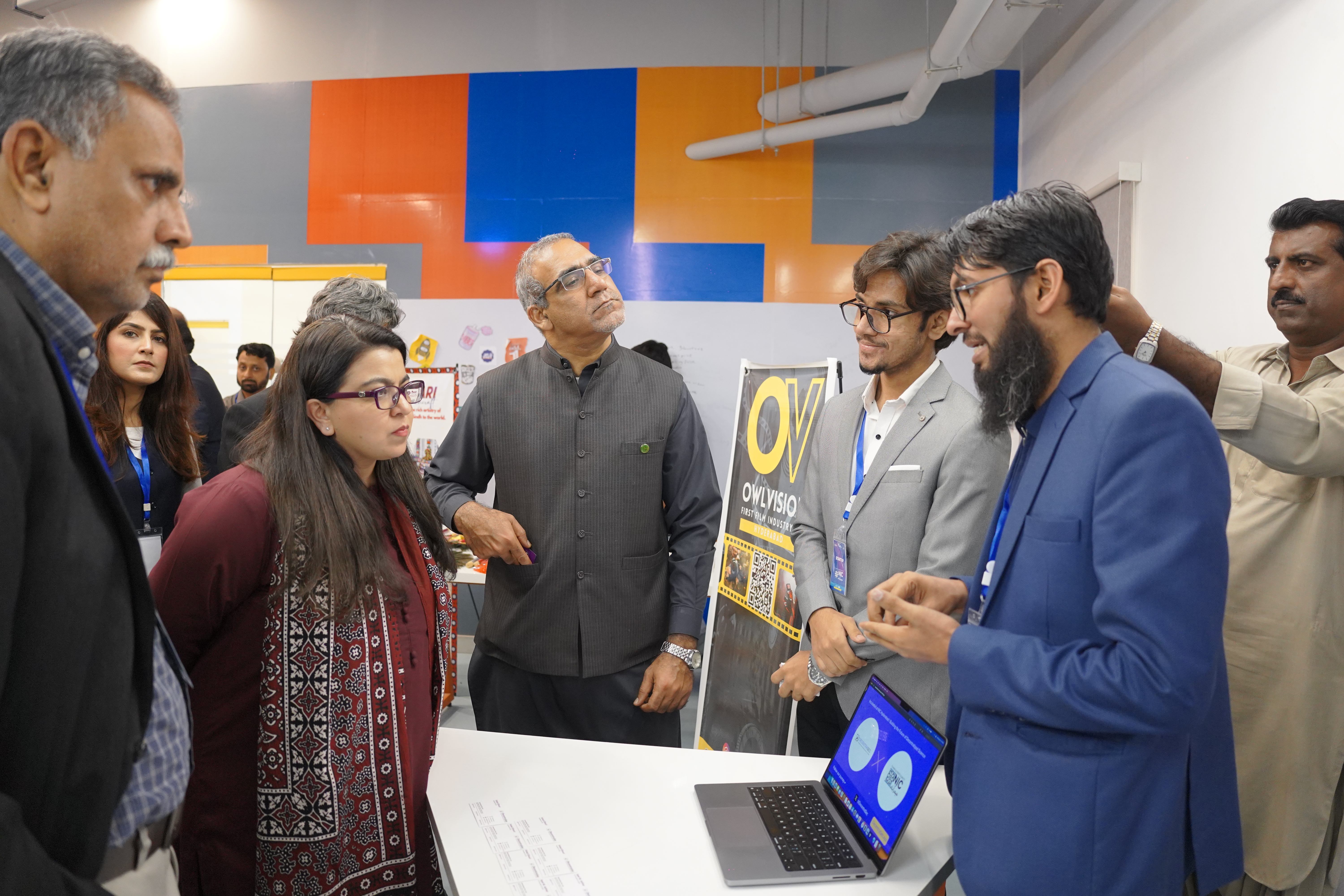
On October 21, 2026, DecentraSec and PASTIC (Ministry of Science & Technology) convened national science leaders, university deans, ORIC directors, and journal editors at NICAT (NASTP), Islamabad, to officially launch ScholarMark—a sovereign deep-tech platform designed to eliminate research manipulation, protect intellectual property, and secure Pakistan’s knowledge economy.
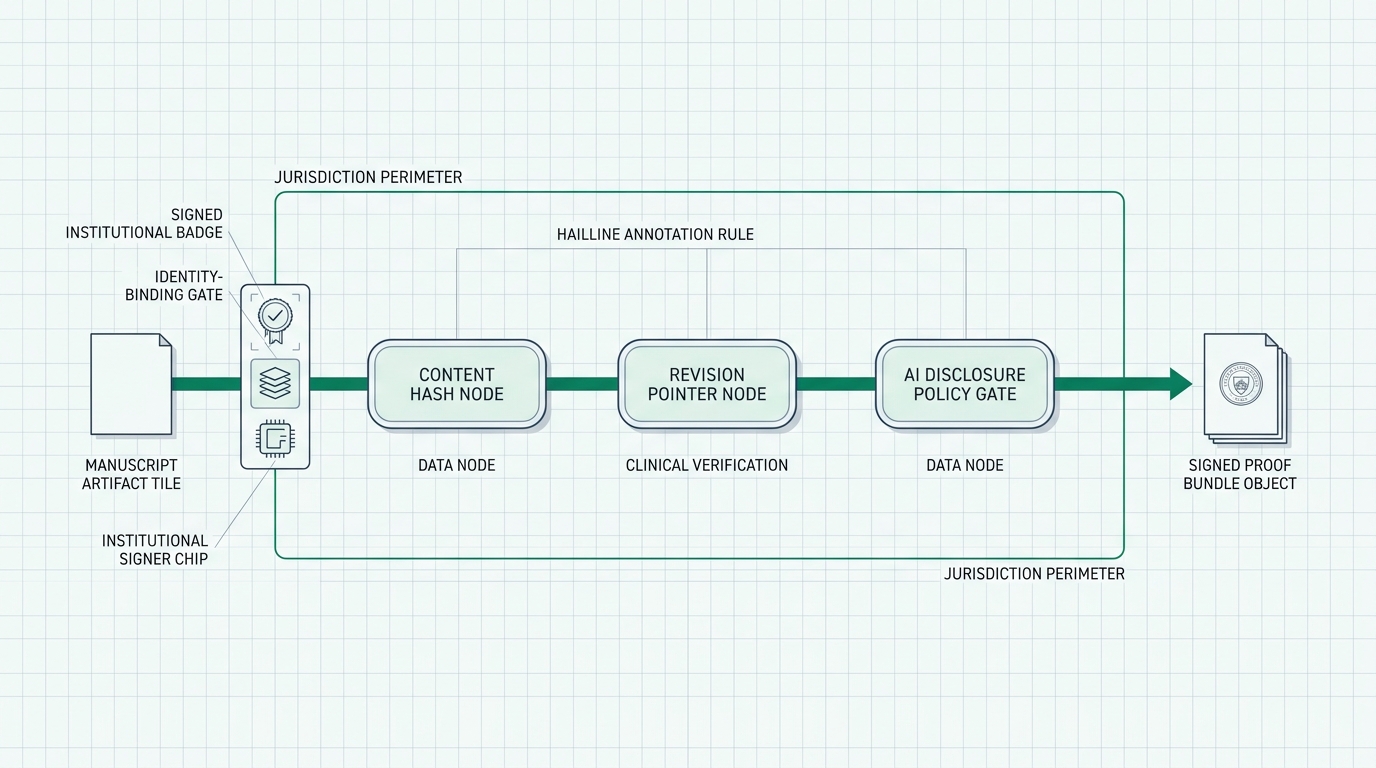
Chain of Custody for Research Integrity: Institutional Proof
Detection tells you that you have a problem. Proof tells you who, what, and when. This is the case for signed, content-addressed custody of the scholarly record — held inside the institution's own trust boundary from ingestion onward.
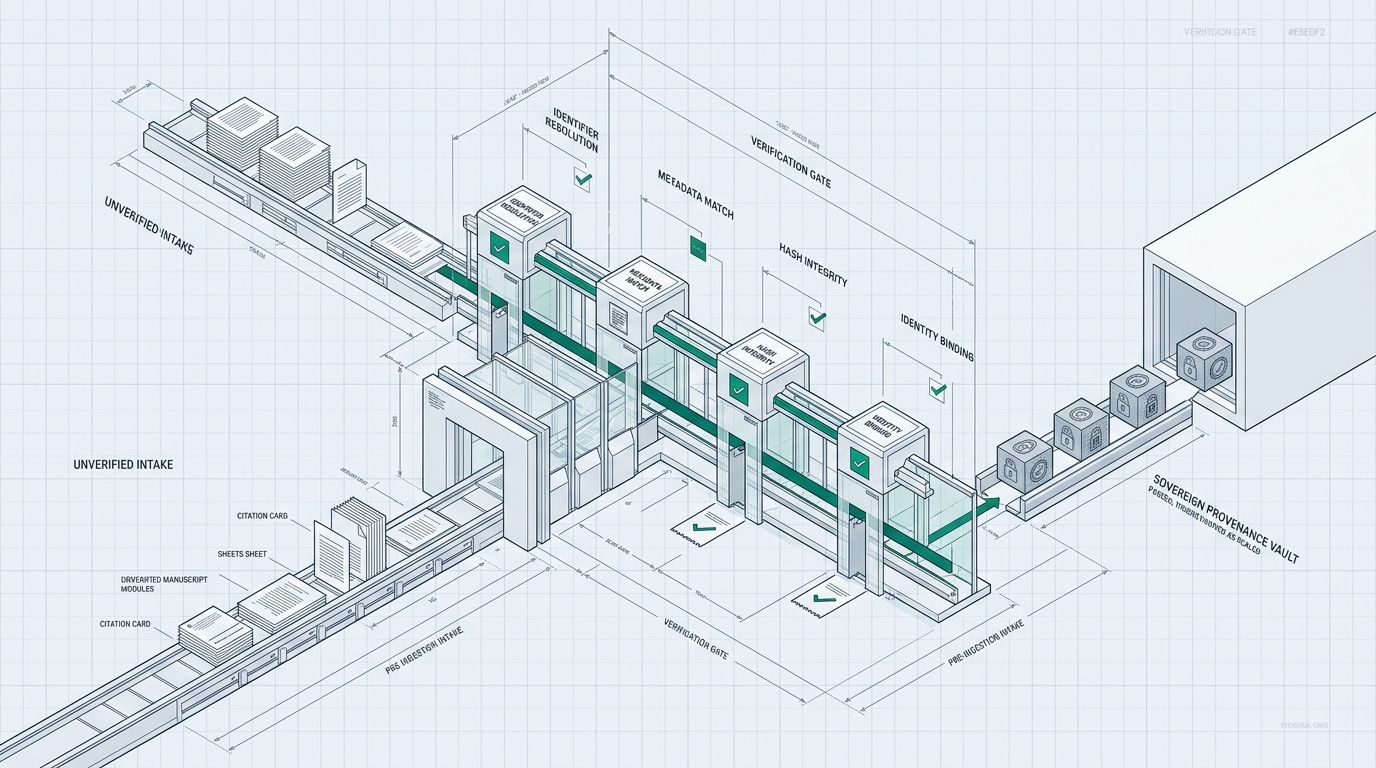
Research Integrity Infrastructure: Pre-Ingestion Checks
Research integrity failures are infrastructure failures. This post outlines pre-ingestion verification, appeal-aware records, and sovereign provenance for academic institutions.