September 26, 2026
Research Integrity Infrastructure: Pre-Ingestion Checks
Research integrity failures are infrastructure failures. This post outlines pre-ingestion verification, appeal-aware records, and sovereign provenance for academic institutions.

The Retraction You Haven't Had Yet
By the DecentraSec team
Research integrity is not a culture problem to enforce. It is an infrastructure problem to build — and every control institutions rely on fires after the liability has already accrued.
May 2026. arXiv enforces a one-year submission ban for unchecked AI output. Biomedical fabricated references run approximately 12× above 2023 levels. Somewhere in that flood sits a paper your faculty submitted four weeks ago, carrying your institution's name and a reference that does not exist.
Every control fires after the damage. The ban, the retraction, the database entry — each documents failure; none prevents the first instance. By the time any control triggers, a fabricated citation has already become a publisher's, a funder's, and a university's liability. The narrow question is: what would it take to stop fabrication at the ingestion layer — before it earns a DOI?
The Control Gap: Why Retrospective Policing Cannot Scale
Integrity enforcement today operates post-ingestion by design. arXiv bans, Retraction Watch listings, misconduct databases — each validates after a claim enters the scholarly record. Retraction Watch crossed roughly 69,911 records by April 2026, about 5,390 tied to misconduct. That registry documents failures; it does not bar them.
Venue-level validation checks the container, not the claim. Pakistan's HJRS W/X/Y tiers, journal whitelists, impact-factor screens — a fabricated reference inside a "recognized" journal passes every tier check ever devised. Sweden's national misconduct committee made that instability explicit in September 2026, when it dismissed a hallucinated-reference case against an AI expert: contested, retrospective detection proves legally brittle and reputationally dangerous in equal measure.
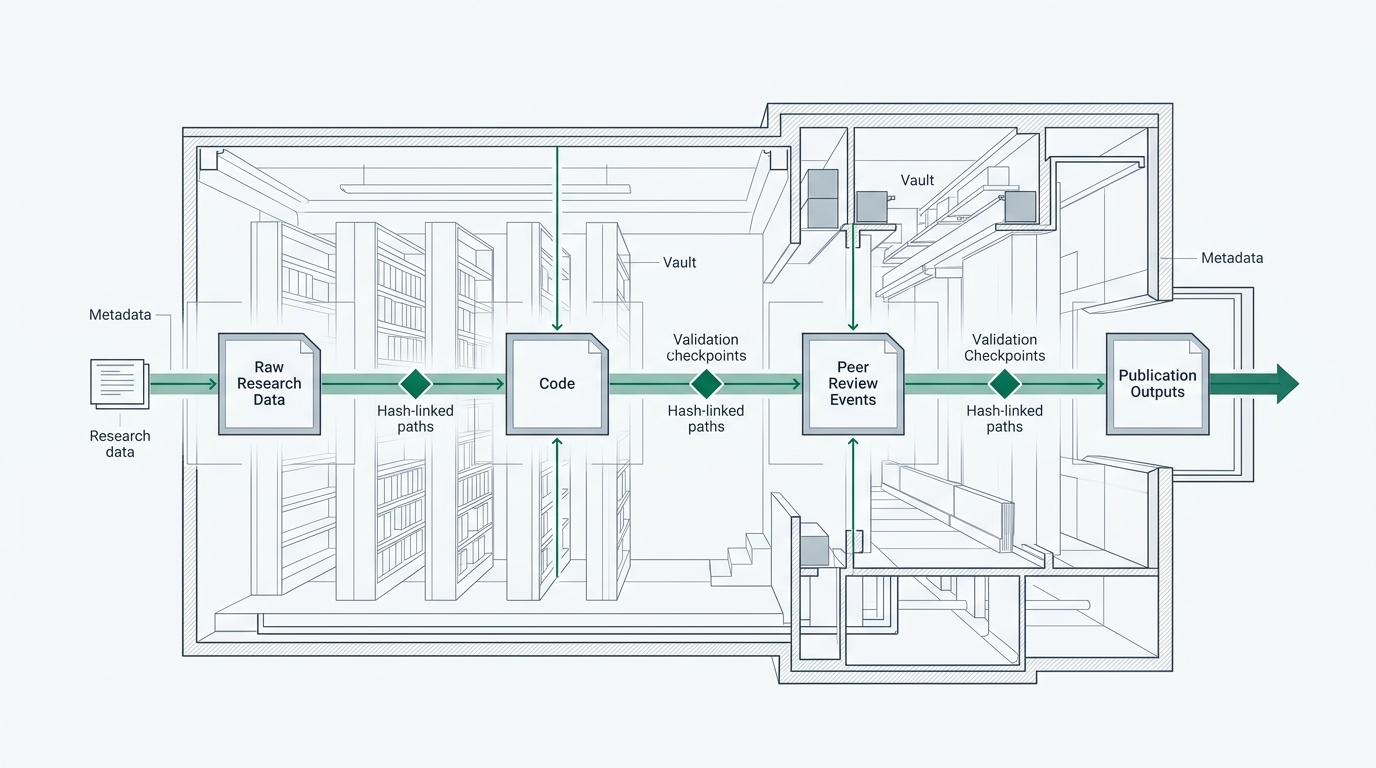
Retrospective audit alone cannot prevent the first loss. The control point must move upstream. ScholarMark's AI Integrity Layer replaces tier-list guesswork with pre-ingestion verification of every citation and dataset link — DOI resolution, metadata matching, hash-based integrity checks, and ORCID/ROR-backed identity binding — and records that verification state before a paper advances.
Five Problems Nobody Has Solved Together
Any credible architecture must satisfy all five at once. Four is not a solution.
Pre-ingestion verification at scale. Resolve every DOI, citation, and dataset link, and record its verification state, before the manuscript advances.
An appeal-aware misconduct record. Append-only and timestamped, yet still open to appeal, correction, and right-of-reply. Corrections must be new signed entries, not silent rewrites. Nature and Retraction Watch's April 2026 proposal for a national misconduct database — limited to concluded findings — reopened the due-process-versus-public-interest argument precisely because permanence without appeal is indefensible.
True sovereignty, not residency. BARC's 2026 survey of 320 organizations found 89% call sovereignty important, while roughly 10% have funded it. Gartner projects about USD 80 billion in sovereign cloud spend in 2026, up 35.6% year over year. Jurisdictional control of the management plane, the encryption hierarchy, the update chain, and AI endpoints is the actual requirement. The GEAR Network keeps provenance and access policy traveling with the record, not with the vendor. The June 2026 US export-control directive that suspended foreign-national access to frontier AI models proved the point: vendor policy can sever research infrastructure faster than law can respond.
Portable, contestable reviewer credit. In one widely cited conservation-biology study, authors perceived peer-review turnaround near 14 weeks against a 6-week optimum; reported waits run nine months in chemistry and eighteen in business and management. The bottleneck is field-specific, but reviewer scarcity binds everywhere, and single-publisher databases entrench it. The Integritas Vault makes a review performed for one journal attestable and portable, cutting resubmission churn.
Promotion audits on attested claims, not re-trusted spreadsheets. HEC's HJRS keeps W/X/Y tiers central to Pakistani promotion audits — a manual process vulnerable to the very fabrication it exists to catch.
Mathematical Validation: Probabilistic Risk, Deterministic Checks
Internal-consistency hallucination detection, as explored in "Do Language Models Know When They're Hallucinating References?" (arXiv:2305.18248), runs post-generation and remains probabilistic. That is its ceiling; scale does not remove it.
Pre-ingestion verification differs in kind, but the difference must be stated precisely. It does not claim to prove that every assertion is true. It converts the existence and integrity components of hallucination risk into deterministic pass/fail checks: DOI resolution establishes that an identifier exists; metadata matching tests whether the resolved record agrees with the citation under a fixed, versioned rule set; hash-based integrity checks bind the referenced artifact to a fixed digest; identity binding ties each verification event to a signed actor and timestamp. Semantic accuracy that cannot be reduced to those checks is isolated as an explicit exception and routed to human review, not silently scored by a model.
The AI Integrity Layer's provenance record captures every state transition: the check performed, the input artifact hash, the method version, the outcome, the timestamp, and the verifying party. Because the record is append-only, signed, and independently replayable, any party — publisher, funder, institution — can re-run the checks against the recorded inputs and audit the history without trusting an operator. That is Decentralized Provenance in the literal sense: proof distributed with the artifact, not held by a central authority. Algorithmic Integrity means the verification pipeline is deterministic, versioned, replayable, and tamper-evident; its outputs can be checked by third parties. It is the difference between Algorithmic Integrity and a vendor's assurance.
The literature gives that distinction a boundary condition. "Stop Automating Peer Review Without Rigorous Evaluation" (arXiv:2605.03202) rejects using today's models as reviewers without rigorous evaluation; this proposal does not automate review, it automates existence, integrity, and provenance checks and leaves judgment to humans. "AI and the Future of Academic Peer Review" (arXiv:2509.14189) shows AI already being piloted across the review pipeline; that makes a pre-ingestion gate more urgent, not less. "How Ten Publishers Retract Research" (arXiv:2602.19197) documents how unevenly retrospective correction operates; post-publication heterogeneity is exactly what a shared pre-ingestion record avoids. "The Data Provenance Initiative: A Large Scale Audit of Dataset Licensing & Attribution in AI" (arXiv:2310.16787) demonstrates that provenance gaps are already a research problem at dataset scale; the scholarly record needs the same discipline.
To the skeptic: this is not AI reviewing AI. It is deterministic metadata and provenance checking, with human judgment reserved for the contested cases that deserve it — a failed check, an unresolvable identifier, or a disputed source.
What Sovereign Integrity Infrastructure Looks Like in Practice
Ingestion gate. Mathematical Validation runs at submission. A hallucinated reference caught by the gate never becomes institutional liability because it never propagates.
Appeal-aware record. Integritas Vault replaces manual tier-list matching with mechanically checkable venue, review, and retraction attestations — attestation over list-matching, with right-of-reply preserved.
Federated sovereignty. GEAR Network nodes sit under institutional jurisdictional control of the management plane and encryption hierarchy, honoring Indigenous and Māori data-sovereignty frameworks now moving out of ethics statements and into platform architecture.
Reviewer pipeline. Portable credit and federated identity relieve the reviewer bottleneck and reduce resubmission churn.
Trust then derives from proof and lineage, not a centralized operator's discretion.
The Institutional Case: Liability, Reputation, and the Cost of Waiting
Integrity spend belongs in the risk-infrastructure budget, beside the cybersecurity line item that a decade ago was also dismissed as overhead. The 89%/10% sovereignty gap is the opening: first movers fund it while peers debate it.
The reputational mathematics are asymmetric. One retraction cluster traced to your institution costs more — in audit exposure, funding relationships, and faculty morale — than years of prevention. Promotion fairness cuts both ways: attested claims protect the researcher who did the work and the committee that must defend its decisions.
You cannot police your way out of an infrastructure failure. You build your way out.
An Institutional Pilot, Not a Product Sale
ScholarMark serves institutions, not individuals. We invite Deans, ORIC Directors, and research-office leadership to apply for an Institutional Pilot Grant — a structured deployment of the AI Integrity Layer and Integritas Vault across a single high-volume discipline or faculty, with a defined verification scope, measurable integrity attestations, and a joint evaluation protocol. For institutions prepared to co-develop sovereign nodes on the GEAR Network, we offer a limited number of Early Adopter Subsidies to offset first-cohort deployment of distributed infrastructure. These are partnership programs with defined evaluation milestones, not commercial trials. Speak with our institutional partnerships team to scope a pilot aligned to your governance and procurement cycles.
References
- "Do Language Models Know When They're Hallucinating References?" arXiv:2305.18248.
- "Stop Automating Peer Review Without Rigorous Evaluation." arXiv:2605.03202.
- "AI and the Future of Academic Peer Review." arXiv:2509.14189.
- "How Ten Publishers Retract Research." arXiv:2602.19197.
- "The Data Provenance Initiative: A Large Scale Audit of Dataset Licensing & Attribution in AI." arXiv:2310.16787.
- Retraction Watch database, ~69,911 records, April 2026.
- BARC Data Sovereignty Survey, 2026; Gartner sovereign cloud forecast, 2026.
- Nature / Retraction Watch national misconduct database proposal, April 2026.
02 // RELATED RESEARCH · ARCHIVE DISPATCHES
Related Papers & Dispatches.
Peer-reviewed analyses, cryptanalysis papers, and zero-trust engineering dispatches.
Research Integrity Infrastructure: Verify Before Publication
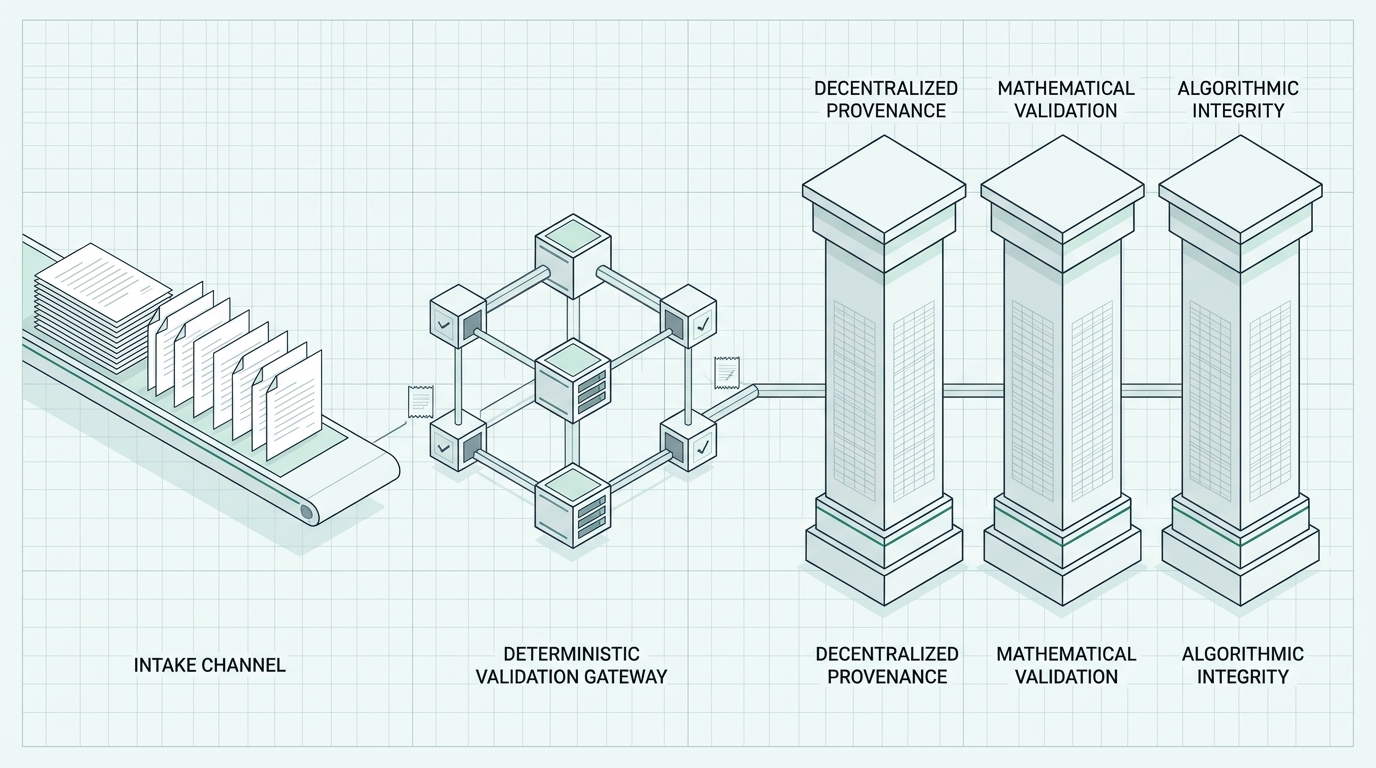
Scholarly integrity does not fail on ethics — it fails at intake. A structural look at pre-publication attestation, deterministic citation validation, and persistent provenance, and what a scoped institutional pilot actually returns.
The Verification Gap: Research Integrity Is Infrastructure
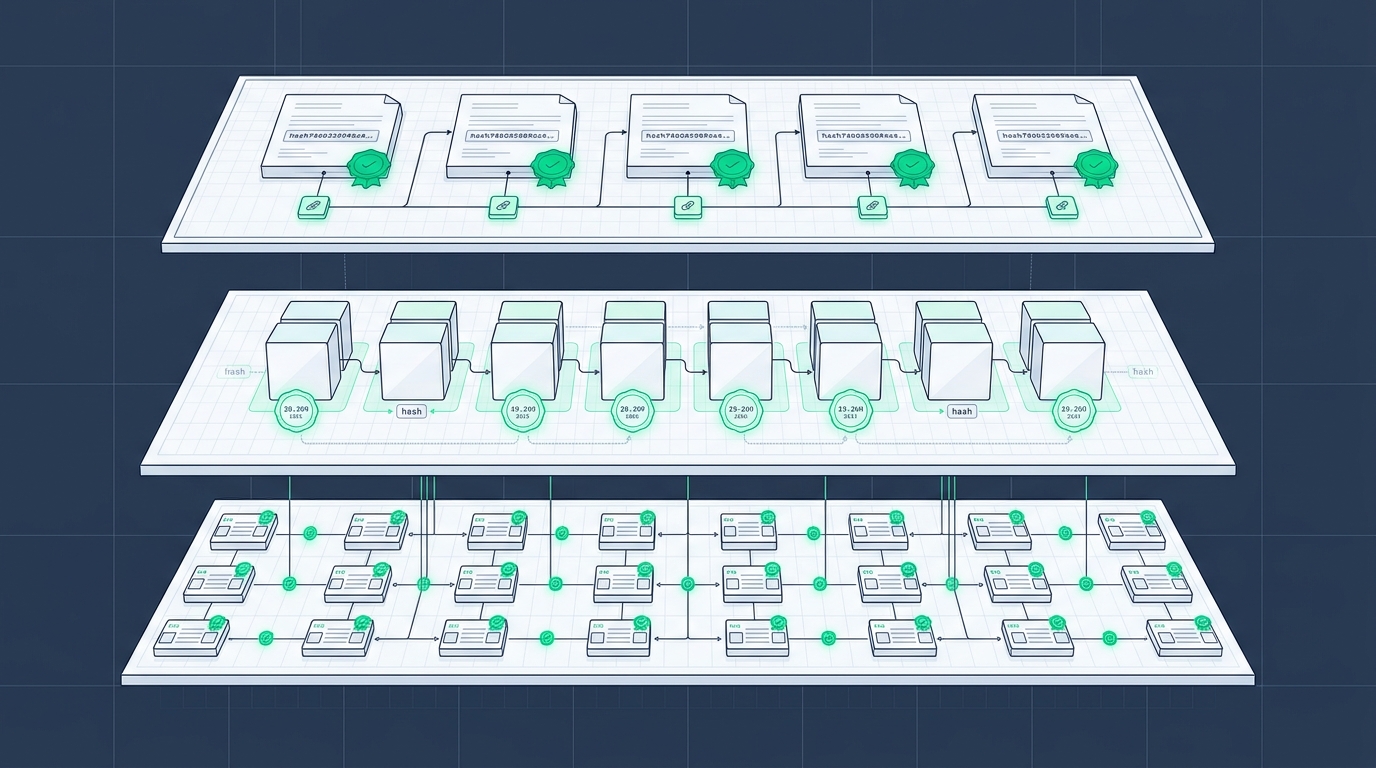
Institutions do not lack AI detectors — they lack a verifiable chain of custody. Why the 21% AI-review finding is an audit failure, how tamper-evident provenance makes retraction clusters structurally impossible, and how deans, ORIC directors, and regulators can pilot verifiable research infrastructure this accreditation cycle.
Verifiable Research Integrity: Provenance & Data Custody
The scholarly record is now a supply-chain dependency for pharma, materials, AI, and policy — and its incoming inspection has failed. Institutions that cannot prove custody of their data will lose the standing to earn trust with it. This brief argues that compliance documentation asserts integrity while decentralized provenance proves it, and that research integrity is no longer a policy to subscribe to but an infrastructure to procure, pilot, and validate.