August 7, 2026
Peer Review Collapse Is a Trust-Infrastructure Failure
Peer review isn't short on reviewers—it's short on verifiable identity, provenance, and algorithmic accountability. Here's the infrastructure fix institutions must adopt before 2027.
The 3.5 Million Submission Threshold: Why Peer Review's Collapse Is a Trust-Infrastructure Failure — and What Deans, ORIC Directors, and Tier-1 Researchers Must Do Before 2027
The peer-review crisis is not a capacity shortage; it is an identity and provenance infrastructure failure. Institutions that treat it as a hiring problem inherit its collapse; institutions that treat it as a verification problem will define the research-integrity standard for the next decade. Adding exhausted reviewers — or black-box AI screeners — to a system that cannot mathematically validate who performed the work, where it originated, or whether it is authentic will accelerate the failure, not arrest it.
The Mathematics of Collapse: Why the Human Editorial Model Cannot Scale
In 2024, Elsevier alone fielded 3.5 million submissions — 600,000 more than the prior year, a 17% surge that is double the historical growth rate of academic publishing. Extrapolate that curve five years out, and sustaining human peer review would demand 200 to 300 million reviews annually — more than every PhD-level researcher on Earth could produce in a career devoted to nothing else. The system is not straining; it is mathematically over.
This year, at NeurIPS 2026, OpenReview buckled under load during the review release — a literal systems failure mirroring the systemic one. In February, The Chronicle of Higher Education published "Peer Review Is Breaking Under Its Own Weight."
The ScholarOne reviewer pool grew 54% since 2018, yet invitation acceptance collapsed from 43% in 2018 to 22% in 2024 (Silverchair, 2026). Supply grows; willingness evaporates. Editors now dispatch 4.5 invitations per completed review — nearly double the 2018 rate — and 55% rate reviewer-finding a "significant or very significant challenge" (The Conversation, 2026). Some editors report 30 or more invitations for a single review.
Desk rejection now absorbs the strain the human pool cannot carry. The Scholarly Kitchen reports 1.69 desk rejects per acceptance in 2022, climbing to 2.49 by 2025: the editorial filter is "working harder, catching more." These buffers remain temporary — exponential input growth outpaces any linear human response. Machine-speed triage is inevitable; the only open question is whether it runs on verifiable truth or unverifiable guesswork.
Why "More Reviewers" Is a False Fix
A 22% acceptance rate indicates burnout, not undersupply. Recruiting more reviewers into a system that cannot verify or reward their contribution manufactures fatigue. The technological shortcut fails on evidence: Fichtl et al. surveyed reviewer-facing AI policies across 111 leading AI/NLP conferences and medical journals and found LLM-generated reviews exhibit "overly positive recommendations, generic criticism, and uneven evidence grounding." Yu et al., analyzing 788,984 AI-written reviews paired with human reviews from ICLR and NeurIPS, concluded that reliable identification of machine-generated text at the individual-review level remains out of reach.
Paul et al. demonstrate that the marginal accuracy benefit of additional reviews diminishes beyond five to six reviewers; more reviews burn more reviewers without improving decisions. The 4.5-invitation problem is a verification problem: editors require a queryable reputation graph of validated prior work and signed review artifacts, not blind invitations.
The Trust Vacuum: Paper Mills, 6,400 Retractions, and Provenance Blindness
Paper-mill peer-review rings now account for more than 6,400 retractions (COPE/STM, 2022). Plagiarism checkers pattern-match against known text; a synthetically novel paper-mill manuscript passes cleanly. Traditional reviewer databases are non-interoperable silos that cannot attest claimed expertise or actual completion — the exact vacuum paper mills exploit.
Biology Open's Fast & Fair model pays reviewers £220 per manuscript and cut mean time to first decision from 37.7 to 5.5 working days — an 85% reduction. Payment without tamper-proof contribution records converts compensation into a volume incentive with no assurance that the credited reviewer performed the work. The reproducibility crisis is a provenance crisis: one cannot reproduce what one cannot trace.
The Institutional Stakes: What Deans and ORIC Directors Face in 2026–27
Retractions and provenance scandals now register in institutional rankings, grant reviews, and international collaboration due diligence. Since June 2025, Nature automatically publishes full peer-review files — reviewer reports, author responses, decision letters — exposing pipeline fragility and raising the cost of a deficient process. Peer Review Week 2026 (14–18 September), themed "Peer Review Capacity: Volume, Speed, and Quality," imposes a named deadline.
The contamination already sits inside institutional walls. Liang et al. (2024), analyzing 950,965 papers across arXiv, bioRxiv, and the Nature portfolio, found that up to 17.5% of computer science papers published through February 2024 showed measurable LLM modification — and that fraction was still climbing at the study's cutoff. These are corpus-level statistical estimates; as Yu et al. established, reliable detection at the individual-paper level remains unsolved. When neither the human pipeline nor the detection apparatus can reliably distinguish authored from synthetic text, institutional reliance on journal-process assurances becomes actuarially unsound. "We rely on the journal's process" no longer constitutes a defensible answer.
The Infrastructure Fix: Mathematical Validation, Not Black-Box AI
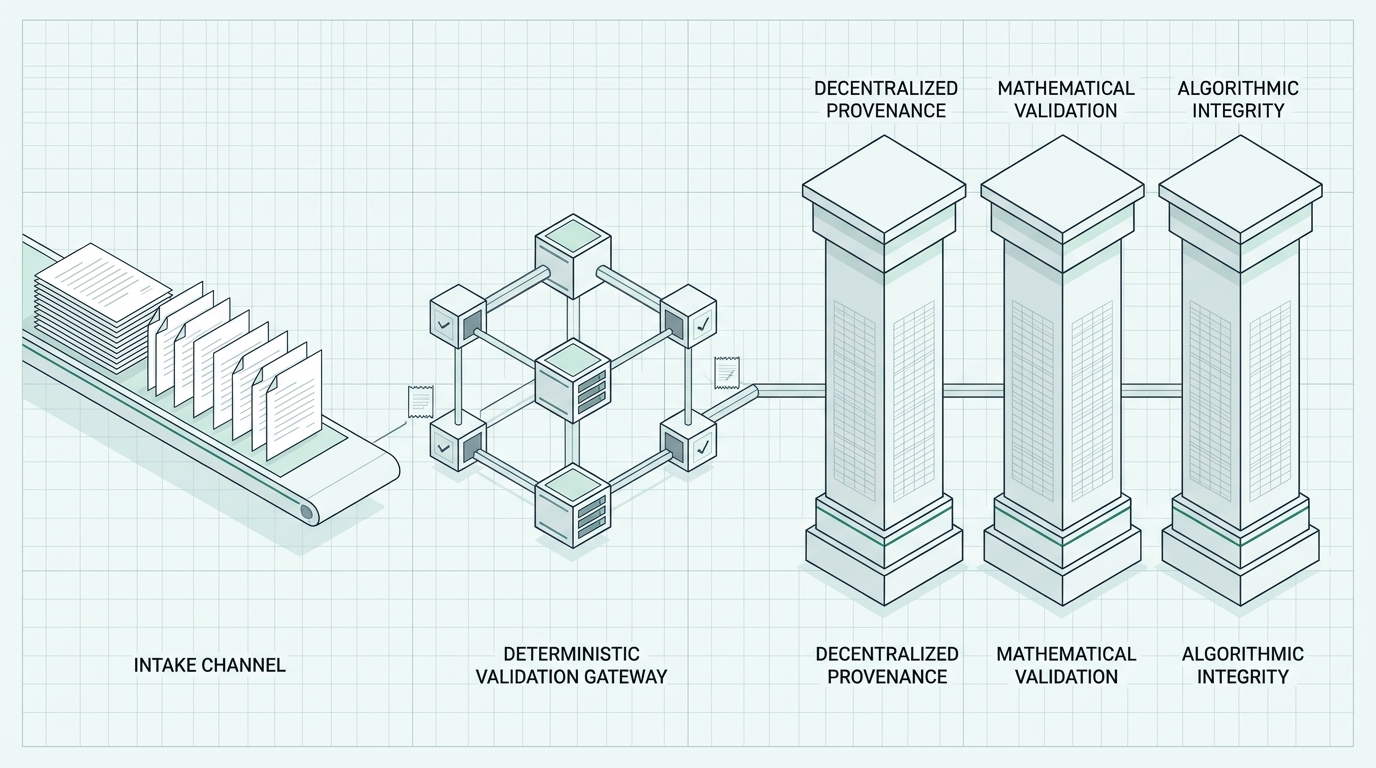
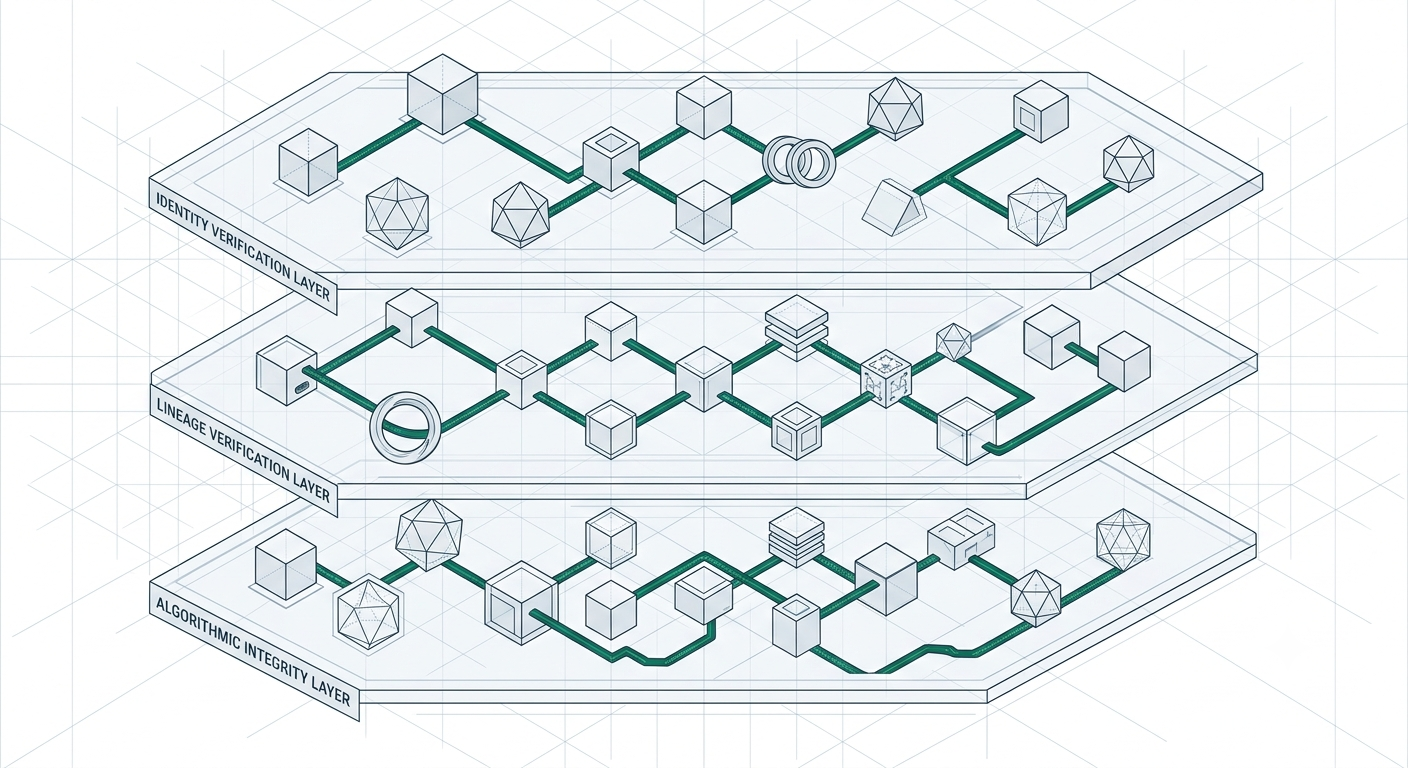
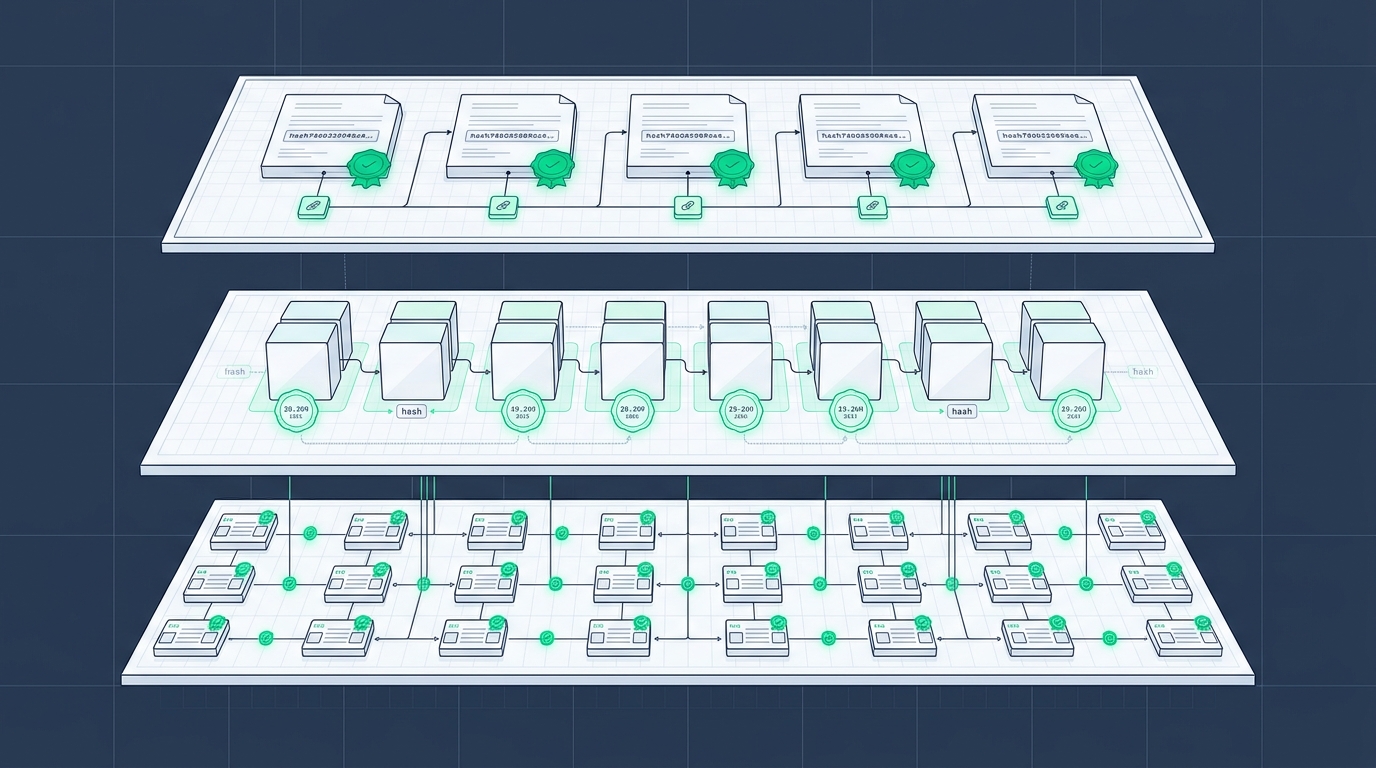
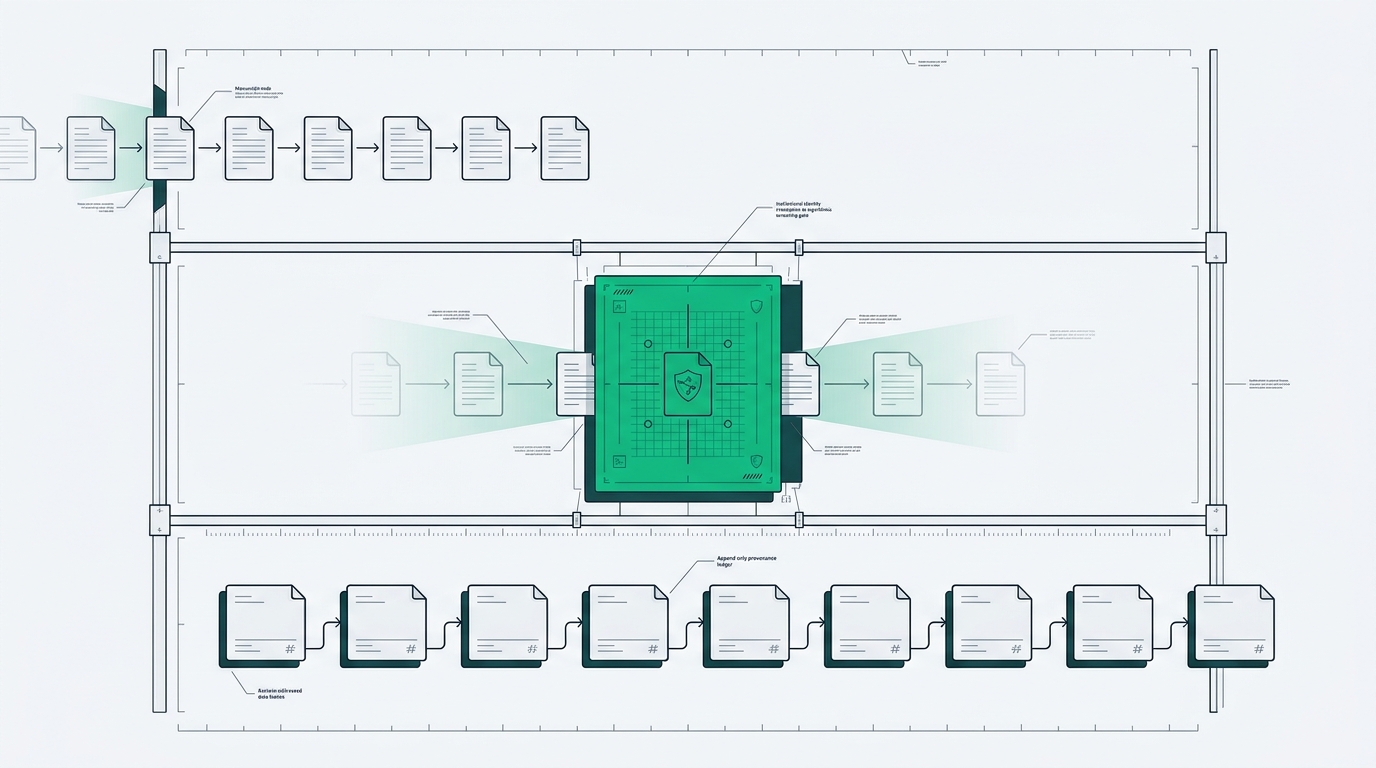
This is an identity and provenance infrastructure problem; the remedy is integrity infrastructure that scales trust rather than throughput. The architecture requires three interdependent layers — identity, lineage, and algorithmic accountability — each building on the guarantees of the layer below it. Without verified identity, provenance records are unanchorable; without provenance-verified inputs, algorithmic triage is unaccountable.
Layer One: Mathematical Validation (GEAR Network)
Every review becomes a digitally signed, timestamped artifact bound to a verified reviewer identity. The signature is mathematically verifiable by any party without trusting a central authority: a reviewer cannot later repudiate authorship, and an institution can validate the credential without querying the reviewer's home database. Verified identities, each attested through institutional credential binding, populate a distributed reputation graph. Editors query this graph — filtering by validated specialization, completion history, and quality signals — instead of dispatching 4.5 blind invitations into an unverifiable pool. Compensation attaches to demonstrated work, not claimed work; payment becomes a quality signal rather than a volume incentive because the underlying contribution record is tamper-evident.
Layer Two: Decentralized Provenance
Each manuscript version, dataset, and review carries a content-addressed lineage record — a mathematical digest of the artifact linked to a signed attestation of its origin, tracing every research output to an attested pipeline. This is not pattern-matching; it is a structural guarantee. A paper-mill manuscript can be novel text that passes every similarity check, but it cannot produce a verifiable lineage demonstrating that it emerged from an institutional research workflow with attested equipment, ethics clearance, and author contributions. The provenance record is tamper-evident: any post-hoc alteration to the artifact or its lineage is mathematically detectable. Because the infrastructure is distributed across participating institutions — no single database is the sole arbiter of truth — provenance verification survives the compromise or retirement of any one institutional record-keeper. This yields a qualitatively different guarantee than centralized registry entries or plagiarism scores.
Layer Three: Algorithmic Integrity
Machine-speed triage operates on provenance-verified inputs and produces signed, auditable outputs. When an automated system flags a submission for desk rejection or routes it to a specific reviewer tier, the decision traces to concrete, verified artifacts — author identity attestations, institutional affiliation proofs, manuscript lineage records — not to a black-box confidence score that nobody can inspect. Every automated action leaves a tamper-evident audit entry: which inputs were evaluated, which rules fired, and which identity attested the result. An unverifiable AI filter layered atop an unverifiable human system compounds the trust deficit; it accelerates triage without creating evidence. Algorithmic integrity reverses that equation: the machine runs faster, but it leaves a trail a human committee can examine.
The three layers form a closed loop. Identity without provenance cannot verify that the identified researcher actually produced the work. Provenance without identity cannot establish who performed the attested steps. And algorithmic triage without both is guesswork — faster guesswork, calibrated on historical patterns that paper mills actively train against. Together, the three layers convert peer review from a trust-based bottleneck into a verification-based pipeline: every artifact carries its own evidence.
The Institutional Pilot Grant
DecentraSec's Academic Research Division will co-design a six-month integrity pilot with each ORIC, pairing institutional data with our identity, provenance, and AI-integrity infrastructure. Institutions committing in the 2026–27 cycle — ahead of the Peer Review Week 2026 inflection point — qualify for the Early Adopter Subsidy, which underwrites a portion of pilot infrastructure costs. This seeds the integrity standard with serious partners; it is not a discount.
Institutions willing to build the trusted infrastructure the next decade of research depends on will save the system — starting with yours.
References
- The Conversation. (2026). "The peer review system is breaking down. Here's how we can fix it" (editor survey: 55% reviewer-finding challenge; 30+ invitations).
- Silverchair. (2026). The Numbers Behind the Noise: 2026 Future of Peer Review Report (54% pool growth; 43% → 22% acceptance; 4.5 invitations).
- The Chronicle of Higher Education. (2026). "Peer Review Is Breaking Under Its Own Weight."
- Singularity Moments. (2026). NeurIPS 2026 OpenReview infrastructure failures under record load.
- Fichtl, A., et al. (2026). AI-Assisted Peer Review Across Research Communities: From Reviewer AI Policies to LLM Review Quality. arXiv:2608.03581.
- Yu, Z., et al. (2025). Is Your Paper Being Reviewed by an LLM? Benchmarking AI Text Detection in Peer Review. arXiv:2502.19614.
- Paul, U., Shah, S., et al. (2025). Optimizing Peer Grading: A Systematic Literature Review of Reviewer Assignment Strategies and Quantity of Reviewers. arXiv:2508.11678.
- Liang, W., et al. (2024). Mapping the Increasing Use of LLMs in Scientific Papers. arXiv:2404.01268. (CS papers: up to 17.5% LLM modification through Feb 2024; corpus-level statistical estimate.)
- COPE & STM. (2022). Paper Mills research report (6,400-retraction linkage).
- Nature. (2025). Transparent peer review extended to all primary research (16 June 2025).
- Company of Biologists. (2026). Biology Open Fast & Fair paid peer review data (37.7 → 5.5 working days; £220 per manuscript).
- The Scholarly Kitchen. (2025). Desk-rejection ratios: 1.69 (2022) → 2.49 (2025) desk rejects per acceptance.
02 // RELATED RESEARCH · ARCHIVE DISPATCHES
Related Papers & Dispatches.
Peer-reviewed analyses, cryptanalysis papers, and zero-trust engineering dispatches.
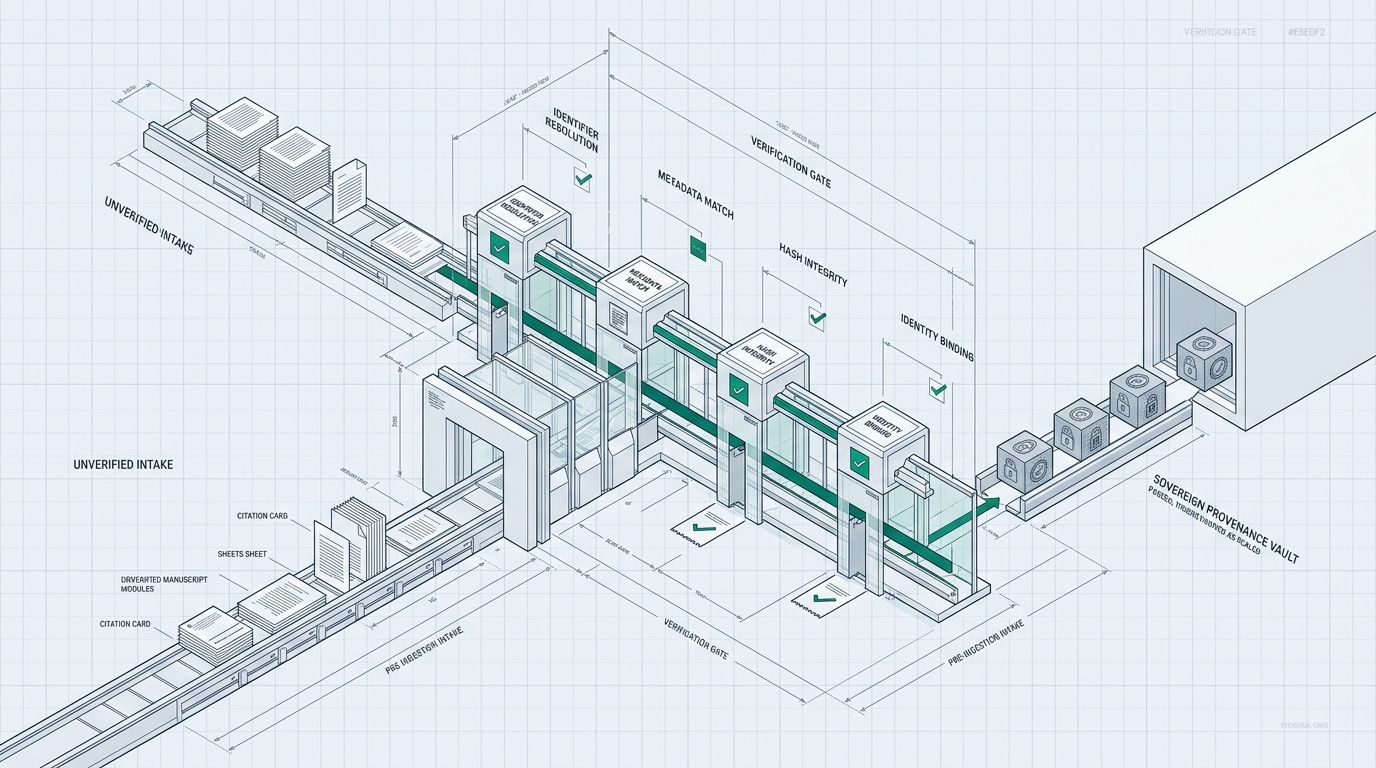
Research Integrity Infrastructure: Pre-Ingestion Checks
Research integrity failures are infrastructure failures. This post outlines pre-ingestion verification, appeal-aware records, and sovereign provenance for academic institutions.
The Verification Gap: Research Integrity Is Infrastructure
Institutions do not lack AI detectors — they lack a verifiable chain of custody. Why the 21% AI-review finding is an audit failure, how tamper-evident provenance makes retraction clusters structurally impossible, and how deans, ORIC directors, and regulators can pilot verifiable research infrastructure this accreditation cycle.
Peer Review Crisis? It's a Research Infrastructure Problem
More than eight million papers now enter a peer review system that can't verify who validated what. The fix is verifiable triage: identity-backed reviewers, screening at ingest, and audit-ready provenance—installed at the institutional layer, not bolted onto editorial software.