August 13, 2026
Research Integrity Is an Infrastructure Problem: 2025–26
The 2025–26 trust collapse is an audit finding on the substrate of published research. Institutions that treat integrity as verifiable infrastructure set the standard.
Research Integrity Is an Infrastructure Problem: The 2025–26 Trust Collapse and the Verifiable-Proof Mandate for Research Institutions
By DecentraSec Team
The 2025–26 review, retraction, reproducibility, and AI-authorship shocks do not demonstrate a collapse of scientific ethics. They demonstrate that research integrity was never engineered as a system property. The institution that treats integrity as a policy memo inherits the risk; the institution that treats it as verifiable infrastructure sets the standard.
In March 2025, a fully AI-generated manuscript produced by Sakana AI’s The AI Scientist-v2 cleared the acceptance threshold in human peer review at an ICLR 2025 workshop (arXiv:2504.08066). That result is not a headline about AI. It is an audit finding on the substrate beneath all published research, and it carries a price tag. Retraction growth reveals the same structural lag: compromised work enters the literature faster than it is corrected. Machine-learning screening flags nearly one in ten cancer papers for paper-mill features, and authorship slots sell for more than $5,600 on open marketplaces. For a Dean, an ORIC Director, or a Tier-1 researcher, this is no longer an academic debate. It is a compliance, funding, and third-party supply-chain risk inside your own portfolio.
The Trust Collapse Is a Capacity and Verification Failure
The crisis is structural, not moral. Prophy’s analysis of 179 million papers shows publication volume climbing while the qualified reviewer pool remains effectively static (Prophy, 2025). Nature’s 2025 reporting on the peer-review crisis documents the same binding constraint: editors and funders now treat reviewer capacity as a system limit, not an administrative inconvenience. The paper-mill economy is industrial: the BuyTheBy dataset (arXiv:2604.24576) logs 18,710 advertisements and 51,812 timestamped prices, with authorship slots ranging from $57 to over $5,600. A BMJ study trained a machine-learning classifier on known paper-mill retractions, screened 2.6 million cancer papers, and flagged nearly 10% as bearing paper-mill-like textual features (BMJ, 2026) — an unacceptable defect rate in a field that drives institutional licensing and clinical pipelines.
The executive reframe is unavoidable: every published claim entering your institution’s grants, rankings, licensing, or spinout pipeline now carries material integrity risk. Aggregate statistics show that “trust the repository” no longer survives contact with the paper-mill economy. Verify-the-proof becomes the scalable audit posture for institutional due diligence.
The Four Infrastructure Gaps Behind the Headlines
This is a systems diagnosis, not a cultural critique. Four gaps explain why integrity fails at scale.
Gap 1 — Mutable authorship
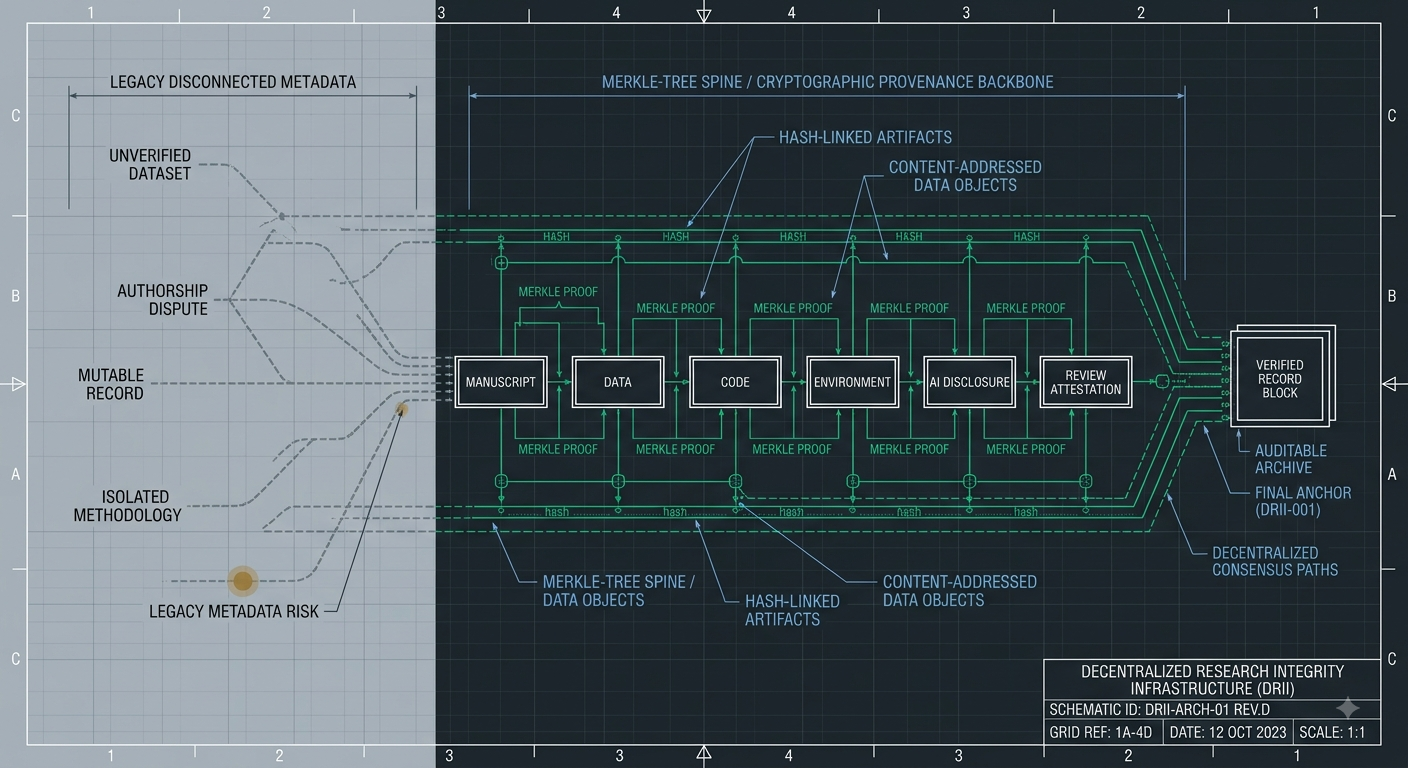
Authorship and submission history exist as self-reported metadata inside editable editorial databases; “who wrote what” cannot be verified or proven. Authorship lineage must become a signed, content-addressed assertion chain: each contributor’s identity, role, and contribution statement is bound to the exact manuscript hash, not to a name field that can be edited later.
Gap 2 — Broken reproducibility binding
Datasets, code, and environment versions are not bound into one verifiable object; “the data was lost” remains an available excuse in hard-science fields. Reproducibility must bind manuscript, data, code, and execution environment into a single content-addressed bundle so every downstream result references the exact inputs — not retrospective memory.
Gap 3 — Siloed reviewer capacity
Reviewer reputation and workload remain trapped in opaque inboxes; no mechanism pools, audits, or balances capacity across institutions. Federated reviewer reputation and workload pooling across institutions, journals, and funders is the only scalable answer.
Gap 4 — Self-attested AI disclosure
AI disclosure is a checkbox under divergent venue policies. A 2026 arXiv study (arXiv:2608.03581) surveyed reviewer-facing AI policies across 111 leading AI/NLP conferences and medical journals, found substantial regulatory divergence, and showed that LLM-generated reviews are fluent but systematically weak in evidence grounding and calibration. Human authorship is an assumption, not a provable claim. Institutions need an auditable AI-disclosure record that holds even where venue policies diverge.
Why Centralized Systems Cannot Fix This
The obvious objection: “Can’t we just buy a platform?” No. The weakness of a centralized system is not that it cannot compute hashes or publish an audit log. It is that verification still routes through a single operator’s key management, database, and availability. A central operator can decline to show the record, rotate signing keys, or alter the copy that downstream users actually query; the verifier’s assurance depends on the operator’s honesty and competence. A distributed append-only provenance log removes that single point by having multiple independent institutions hold replicas and validate proofs against a common root. Divergence becomes visible; verification no longer requires trusting the operator’s self-report. Documented policy divergence across venues proves that one-size-fits-all enforcement fails in a federated publishing landscape.
The European Commission’s 17 December 2025 EOSC Steering Board opinion paper positions EOSC as the coordination layer for sovereign, interoperable research data — governed where it originates, not concentrated in a hyperscaler-controlled silo. The verdict is clear: the fix must be federated and provenance-native — checkable by any party without relying on a central operator’s honesty. This is the moment to move from centralized custody to distributed verification.
ScholarMark: The Institutional-Grade Substrate
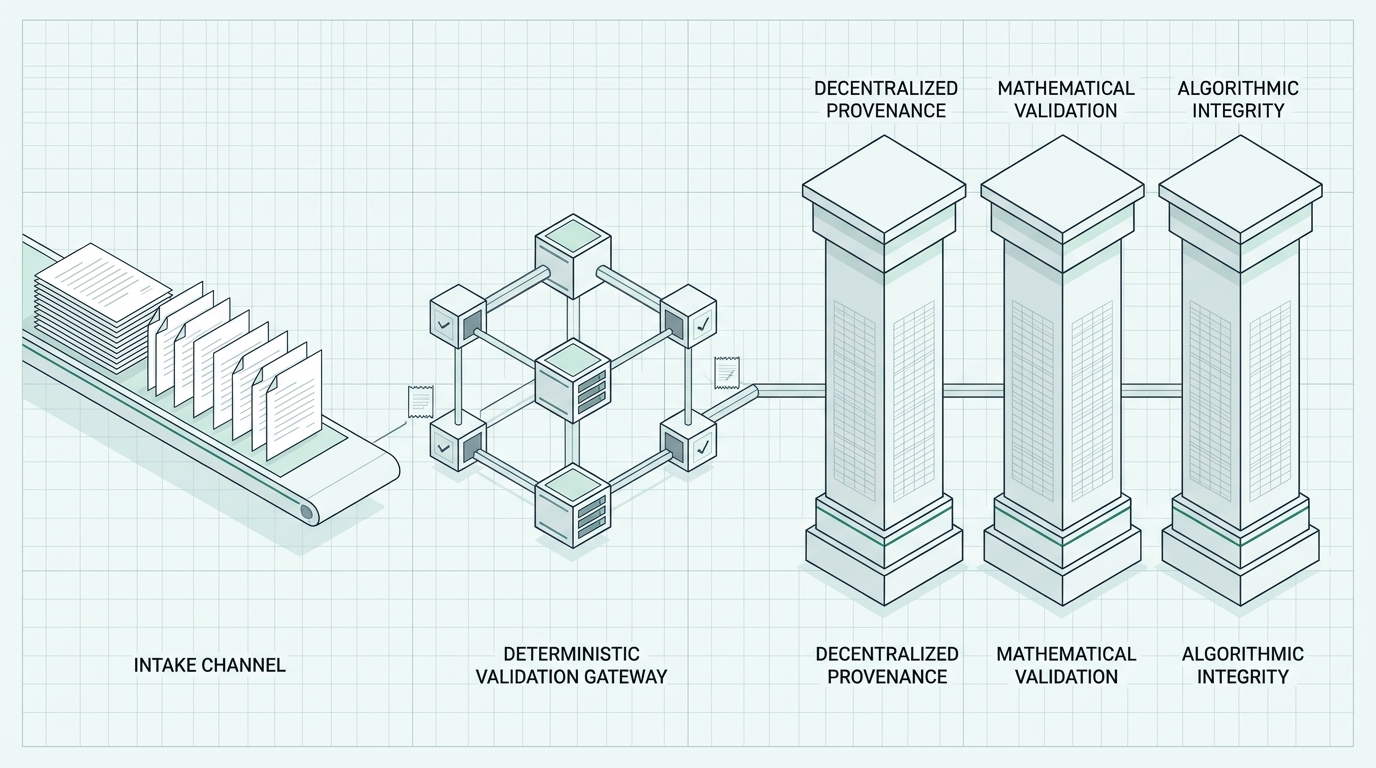
DecentraSec built ScholarMark as an integrity-infrastructure layer engineered for research institutions. Its core primitive is decentralized provenance: a content-addressed lineage graph, not a database label. Each artifact carries an identifier derived from a deterministic hash of its bytes; each relationship — authorship, derivation, AI assistance, review decision — is an assertion linked to the artifact hashes it connects and to the identity keys of the parties making it. In ScholarMark’s architecture, no single party is the sole custodian of the record; independent institutional nodes hold replicas and validate proofs, so verification survives any one operator’s failure.
Integritas Vault
Integritas Vault converts provenance from a database field into a verifiable bundle: hypotheses, data snapshots, code, and manuscript versions become content-addressed and linked into hash-bound lineage. Every downstream artifact carries a complete, bound lineage.
Mathematical Validation
Mathematical Validation is the proof layer for those bundles. Each artifact is fingerprinted by a deterministic hash; versions and dependencies are committed into a Merkle tree, so a compact proof attests that a specific file is included at a specific position in an unbroken chain. Change one byte and the artifact hash changes; every downstream proof fails. This does not claim a paper is true or an author honest. It proves that the object under review is exactly the object that was produced, unchanged, and bound to its declared inputs. For institutions, that converts pre-award due diligence, licensing review, and misconduct proceedings from exported spreadsheets and self-reported metadata into tamper-evident lineage.
GEAR Network
GEAR Network acts as the neutral coordination layer where institutions, journals, and funders pool reviewer reputation, balance workloads, and attach portable, verifiable attestations to every review.
AI Integrity Layer
AI Integrity Layer records what was human-authored, AI-assisted, or machine-generated end-to-end and binds the model, prompt, date, scope, and disclosure statement to the manuscript hash. Publishers and enterprises can verify an AI-disclosure claim against the artifact rather than a checkbox, even where venue policies diverge.
The executive framing: screen published research the way you screen any regulated third-party input — with auditable evidence, not heuristics. Decentralized provenance must become a default expectation for any claim your institution adopts, licenses, or builds upon.
The Institutional Mandate: What Deans, ORIC Directors, and Tier-1 Researchers Do Now
For Deans: convert research integrity from a compliance checkbox into a verifiable institutional capability — protecting funding continuity, rankings, and reputational exposure with auditable provenance.
For ORIC Directors: de-risk the innovation and commercialization pipeline by provenance-screening research inputs before licensing, partnership, or spinout decisions. Verify chain of custody and AI disclosure before deal diligence, not after a controversy.
For Tier-1 Researchers: adopt provenance-native workflows so reproducibility is a provable property of outputs, not a post-hoc explanation after a replication failure.
Policy alignment matters. A federated, sovereignty-respecting substrate positions your institution ahead of EOSC and comparable data-sovereignty requirements rather than catching up to them. Institutions that require verifiable provenance become the trusted counterparties of funders and industry; institutions that do not will carry the risk premium. Algorithmic integrity — the property that automated drafting, screening, and analysis are themselves versioned, attested, and bound to their outputs — separates an institution that governs its research pipeline from one that merely hopes it holds together.
The Institutional Pilot Grant
For a limited cohort, DecentraSec is extending an Institutional Pilot Grant — co-investment that lets a Dean’s office or ORIC run ScholarMark’s provenance layer across a live research unit, department, or pre-publication workflow.
The pilot output: measurable verification coverage, an auditable AI-disclosure record, and a reproducible-provenance template your institution can scale across faculties. This is an early-adopter subsidy for institutions that want to set the standard rather than inherit it — infrastructure investment, not a license purchase.
The ask is a 30-minute executive briefing with your ORIC team to scope the pilot against your specific pipeline. No discounts, no promo pricing — this is grant-funded, not a SaaS promotion. The institutions that embed verifiable proof into their research pipeline will define the next decade’s standard for integrity. The ones that wait will inherit the risk. The substrate is ready.
References
- Prophy. The Peer Review Crisis: Why Publishers Are Struggling in 2025. 2025. https://blog.prophy.ai/the-peer-review-crisis-why-publishers-are-struggling-in-2025
- Nature. “The peer-review crisis: how to fix an overloaded system.” Nature, 6 August 2025. doi:10.1038/d41586-025-02457-2
- Richardson, R.A., Hong, S.S., and Abalkina, A. “BuyTheBy: A dataset of 18,710 text-based paper mill advertisements with 51,812 timestamped prices.” arXiv:2604.24576, 2026.
- Scancar, B., Byrne, J.A., Causeur, D., and Barnett, A.G. “Machine learning based screening of potential paper mill publications in cancer research: methodological and cross sectional study.” The BMJ, 2026. doi:10.1136/bmj-2025-087581
- Fichtl, A.M., Ellinger, L., Kelber, J., Olík, K., and Groh, G. “AI-Assisted Peer Review Across Research Communities: From Reviewer AI Policies to LLM Review Quality.” arXiv:2608.03581, 2026.
- European Commission / EOSC Steering Board. “Enhancing data sovereignty for research.” 17 December 2025.
- Yamada, Y., Lange, R.T., Lu, C., Hu, S., Lu, C., Foerster, J., Clune, J., and Ha, D. “The AI Scientist-v2: Workshop-Level Automated Scientific Discovery via Agentic Tree Search.” arXiv:2504.08066, 2025.
02 // RELATED RESEARCH · ARCHIVE DISPATCHES
Related Papers & Dispatches.
Peer-reviewed analyses, cryptanalysis papers, and zero-trust engineering dispatches.
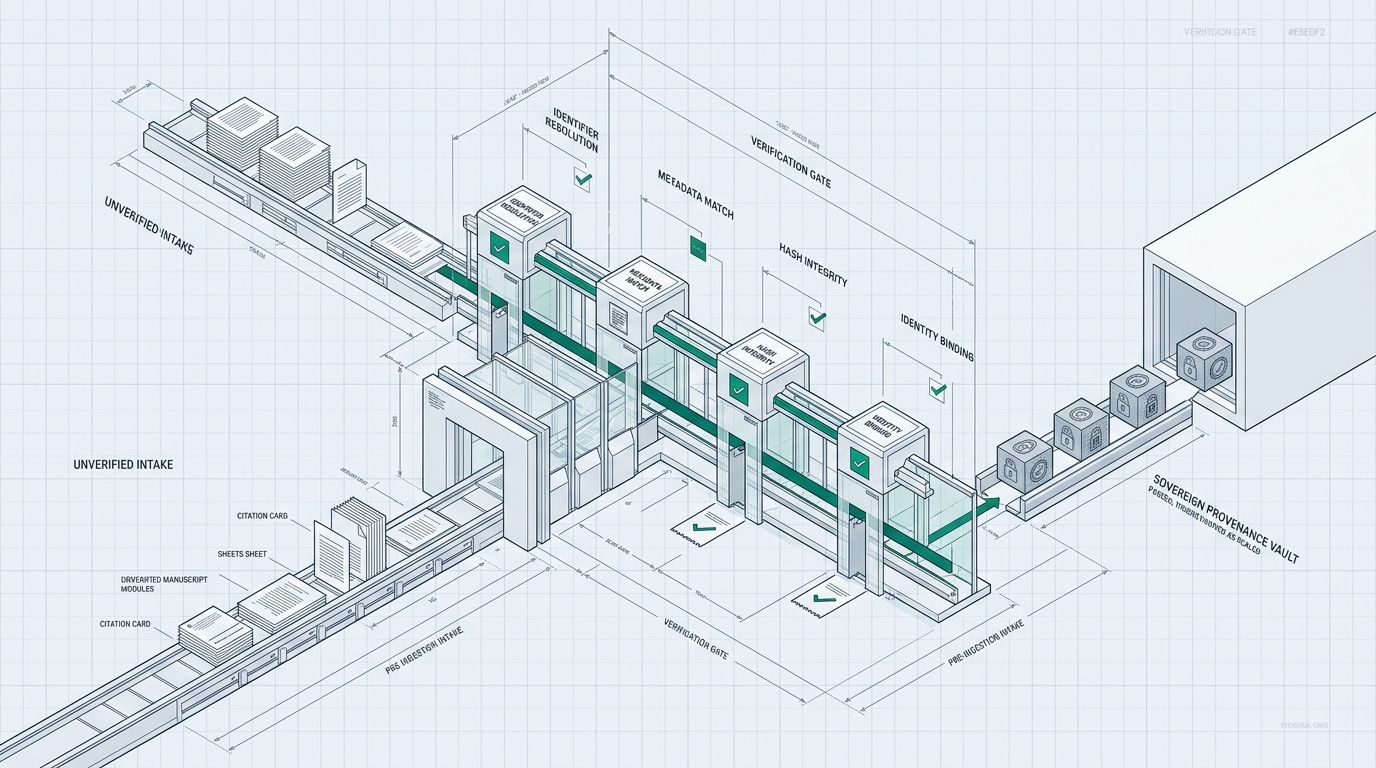
Research Integrity Infrastructure: Pre-Ingestion Checks
Research integrity failures are infrastructure failures. This post outlines pre-ingestion verification, appeal-aware records, and sovereign provenance for academic institutions.
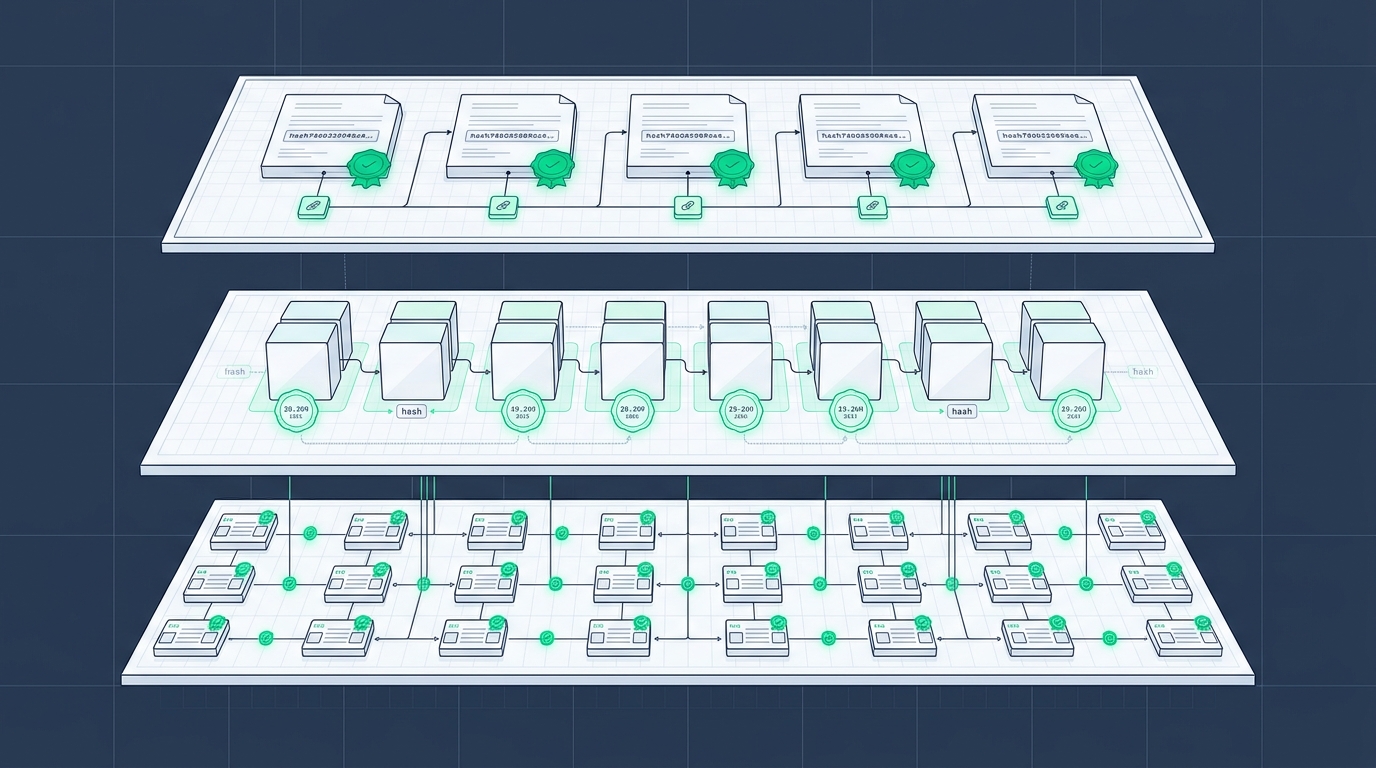
The Verification Gap: Research Integrity Is Infrastructure
Institutions do not lack AI detectors — they lack a verifiable chain of custody. Why the 21% AI-review finding is an audit failure, how tamper-evident provenance makes retraction clusters structurally impossible, and how deans, ORIC directors, and regulators can pilot verifiable research infrastructure this accreditation cycle.
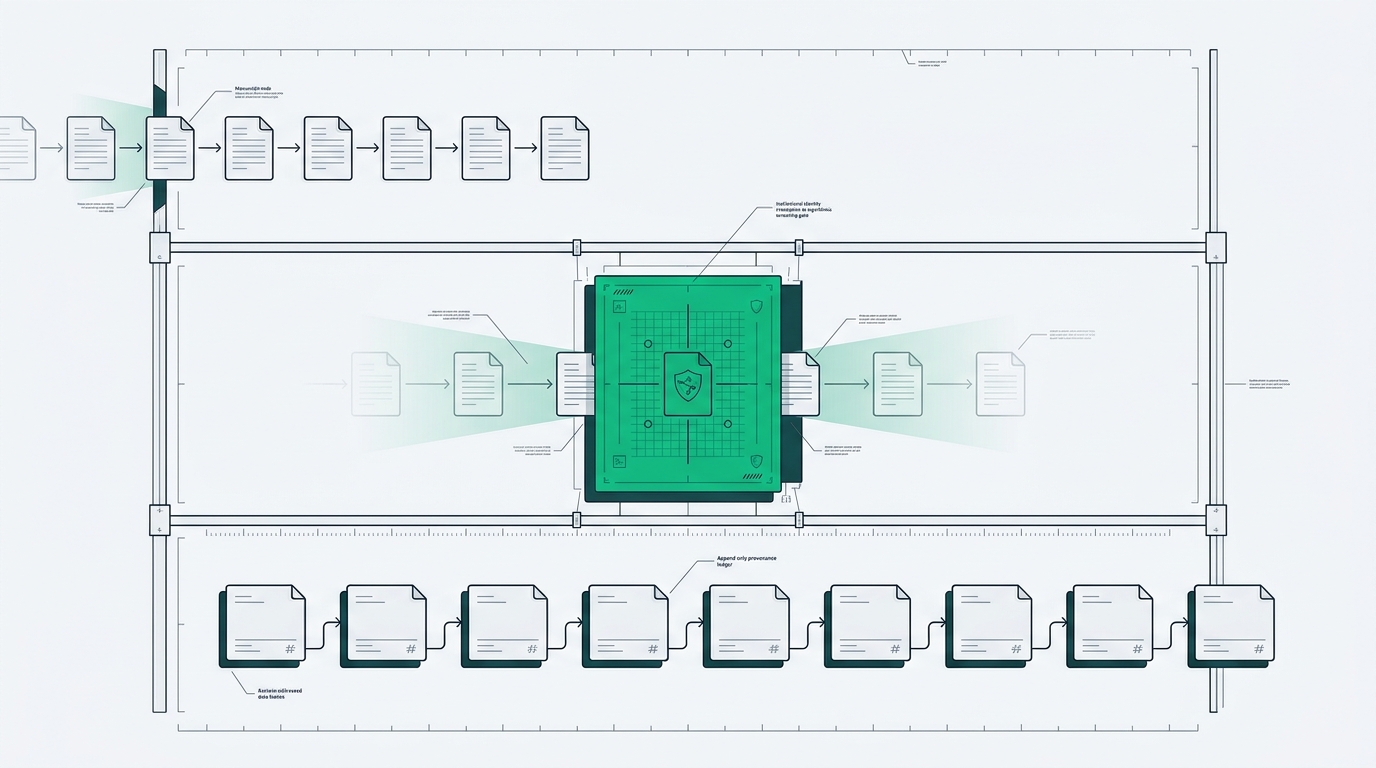
Peer Review Crisis? It's a Research Infrastructure Problem
More than eight million papers now enter a peer review system that can't verify who validated what. The fix is verifiable triage: identity-backed reviewers, screening at ingest, and audit-ready provenance—installed at the institutional layer, not bolted onto editorial software.