September 1, 2026
AI Reproducibility Ceiling: 21% Derived, 79% Not Verified
The strongest tested agent re-derived only 21% of tasks from top-venue AI papers. The institutional remedy is verifiable provenance infrastructure—not another checklist.
The Replication Ceiling: Why the Strongest Tested Agent Re-derived Only 21% of Top-Venue AI Research — and What It Costs Your Institution's Scientific Reputation
By DecentraSec Team
Reproducibility in AI is a governance liability, not a scholarly nicety. When a paper's headline metric cannot be re-derived from its own code, data, and compute, the institution that published it owns an unverifiable claim. Universities that cannot supply mathematical validation of research provenance—an independently recomputable derivation path from claim to artifact—forfeit funding, licensing, and procurement credibility to institutions that can. The remedy is not a better checklist; it is making verification a computational property of the research record rather than a promise.
The inciting incident arrived in April 2025. PaperBench (arXiv:2504.01848) is an 8,316-task benchmark built from 20 flagship ICML 2024 Spotlight and Oral papers, with rubrics co-developed with the papers' authors. Across the full benchmark, the strongest tested agent—Claude 3.5 Sonnet (New) with open-source scaffolding—scored 21.0%. A separate human baseline of ML PhD researchers, given 48 hours on a three-paper subset, re-derived 41.4% of graded tasks. The two figures are not a like-for-like comparison, but the decisive result is precise: the strongest tested agent failed on 79.0% of graded tasks drawn from peer-reviewed, top-venue publications.
That 79.0% failure rate severs the evidentiary chain that permits a dean to certify research integrity, an ORIC director to sign an assurance statement, and a Tier-1 PI to claim "state of the art" before a funding panel. The gap between published claim and provable result is a structural risk on the institutional balance sheet.
The Trust Deficit Is Quantified: Reproducibility Evidence
This is a measured crisis. Cobey and colleagues surveyed 1,630 biomedical researchers; 72% agreed that their field faces a reproducibility crisis (PLOS Biology, DOI 10.1371/journal.pbio.3002870). The AI-specific evidence is narrower but more concrete. On PaperBench's full 8,316 graded tasks, the strongest tested agent achieved 21.0% replication; on the three-paper human baseline, ML PhD researchers achieved 41.4% (arXiv:2504.01848). Desai and colleagues document a concrete nondeterminism result: sixteen nominally identical LeNet5 training runs produced accuracy spanning 8.6% to 99.0% (AI Magazine, DOI 10.1002/aaai.70004). One nominal experiment therefore yielded opposite conclusions. Mason-Williams and Mason-Williams name the consequence: reproducibility is "the new frontier in AI governance," and weak reproducibility protocols erode the evidentiary basis for policy and audit (arXiv:2510.11595). "Crisis" is an actuarial description, not hyperbole.
The Failure Chain: Three Mechanisms That Break Reproducibility
Three mechanisms drive the failure.
Nondeterminism. Seeds, GPU scheduling, operator nondeterminism, and dependency drift break bit-exactness. "The experiment" has no stable identity; one command line yields 8.6% or 99.0%. A narrative environment description is not an identity; a content-addressed manifest is. But a manifest alone is not enough: exact recomputation also requires pinned versions and constrained nondeterministic execution. The manifest makes the attempted configuration auditable; it does not, by itself, make the computation deterministic.
Missing lineage. Paper claim, code, dataset, and trained artifact exist as disconnected objects. Without a mathematical provenance graph, verification reduces to manual archaeology—and manual archaeology fails often: even the human baseline re-derived only 41.4% on a three-paper subset, while the strongest tested agent reached only 21.0% on the full benchmark.
Unauditable self-reporting. NeurIPS and AAAI checklists, model cards, preregistration, and containers, as commonly deployed, are self-declared artifacts in mutable stores. They are operator-trusted and unenforceable. A claim counts as "verified" because someone asserted it—a trust-me declaration, not an audit control.
For enterprises adopting research-derived AI, an unverifiable claim is a model-governance and procurement risk. A capability asserted in a paper cannot become a business asset unless its origin and computation are provable.
Why "Better Checklists" Cannot Fix Institutional Integrity
Existing mitigations—Pineau and colleagues' ML Reproducibility Checklist (JMLR 22(164), 2021), model cards, preregistration, and containerization—are valuable hygiene, but they are declarative, not computational. They describe intent; they cannot bind a claim to a run.
Centralized repositories—publisher databases, MLflow instances, cloud catalogs—keep mutable records behind a single operator's trust boundary. Any party with operator access can rewrite history, and the record is only as trustworthy as its custodian. Leadership should apply one integrity test: If a dispute arises, can anyone—including the original author—prove what happened without anyone's testimony? If not, the provenance is a biography, not an audit record. The alternative is an append-only, hash-linked provenance log replicated across independent witnesses and time-stamp authorities. Each record binds the previous entry's digest, so a retroactive edit invalidates every successor entry and is detectable by any auditor holding a prior anchor. No single entity controls the archive, and no custodian's testimony is required. This is the difference between accounting and autobiography.
The Institutional-Grade Answer: Integrity Infrastructure
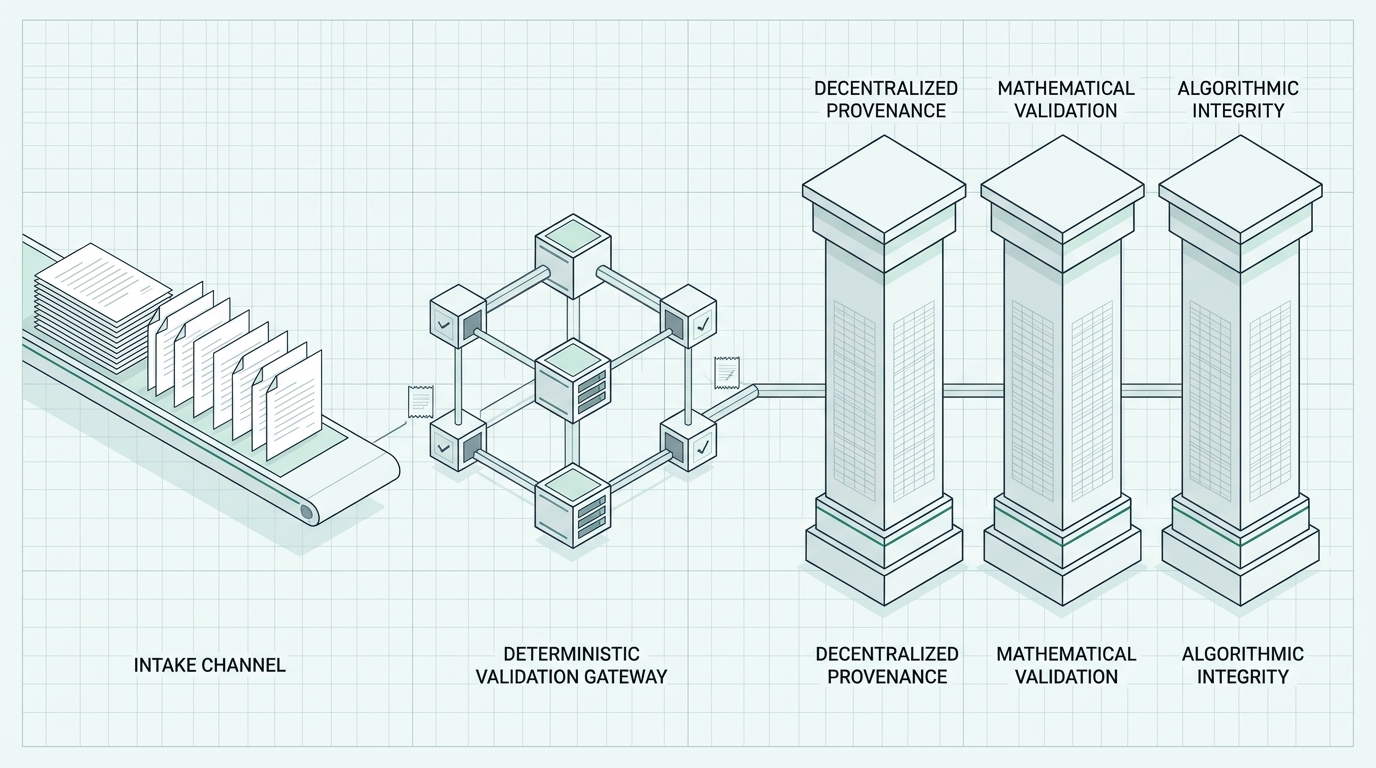
The fix is not another checklist. It is Integrity Infrastructure—distributed infrastructure that makes verification a mathematical property of the research record.
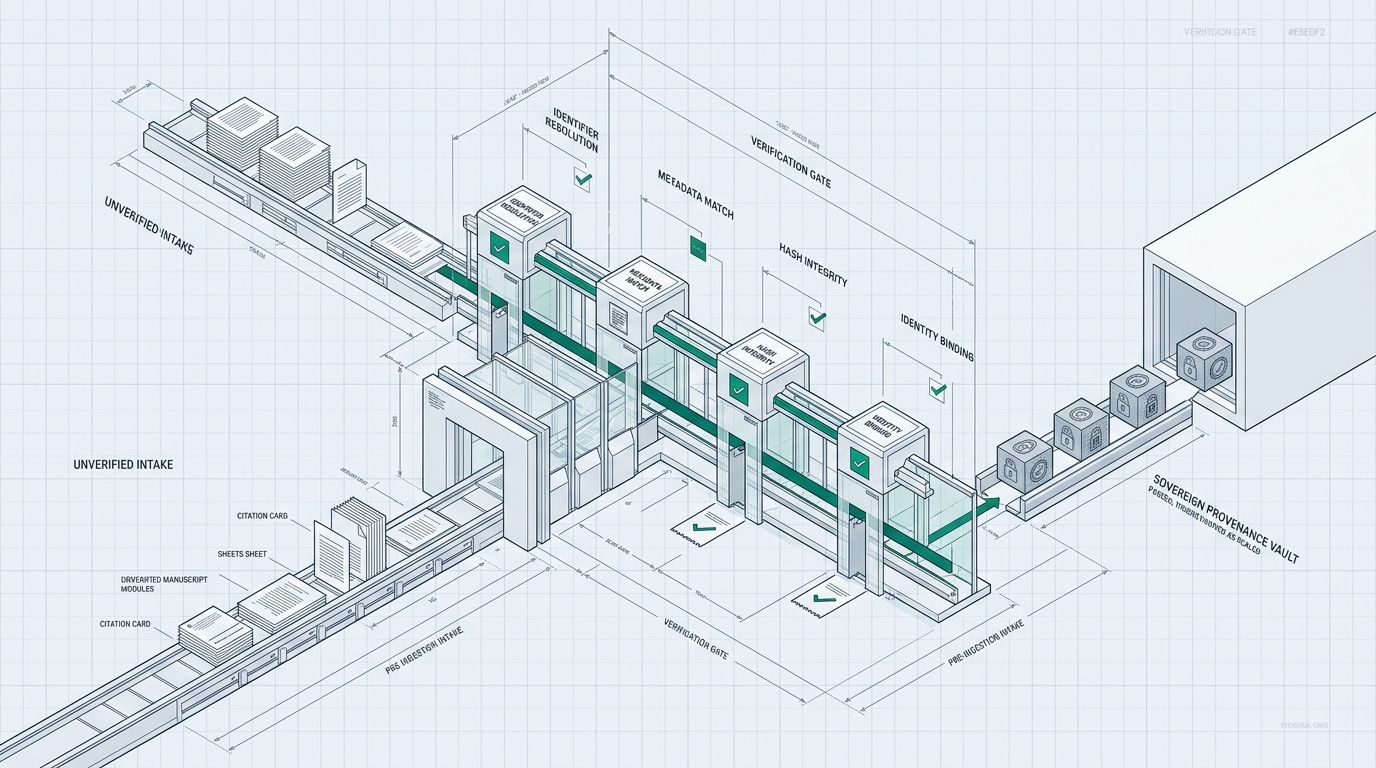
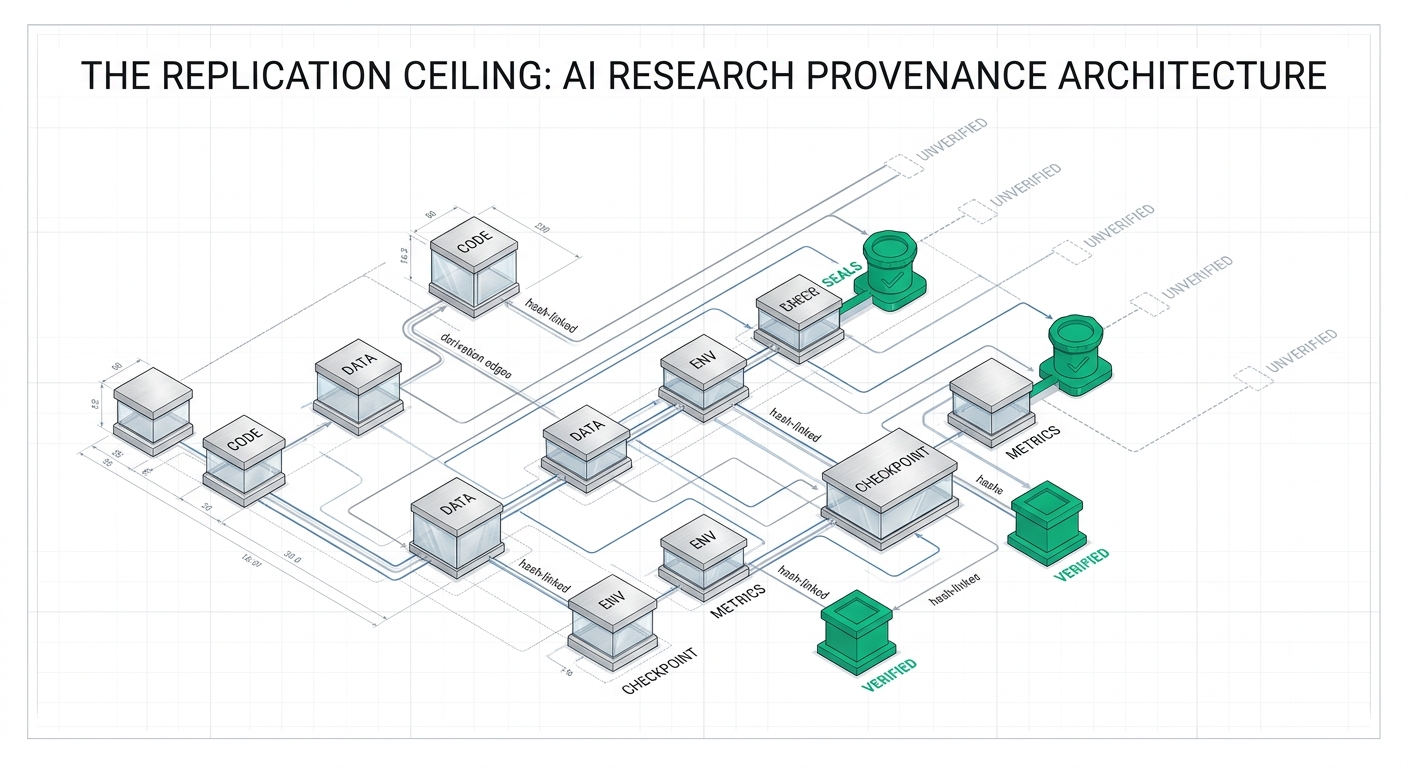
A mathematical provenance graph is a directed acyclic graph whose nodes are content-addressed artifacts—code, data, environment manifests, hyperparameters, checkpoints, metrics—identified by collision-resistant digests such as SHA-256 or BLAKE3, and whose edges are typed derivation relations. Verification is deterministic: an auditor recomputes each digest and checks that every edge is consistent with the recorded computation. The AI Integrity Layer pins each experiment to content-addressed fingerprints of code, datasets, environment manifests, training runs, and model checkpoints. A claimed 99.0% accuracy must trace to an anchored run; a claim that cannot be reached from an anchored artifact is flagged as unverifiable. "Unreproducible" becomes computationally falsifiable. Nothing requires belief; everything invites checking.
The Integritas Vault records those anchors as tamper-evident, time-stamped provenance. Downstream mutation—a swapped split, a drifted dependency, a retrofitted seed—becomes detectable because it breaks the hash-linked chain or violates the derivation graph. Any auditor can rerun the verification algorithm and reach the same accept/reject result without trusting the record keeper; that deterministic, operator-independent verification is algorithmic integrity.
Lineage remains institution-governed and privacy-preserving: institutions publish hash commitments to artifacts and prove derivation without disclosing proprietary data or unpublished results. The proof an auditor demands of a model's origin is the proof an enterprise buyer demands before licensing research-derived AI. Reproducibility ceases to be a lab metric and becomes a business asset. This is decentralized provenance deployed as governance infrastructure—the standard a dean can certify, an ORIC director can audit, and a competitor cannot dispute without disputing the recomputation itself.
What Leadership Should Do This Quarter: Provenance Attestation
For Deans: Require provenance attestation in lab publications and annual research-integrity reviews. Ask one question of every flagship claim: Can this be re-derived from the code, data, and compute that produced it, without trusting the author's word? Place hash-linked lineage at the center of that question.
For ORIC Directors: Add mathematical provenance to the integrity toolkit alongside ethics review and data-management plans. Reproducibility is becoming an instrument of governance rather than a journal requirement. Prepare with the same rigor applied to data-management compliance.
For Tier-1 Researchers: Treat provenance infrastructure as competitive advantage in grants and industry partnerships. Verifiable provenance shortens the diligence cycle and de-risks licensing. Your claims survive independent recomputation; competitors' claims do not.
The Pilot That Defines the Standard: Institutional Pilot Grant
Institutions that set the provenance standard will capture the next decade's licensing, funding, and talent. DecentraSec invites a small cohort of research institutions to join the Institutional Pilot Grant: a structured, semester-long engagement in which flagship-venue projects are anchored through the AI Integrity Layer and recorded in the Integritas Vault, with DecentraSec's team supporting ORIC and lab leads end-to-end. Participants receive prioritized onboarding, dedicated provenance-architecture support, and co-authorship of the resulting governance case study. This is not a tool purchase; it is a partnership to define what verifiable AI research means. Applications close at the end of the quarter.
Run one semester of flagship-venue projects through hash-anchored lineage. Measure the delta between claimed and provable results. That delta is your institution's exposure—and your board will demand it quantified before the next funding cycle.
ScholarMark by DecentraSec is building the pre-submission infrastructure that academic publishing has never had — AI-powered integrity checks, paid peer review via the GEAR Network, and immutable provenance-based authorship seals. Start here →
References
- Cobey, K. D., Ebrahimzadeh, S., Page, M. J., et al. "Biomedical researchers' perspectives on the reproducibility of research." PLOS Biology 22(11), 2024. DOI 10.1371/journal.pbio.3002870.
- Starace, G., et al. "PaperBench: Evaluating AI's Ability to Replicate AI Research." arXiv:2504.01848.
- Desai, A. "What is reproducibility in artificial intelligence and machine learning research?" AI Magazine 46(2), 2025. DOI 10.1002/aaai.70004.
- Mason-Williams, I., & Mason-Williams, G. "Reproducibility: The New Frontier in AI Governance." arXiv:2510.11595.
- Pineau, J., et al. "Improving Reproducibility in Machine Learning Research (A Report from the NeurIPS 2019 Reproducibility Program)." JMLR 22(164), 2021.
02 // RELATED RESEARCH · ARCHIVE DISPATCHES
Related Papers & Dispatches.
Peer-reviewed analyses, cryptanalysis papers, and zero-trust engineering dispatches.
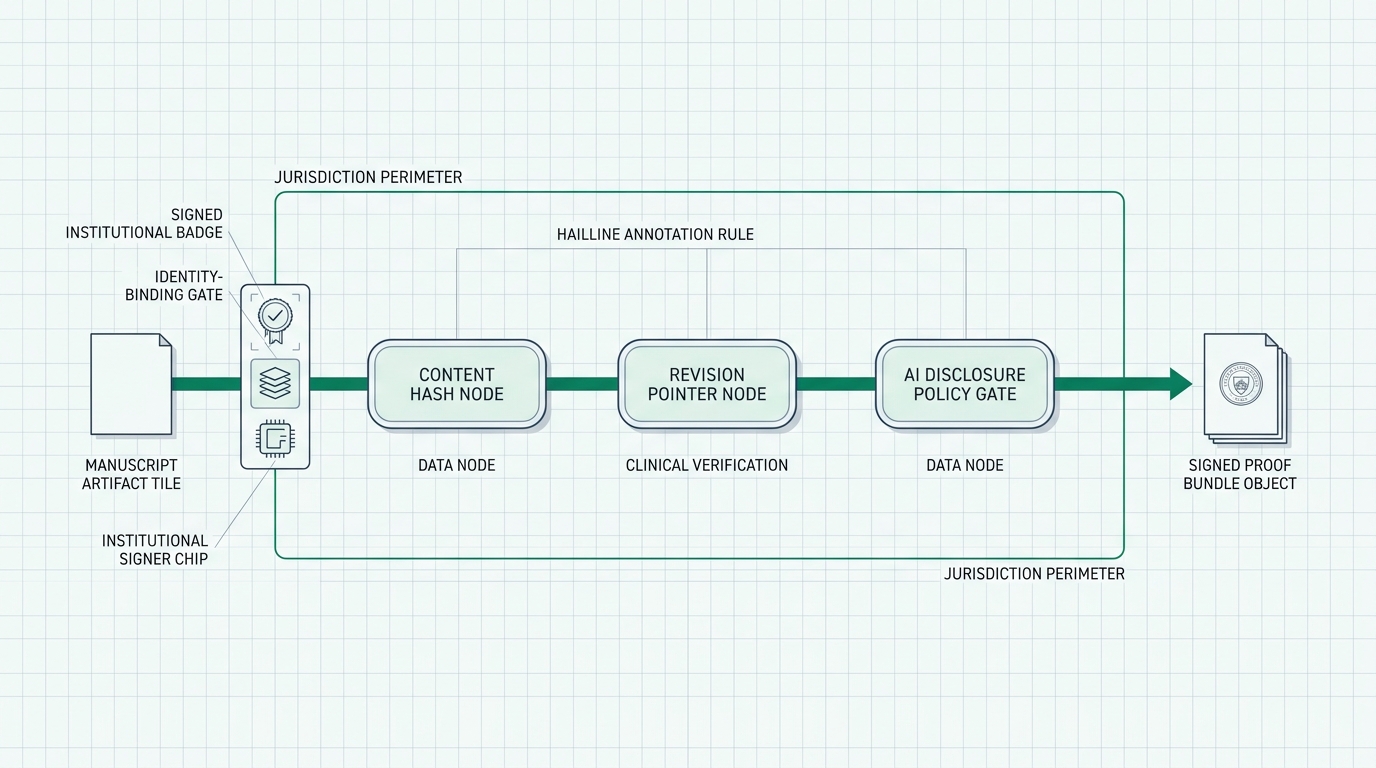
Chain of Custody for Research Integrity: Institutional Proof
Detection tells you that you have a problem. Proof tells you who, what, and when. This is the case for signed, content-addressed custody of the scholarly record — held inside the institution's own trust boundary from ingestion onward.
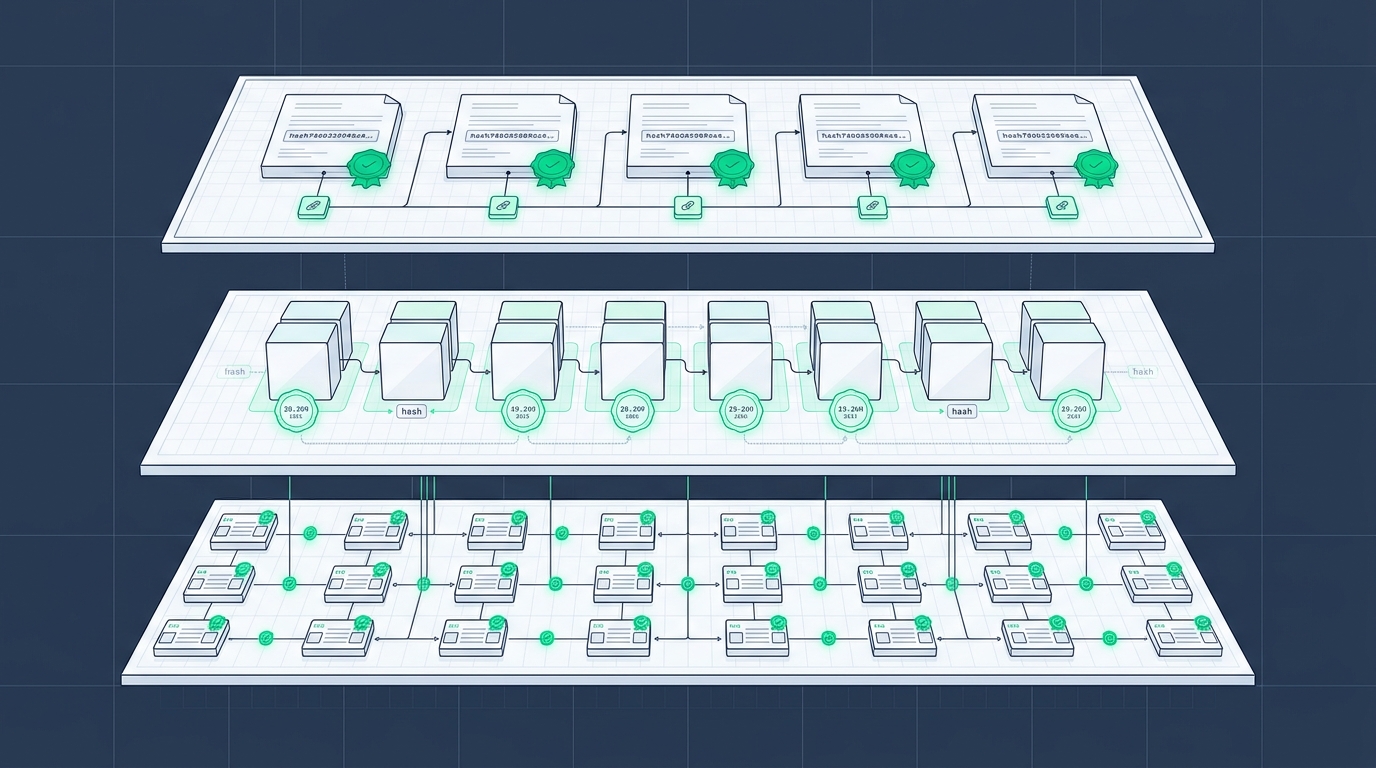
The Verification Gap: Research Integrity Is Infrastructure
Institutions do not lack AI detectors — they lack a verifiable chain of custody. Why the 21% AI-review finding is an audit failure, how tamper-evident provenance makes retraction clusters structurally impossible, and how deans, ORIC directors, and regulators can pilot verifiable research infrastructure this accreditation cycle.
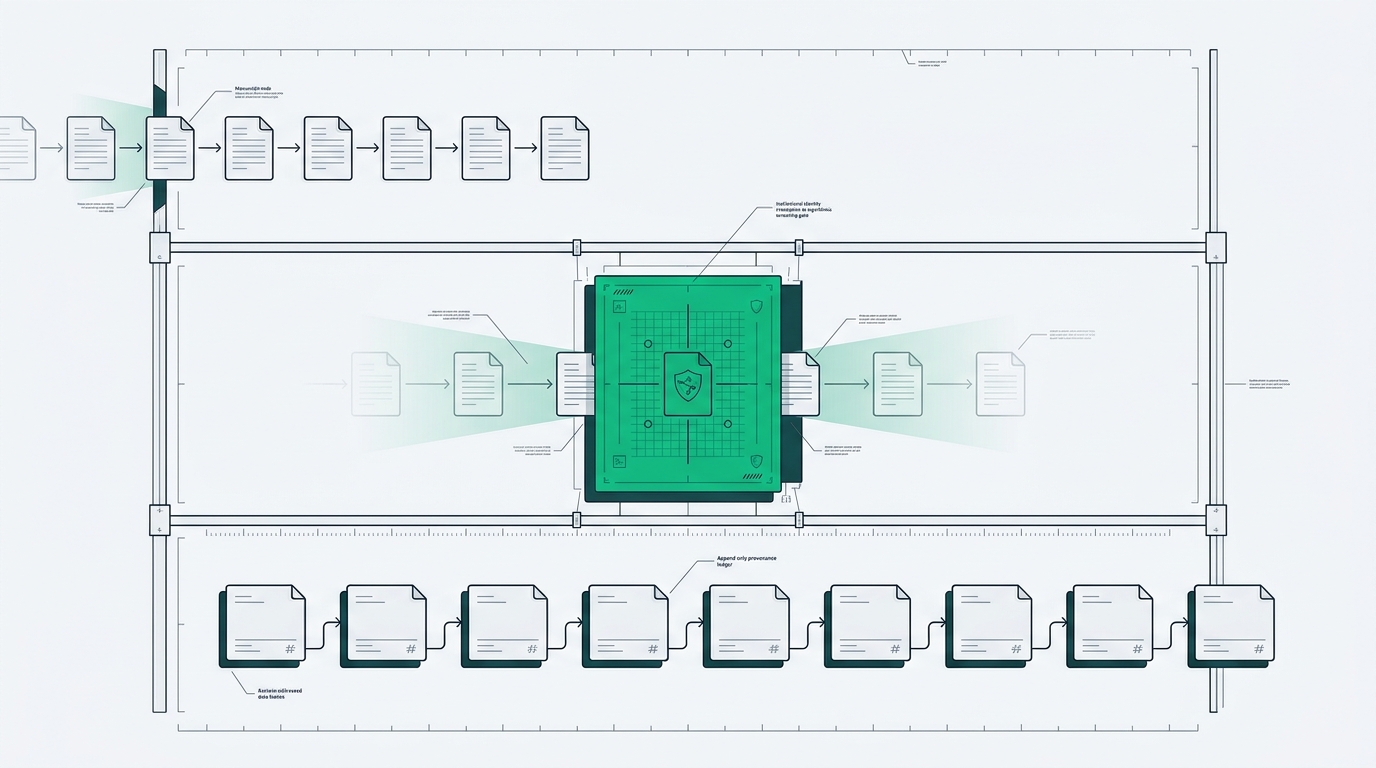
Peer Review Crisis? It's a Research Infrastructure Problem
More than eight million papers now enter a peer review system that can't verify who validated what. The fix is verifiable triage: identity-backed reviewers, screening at ingest, and audit-ready provenance—installed at the institutional layer, not bolted onto editorial software.