September 14, 2026
The Verification Gap: Research Integrity Is Infrastructure
Institutions do not lack AI detectors — they lack a verifiable chain of custody. Why the 21% AI-review finding is an audit failure, how tamper-evident provenance makes retraction clusters structurally impossible, and how deans, ORIC directors, and regulators can pilot verifiable research infrastructure this accreditation cycle.
The Verification Gap: Why Research Integrity Is an Infrastructure Problem, Not a Detection Problem — And What Academic Leaders Must Do About It Now
By the DecentraSec Team
Research integrity faces no detection failure. It faces an infrastructure failure. Institutions do not lack AI detectors; they lack a verifiable chain of custody for manuscripts, reviews, and decisions. Detection asks whether a document looks machine-written. Decentralized Provenance asks whether the institution can prove what was submitted, who was accountable for each review, when it changed, and that any later alteration would be visible. Every dollar spent on probabilistic suspicion is a dollar withheld from the Integrity Infrastructure that produces evidence.
A dean opens an email this term: a faculty member's landmark paper—cited hundreds of times, load-bearing in a promotion dossier—sits inside a retraction cluster. The institution holds no tamper-evident history of its revisions, no verifiable record of which credentialed reviewer signed the referee report, and no way to prove that a qualified human accepted accountability for the review rather than leaving an unsigned, unattributed text. The paper is not the problem. The missing record is. In 2026, that is no scandal—it is a structural certainty. The fix already exists, it is deterministic, and it is unglamorous.
The Verification Gap Is Now Measurable
An analysis in Nature estimated that language models fully generated 21% of the 75,800 ICLR 2026 peer reviews (doi:10.1038/d41586-025-03506-6). Read that as an audit failure, not a content-quality complaint: thousands of high-stakes decisions were rendered by unverifiable actors, with no signed record of who was accountable.
The detection layer does not close the gap. A follow-up Nature investigation confirmed that available detectors fail to flag most AI-written referee reports (doi:10.1038/d41586-025-04032-1). When the control cannot see the problem, the control strategy is the problem.
The precedent is expensive. Wiley retracted more than 11,300 Hindawi papers and shuttered 19 journals—the largest retraction event in publishing history (UKSG Insights, doi:10.1629/uksg.659). Operationally, that was an audit-trail failure at industrial scale: fabricated papers and manipulated reviews entered a system with no tamper-evident record. At national scale, a single clone journal drew 400-plus Pakistani researchers, and HEC held only retrospective monitoring and delisting (The News, 2022). Such controls move at the speed of damage already done. Preprint servers now operate at volumes that outstrip centralized editorial screening; no manual queue can absorb that load. The missing record is the vulnerability—and it is the one vulnerability that can be engineered out of existence rather than merely investigated after the fact.
Detection Theater Cannot Win
Two 2026 arXiv studies make the technical point. Stop Automating Peer Review Without Rigorous Evaluation (doi:10.48550/arXiv.2605.03202) finds AI review pipelines empirically weak and detection fragile under paraphrasing. Detecting AI-Generated Content in Academic Peer Reviews (doi:10.48550/arXiv.2602.00319) applies a detection model trained on historical reviews to later ICLR and Nature Communications cycles and estimates AI involvement near 20% and 12%, respectively. Together, they establish the control failure: neither detection nor automation assigns accountability. Only a signed, verifiable record does.
Four structural failures define centralized control: probabilistic AI detectors, single-organization blacklists, self-reported conflicts of interest, and manual editorial review. All four are reactive, gameable, and vulnerable to bias. Detectors chase stylistic proxies. Blacklists encode one actor's judgment. Self-reported conflicts cannot catch undisclosed interests. Manual review does not scale.
Bias is not hypothetical. Two large-scale randomized experiments with U.S. policymakers and U.S.-based scientists found systematic penalties for otherwise identical proposals involving a China-based collaborator relative to a Germany-based collaborator (NBER WP 34789, doi:10.3386/w34789). Merit review already bends to inferred nationality. A control regime that cannot separate identity from merit is itself a governance risk—and COPE's case-by-case adjudication guidance on suspected AI reviewers does not scale to 75,800 reviews.
Detection demands that reviewers prove a negative: that no undisclosed language model contributed. Provenance requires that systems prove a positive: a signed, verifiable record binding a reviewer credential to the review text. The first is unprovable. The second is checkable in milliseconds. That is precisely what the AI Integrity Layer is built to score—reviewer attestation, submission hashes, and declared LLM use, converted into auditable evidence instead of stylistic suspicion.
The Mathematical Fix: Attribution Without Identity, Timelines That Cannot Be Rewritten
The hardest problem is accountable attribution without identity disclosure. A review must be bound to a qualified credential—an institution, funder, or professional body attests that the holder meets a reviewer standard—without leaking nationality or personal data. That is a Mathematical Validation problem, not a moderation problem.
Mathematical Validation here means three concrete properties.
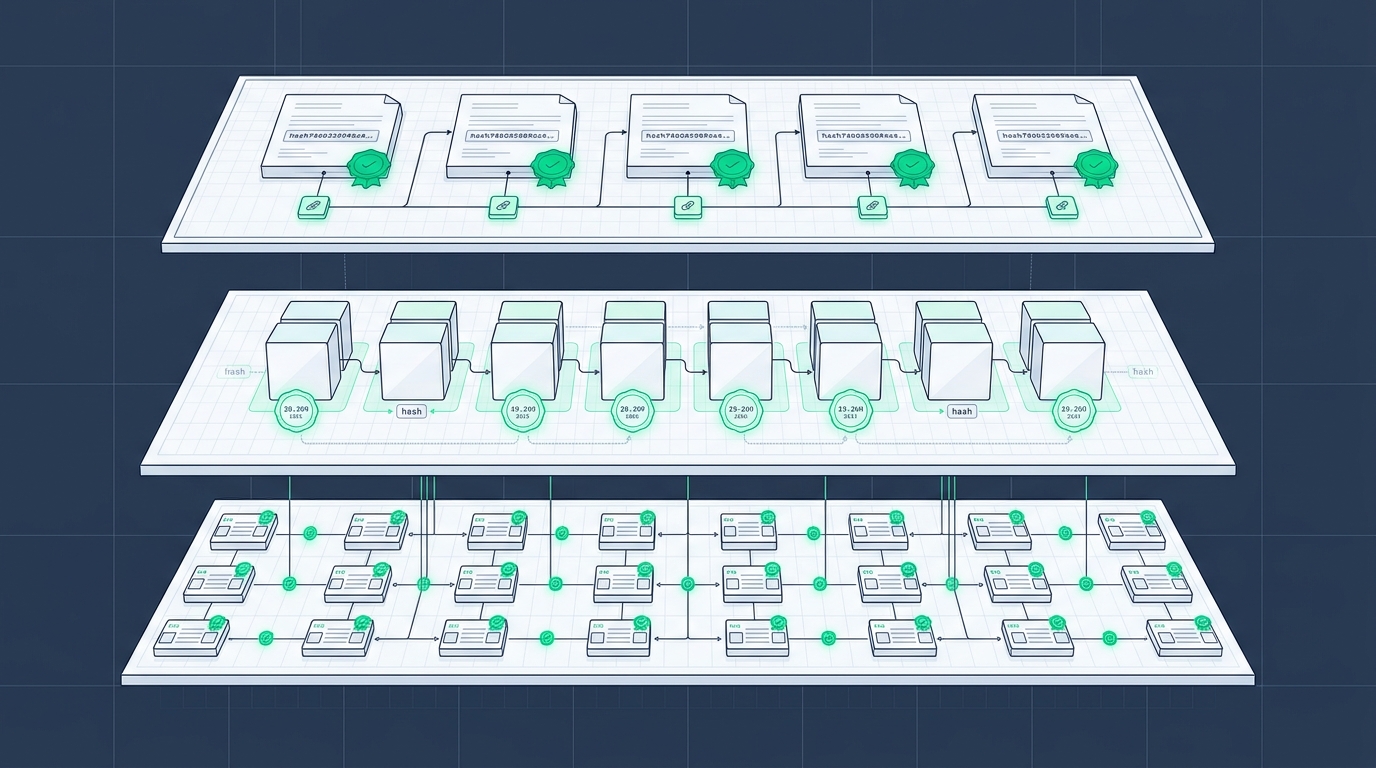
Binding. The reviewer holds a signed credential. The review is hashed, and the reviewer signs that hash. A verifier checks the signature against the credential's public key and confirms the credential is unrevoked—without seeing the reviewer's name, institution, or nationality unless disclosure is required.
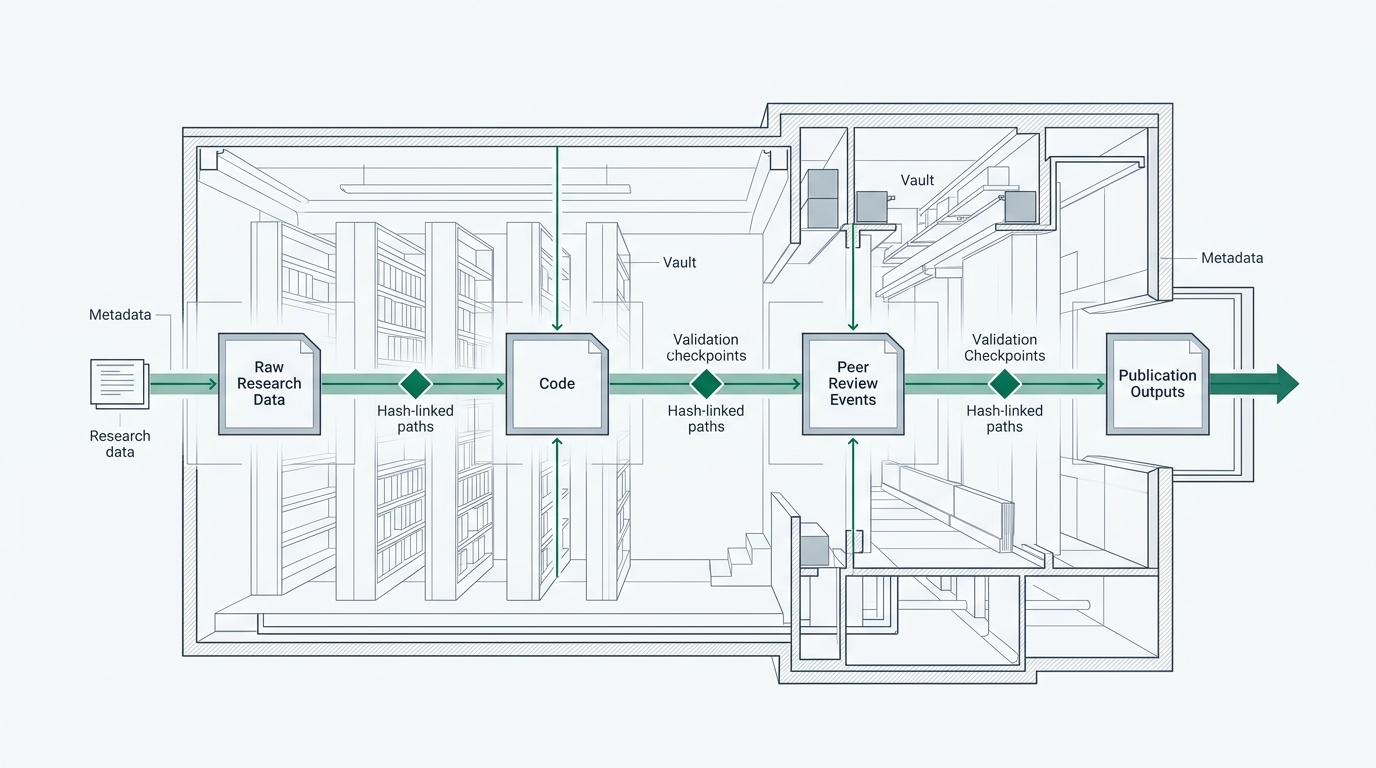
Ordering. Each submission, revision, review, and decision is written to an append-only log. Each entry hashes the previous entry and the new payload; change one bit and the fingerprint changes. A retroactive edit breaks every downstream hash, making tampering detectable rather than merely discouraged.
Non-equivocation. Because the log is anchored at multiple independent nodes, no single operator can present two conflicting versions of the same event and have both verify. The institution can show what happened, in what order, and that no later rewrite occurred.
No probability. No accusation. Evidence. Each manuscript, review, and decision then carries a verifiable lineage from creation to acceptance—Decentralized Provenance as the chain of custody research has never had. The jurisdictional payoff is decisive: institutions can satisfy research-security mandates without converting merit review into a nationality filter. Compliance and fairness stop fighting each other.
The Three-Layer Institutional Stack: Map It to Your Risk Register
Layer 1 — AI Integrity Layer (review pipeline)
ICLR's 21% becomes an audit problem, not a detector problem. Signed reviewer attestation, submission hashes, and LLM-use declarations produce an auditable integrity score—a deterministic check that a review is bound to a credentialed signer, not a stylistic guess that it "feels" human. Editors and ORIC directors own this layer.
Layer 2 — Integritas Vault (records and regulators)
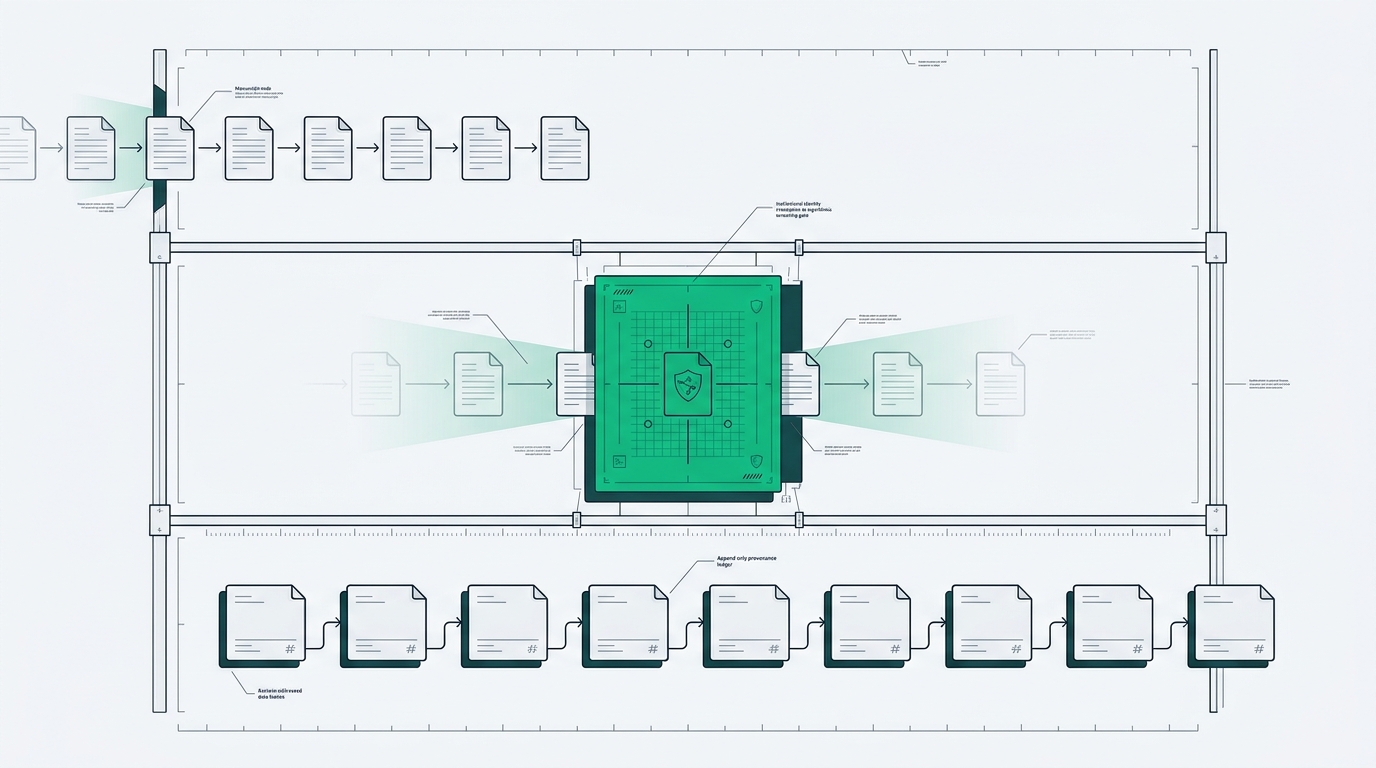
The Integritas Vault seals submission, revision, and peer-review artifacts at the point of creation, producing one append-only, tamper-evident chain of custody for publishers, funders, HEC, PM&DC, and national regulators. Auditors do not ask the platform to be trusted; they verify hashes, signatures, and timestamps. Deans and regulators face this layer.
Layer 3 — GEAR Network (scalable, fair moderation)
Preprint gatekeeping and the documented nationality penalty demand layered, federated trust—not centralized authority. Signed submission attestations and federated moderation pools supply screening capacity without a bottleneck and without a bias vector. Algorithmic Integrity means the screening rule is explicit and reproducible: it checks verifiable predicates—attestation present, submission hash matches, LLM-use declaration complete, conflict declaration signed—rather than inferring risk from the geography of a co-author's institution.
The governance outcome is a rare three-way alignment: regulators gain continuous assurance, researchers retain ownership of identity data, and publishers gain screening that scales on Distributed Infrastructure rather than headcount.
The Window Is Closing
Three signals belong on every research leader's desk this term. CAST's decision to stop funding Chinese scholars at NeurIPS shows research-security anxiety now producing blunt fair-process failures—infrastructure, not exclusion, is the answer. openRxiv's independent stewardship transition shows preprint governance rearchitecting in real time; institutions that adopt provenance now help author the standard. And when retraction clusters reach promotion and citation records, institutions without verifiable lineage cannot separate a researcher's legitimate output from a fabricated program; the risk has moved from hypothetical to dossier-level.
The direction of travel is unambiguous: institutions need infrastructure that verifies provenance, not more detection theater. Over the next twelve months that means audit-readiness for accreditation and funder review, defensible promotion dossiers, and jurisdiction-proof collaboration policies. Read the retraction clusters of the past decade as missing-audit-trail failures, and the forward-looking fix becomes obvious: a sealed, verifiable record of every submission, revision, and decision—the standard your institution should help define rather than inherit.
Institutional Leadership, Not a Software Purchase
Join the ScholarMark Institutional Pilot Grant program—a structured, cohort-based deployment that establishes a tamper-evident provenance layer across one school, one review pipeline, or one national regulatory workflow. Pilot participants receive an Early Adopter Subsidy covering onboarding, integration with existing submission systems, and a published institutional integrity report at conclusion.
This is a policy instrument, not a product license. You are not buying a tool; you are installing the audit infrastructure your accreditation, funder-compliance, and promotion-integrity obligations will soon require. Institutions are setting standards for verifiable research provenance now. Early adopters help author the standard; late adopters inherit it.
Your institution will face a provenance demand within the next accreditation cycle. The question is whether that proof is mathematical—or improvised. Request the Institutional Pilot Grant brief and the Early Adopter Subsidy terms.
--- ScholarMark by DecentraSec is building the pre-submission infrastructure that academic publishing has never had — AI-powered integrity checks, paid peer review via the GEAR Network, and immutable provenance-based authorship seals. Start here →
References
- Nature, doi:10.1038/d41586-025-03506-6 — ICLR 2026 peer review analysis.
- Nature, doi:10.1038/d41586-025-04032-1 — Detector performance on AI-written referee reports.
- UKSG Insights, doi:10.1629/uksg.659 — Hindawi retraction event and journal closures.
- The News — Clone-journal reporting and HEC retrospective monitoring (2022).
- doi:10.48550/arXiv.2605.03202 — Stop Automating Peer Review Without Rigorous Evaluation.
- doi:10.48550/arXiv.2602.00319 — Detecting AI-Generated Content in Academic Peer Reviews.
- NBER WP 34789, doi:10.3386/w34789 — Geopolitics in the Evaluation of International Scientific Collaboration.
- COPE case guidance on suspected AI reviewers.
02 // RELATED RESEARCH · ARCHIVE DISPATCHES
Related Papers & Dispatches.
Peer-reviewed analyses, cryptanalysis papers, and zero-trust engineering dispatches.
Peer Review Crisis? It's a Research Infrastructure Problem
More than eight million papers now enter a peer review system that can't verify who validated what. The fix is verifiable triage: identity-backed reviewers, screening at ingest, and audit-ready provenance—installed at the institutional layer, not bolted onto editorial software.
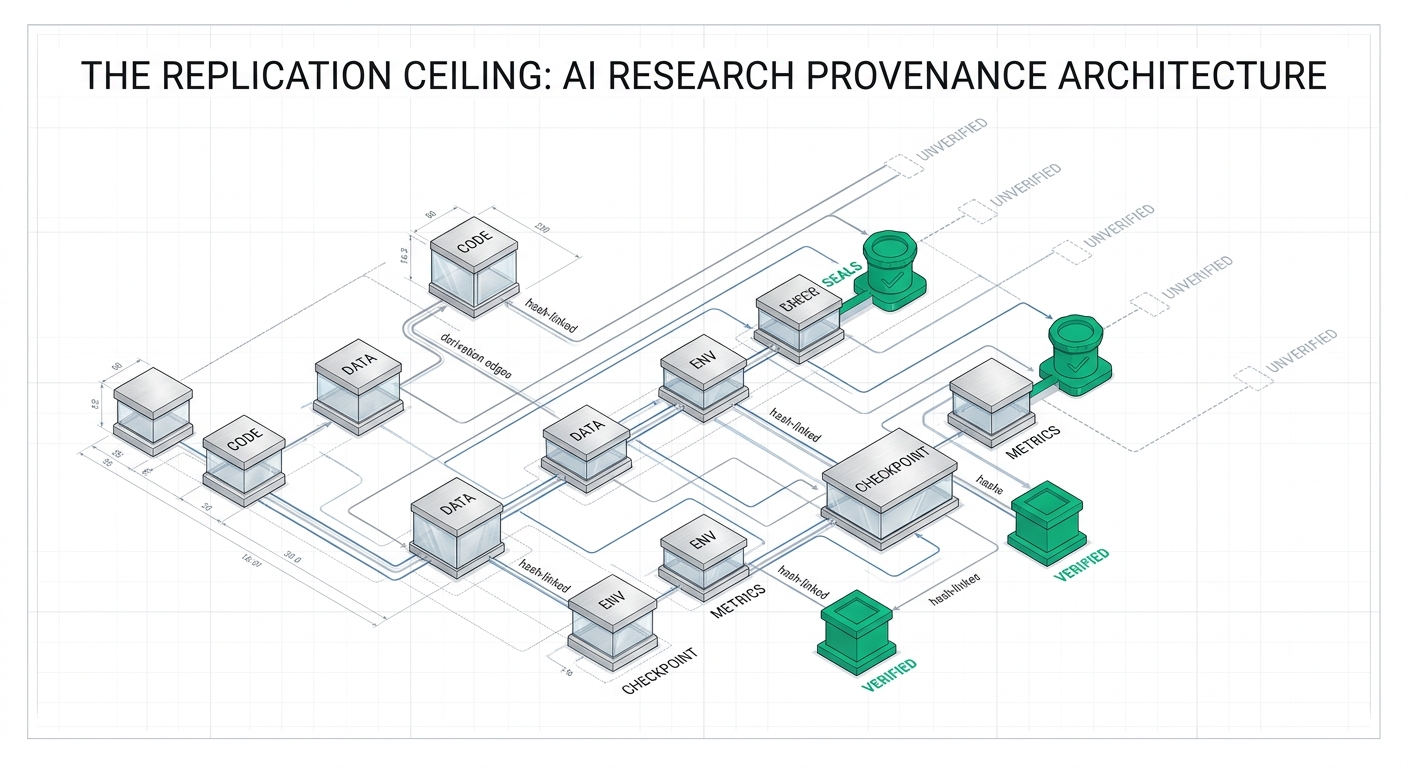
AI Reproducibility Ceiling: 21% Derived, 79% Not Verified
The strongest tested agent re-derived only 21% of tasks from top-venue AI papers. The institutional remedy is verifiable provenance infrastructure—not another checklist.
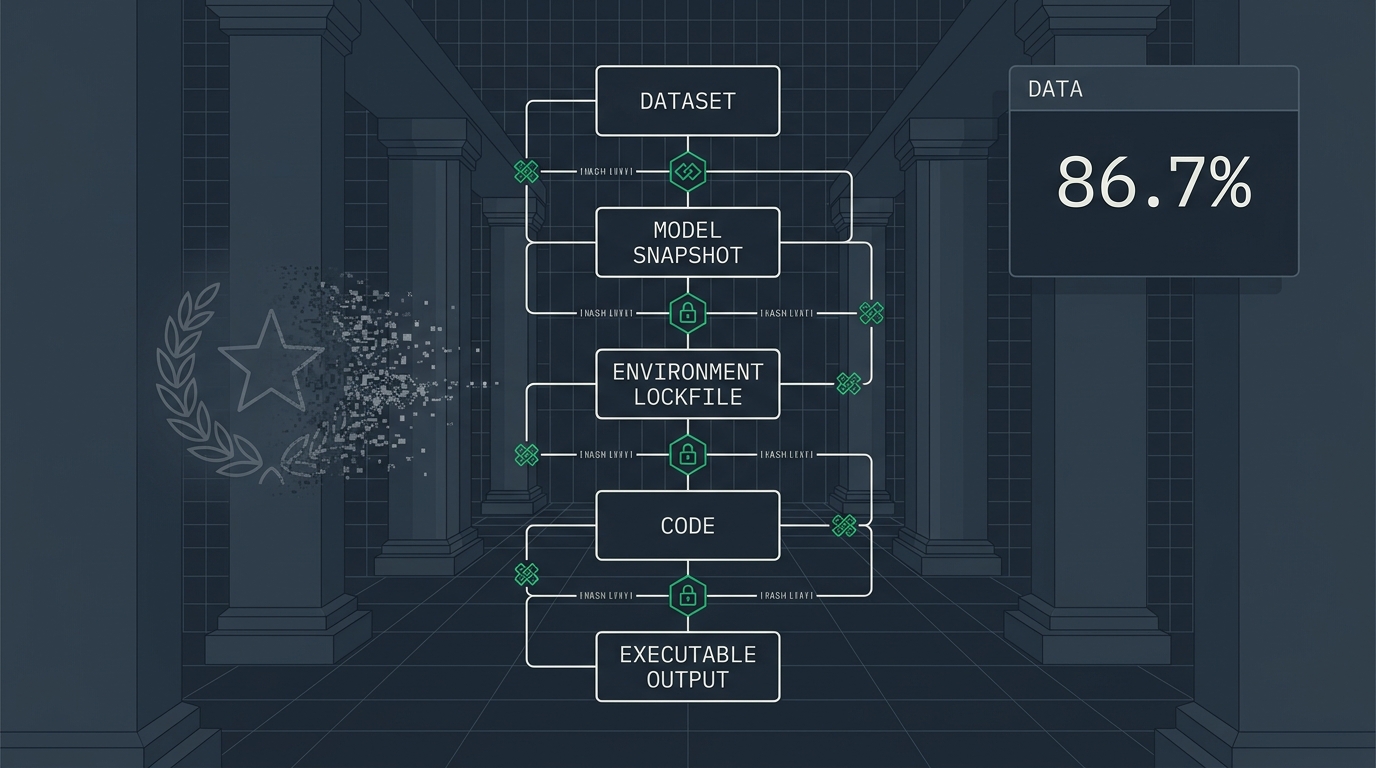
LLM4SE Reproducibility Crisis: 86.7% of Papers Fail Audit
First 640-paper audit of LLM4SE research finds 86.7% reproducibility failure modes. ScholarMark replaces badges with tamper-evident, mathematically verifiable infrastructure — proof, not presence.