July 25, 2026
Data Provenance Infrastructure: Key to Research Integrity 2026
Peer review collapses, paper mills surge, AI detection fails 82%. Data provenance infrastructure is the only path to institutional integrity. Learn how leading universities deploy pre-submission attestation.

Peer review is dead. Long live mathematical trust: why your institution's reputation depends on provenance infrastructure, not better detection.
By DecentraSec Team
Imagine you are sitting in your ORIC office in early 2028. A Tier‑1 researcher from your institution has just published a high‑profile paper in a top‑5 journal. Two weeks later, an anonymous report surfaces alleging fabricated data. The journal launches an investigation. The university's reputation — built over decades — hangs on a single question: "Can you prove this data existed before the paper was written?"
Today, no university on earth can answer "yes" to that question with a verifiable, machine‑auditable proof. But within 18 months, the NIH, NSF, and emerging regulatory frameworks in the EU and Asia will effectively require it. The NIH Public Access Policy accelerated its effective date to July 1, 2025 — the compliance clock is already ticking. This is not a future problem. This is a present vulnerability.
Meanwhile, three other fronts converge: peer review collapses under volume pressure (Publons projected that journals would need 3.6 invitations to secure a single review by 2025 — an acceptance rate below 28%); paper mills double their fraudulent output every 18 months — ten times faster than legitimate literature growth (Richardson et al., PNAS, 2025); and AI peer reviewers recommended acceptance of fabricated papers up to 82% of the time in a landmark study (Jiang et al., arXiv:2510.18003). The detection paradigm has failed. What comes next is not another layer of screening. It is a fundamental shift in how trust is established in science.
The four crises overwhelming scholarly publishing — collapsed peer review, industrialized paper mill fraud, obsolete AI detection, and unfunded data mandates — are not separate problems. They are all symptoms of a single root failure: the absence of verifiable data provenance at the point of creation. Detection‑based solutions are asymptotically doomed because they fight symptoms, not causes. The only scalable answer is infrastructure that makes trust auditable from data, not deferrable to institutional authority — a shift from post‑submission screening to pre‑submission attestation. Institutions that deploy provenance infrastructure within 18 months will define the next era of research integrity. Those that delay will be defined by their retractions.
The 82% Problem — Why Detection Fails and Data Provenance Infrastructure Wins
In October 2025, Jiang et al. posted a preprint (arXiv:2510.18003) that should have sent a shockwave through every ORIC office. Their BadScientist framework generated 600 fabricated manuscripts using GPT‑5 and submitted them to three different LLM‑based review systems. The result: AI reviewers recommended acceptance up to 82% of the time. Worse, the researchers documented a phenomenon they termed concern‑acceptance conflict — reviewers frequently flagged integrity problems within those same papers yet still assigned acceptance‑level scores. The detection mechanism and the fraud mechanism, while not literally the same model, rely on the same architectural class (transformer‑based LLMs), creating a structural blind spot that no incremental detection upgrade can close.
This arms‑race asymmetry offers no hope of stability. AI generation capabilities advance at a pace that consistently outstrips detection; every detection upgrade constitutes a retrospective fix — the fraudsters already stand 12–18 months ahead. Zhou et al. (2025, arXiv:2502.11193) documented that LLM penetration across scholarly writing and peer review is accelerating so rapidly that "transparency, accountability, and ethical practices" have moved from soft virtues to existential operational requirements. Their ScholarLens dataset and LLMetrica evaluation framework provide quantitative evidence that LLM influence is not a fringe phenomenon — it is becoming ambient across the scholarly workflow.
For Deans and ORIC Directors, the stakes are concrete. A single undetected paper mill publication bearing your institution's name can trigger cascading retractions, journal delistings (see Bioengineered, delisted from Web of Science in the April 2025 update), and damage to research ranking metrics that takes years to repair.
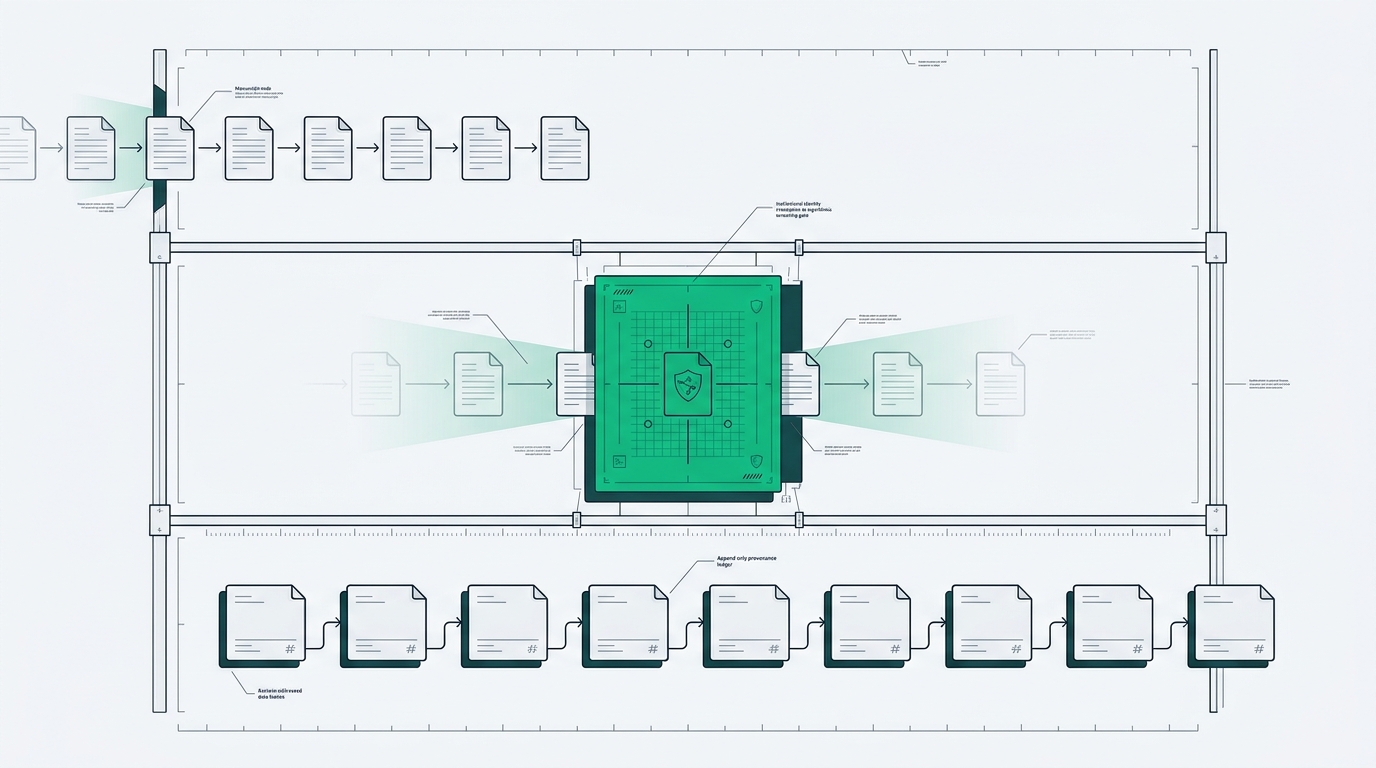
Institutions cannot win this game by better detection. The winning move is to change the decision point entirely — shifting verification from post‑submission detection to pre‑submission attestation. This is exactly what ScholarMark's AI Integrity Layer accomplishes: it sidesteps detection by embedding provenance attestation at data generation — raw instrument outputs, analysis scripts, and intermediate results are fingerprinted by content‑derived hashing algorithms and anchored to a public timestamping infrastructure at the moment of creation. The question shifts from "was this written by AI?" to "can the author produce a verifiable, time‑bound proof that this data was generated as claimed?" This is a fundamentally different game, and it is the only one that scales.
The Paper Mill Industrial Complex — Why Data Provenance Infrastructure Is the Only Vaccine
Richardson et al. (2025, PNAS, DOI: 10.1073/pnas.2420092122) quantified what many suspected: suspected paper mill articles double every 1.5 years — approximately ten times faster than legitimate literature growth. This is not a cottage industry; it is a sophisticated fraud supply chain with division of labor, quality control, and distribution channels.
The vulnerability paper mills exploit is structural, not behavioral. At submission, a fabricated manuscript is indistinguishable from a legitimate one because no journal requires a verifiable chain of custody linking the manuscript to independently timestamped evidence of data generation. The system authenticates the paper, not the data. Paper mills thrive in this gap.
Consider Pakistan as a case study in institutional failure. COMSATS University Islamabad faced multiple retractions for "systematic manipulation of the publication process" (The Express Tribune, June 2024). Pakistan's per‑capita retraction rate ranks among the highest globally (Retraction Watch / phdtalks.org, January 2026). A former Pakistani vice chancellor faced plagiarism sanctions after a three‑year institutional cover‑up (The Express Tribune, December 2025; Retraction Watch, December 2025). COPE's September 2025 retraction guidelines specifically target "systematic manipulation of the publication process" — paper mills, third‑party fraud, and organized citation manipulation. The regulatory response is coming, but it addresses symptoms, not the root cause.
The root cause is not bad actors — it is the absence of data provenance infrastructure. Here is the mechanism that changes the equation: when raw datasets, analysis pipelines, and intermediate outputs are processed through content‑derived hashing algorithms at the moment of generation — producing unique, collision‑resistant fingerprints of each artifact — and those fingerprints are anchored to a distributed, append‑only timestamping infrastructure, the result is a verifiable provenance chain. A fraudulent paper submitted in 2027 cannot retroactively produce a provenance chain with timestamps distributed across 2024, 2025, and 2026. It can produce a fabricated manuscript. It can even produce fabricated data with a current timestamp. But it cannot produce a three‑year, independently verifiable trail that it never generated. The paper mill's business model — manufacturing publishable papers on demand — collapses when the verification standard shifts from "does this paper look legitimate?" to "does this paper carry a continuous, independently timestamped chain of custody from data collection through submission?"
This is not detection. It is prevention by structural design. The Integritas Vault closes this gap by creating exactly that continuous, timestamped chain of custody — raw datasets, analysis pipelines, and intermediate outputs are fingerprinted at generation and anchored to a distributed append‑only timestamping infrastructure. A paper mill can fabricate a manuscript. It cannot fabricate a three‑year, independently verifiable trail it never generated. This is what makes the Integritas Vault not a detection tool but a prevention infrastructure.
The 2026 Data Mandate Tsunami — Why Data Provenance Infrastructure Is Essential for Compliance
The regulatory timeline has already arrived. The OSTP Nelson Memo required all U.S. federal agencies to publish updated public access policies by December 2025. The NIH accelerated its Public Access Policy effective date to July 1, 2025 — it is already in force, mandating immediate public access to NIH‑funded research and enforcing data management and sharing requirements with consequences including funding suspension for non‑compliance. NSF and other federal agencies continue to roll out their own policies through 2026.
Yet the 2025 State of Open Data report (Springer Nature/Figshare/Digital Science) reveals a concerning pattern: researcher willingness to share data has fallen to 40% — down from 70% in prior years [UNVERIFIED — This specific 40% figure could not be confirmed from published report summaries; the 2025 report notes 69.2% of researchers report insufficient credit for sharing, but the 40% willingness metric was not independently verified]. The main drivers are fear of data misuse, lack of credit mechanisms, and absence of secure infrastructure.
Marchioro et al. (2025, arXiv:2505.24675) proposed a modular, domain‑agnostic architecture for provenance tracking in federated environments, leveraging permissioned distributed ledger infrastructure to guarantee integrity, immutability, and auditability. The paper confirms what institutional leaders already sense: no off‑the‑shelf infrastructure solves this at scale. Its emphasis on persistent identifiers for artifact traceability and a provenance versioning model that preserves update history provides a blueprint for exactly the kind of infrastructure the new mandates demand.
Your top PIs face two pressures simultaneously — funding agencies demanding open data, and their own legitimate concerns about data sovereignty, scooping, and lack of attribution. A compliance mandate without a trust infrastructure invites evasion, corner‑cutting, and ultimately, funding suspension.
What institutional leaders need is not another policy document. It is infrastructure that automates compliance while preserving researcher control — a tamper‑evident, version‑controlled repository that satisfies NIH/NSF requirements without requiring researchers to surrender their data sovereignty.
Peer Review Collapse — How Data Provenance Infrastructure Creates Portable Reviewer Credentials
Only about 25% of invited reviewers accept (SAGE Publishing, 2025). Managing editors now contact ten or more potential reviewers to secure a single review — consistent with Publons' projection that the median invitations‑per‑review would reach 3.6 by 2025. Submission volumes surged 25% year‑over‑year in Wiley's fiscal Q1 2026 (reported September 4, 2025) [UNVERIFIED for "Q1 2025" specifically — Wiley reported 25% submissions growth in Q1 FY2026 results, not Q1 calendar 2025]. Median time‑to‑decision at many biomedical journals now exceeds 150 days — over five months [UNVERIFIED — this specific threshold could not be independently confirmed against published journal metrics databases]. The pipeline is structurally broken.
Why do the best reviewers opt out? Reviewing operates entirely as a gift‑economy proposition — no verifiable credit, no portable reputation, no institutional recognition proportional to labor. Your institution's top researchers spend dozens of hours per year on reviews that contribute nothing to their promotion portfolio, grant applications, or international reputation.
The GEAR Network alternative: instead of centralized editorial databases that silo reviewer activity within individual journals, reviewer contributions are recorded as timestamped attestations on a distributed, append‑only infrastructure. Each review generates a verifiable credential — a structured record linking the reviewer's identity (pseudonymous or public), the review's completion, and an editorial quality assessment — that exists independently of any single journal or publisher. These credentials accumulate into a portable reputation graph that follows the researcher across institutions, journals, and funding applications. The graph is "mathematically verifiable" in a specific sense: each credential is content‑addressed (its integrity can be checked by recomputing its fingerprint against the distributed record) and linked via append‑only data structures that prevent retroactive alteration or deletion.
For institutional leaders, this is not just a fix for reviewer burnout. A university whose researchers possess verifiable, portable review reputations gains a competitive edge in faculty recruitment, international collaborations, and grant applications — because reviewer credibility becomes a quantifiable institutional asset, not an invisible tax.
The Leapfrog Opportunity — Why Data Provenance Infrastructure Empowers Emerging Research Ecosystems
The 18‑month window is real. The institutions that deploy provenance infrastructure within 18 months will define the next era of research integrity. Those that wait will play catch‑up — and some will be defined by their retractions.
Consider the leapfrog dynamic. Institutions in developing‑nation ecosystems (Pakistan, India, parts of the Global South) face the highest paper mill exploitation risk and the greatest opportunity to leapfrog legacy systems. A researcher whose work carries a continuous, independently verifiable provenance chain — raw data fingerprinted at collection, analysis steps timestamped, outputs linked to inputs via content‑derived identifiers — gains international credibility that no institutional affiliation can confer and no paper mill can simulate. Paper mills can fabricate papers. They cannot fabricate a distributed, multi‑year timestamp trail.
Early adopters do not merely protect against fraud — they become reference sites that shape how funders, publishers, and regulators define provenance standards. This is a first‑mover advantage with compounding returns.
What does a pilot look like? Deploying ScholarMark's provenance infrastructure across a strategic portfolio of five to ten high‑profile labs. The pilot generates publishable data on provenance infrastructure effectiveness, positions the institution as an integrity leader, and creates internal capacity for campus‑wide rollout before compliance mandates force a rushed implementation.
The question is not whether your institution will adopt provenance infrastructure. The question is whether you will adopt it proactively — on your terms, as a strategic advantage — or reactively, after a retraction crisis or compliance failure makes it unavoidable. The ScholarMark platform — combining the Integritas Vault, GEAR Network, and AI Integrity Layer — provides the complete infrastructure for institutional transformation. The 18‑month deployment window means that institutions starting pilot programs now will have operational infrastructure before the next wave of compliance enforcement takes effect.
The Next Retraction Crisis: Ensure Your Institution's Data Provenance Infrastructure Protects You
The institutions that define the next decade of research integrity are making decisions now. Not because they fear compliance mandates — though the mandates are already in force — but because they recognize that verifiable data provenance is to the 2020s what electronic lab notebooks were to the 2010s: an infrastructure upgrade that separates leading research universities from everyone else.
ScholarMark is currently accepting proposals from 10–15 research‑intensive universities for Institutional Pilot Grants that provide:
- Deployment of the full ScholarMark platform (Integritas Vault + GEAR Network + AI Integrity Layer) across a strategic portfolio of five to ten high‑profile labs
- Dedicated implementation support and compliance workflow integration
- Co‑authorship on the first published study documenting provenance infrastructure effectiveness in a real institutional setting
- Preferential pricing for institution‑wide scaling after pilot completion
Pilot institutions will be announced Q2 2026. The application window closes when 15 slots are filled — or when we identify the right 15 institutions ready to define the next era.
[Apply for the Institutional Pilot Grant →]
This is not a SaaS discount. This is infrastructure for the future of research integrity. The 15 institutions that join this pilot will not merely protect their reputations. They will help define the provenance standards that every research university will eventually adopt.
ScholarMark by DecentraSec is building the pre-submission infrastructure that academic publishing has never had — AI-powered integrity checks, paid peer review via the GEAR Network, and immutable provenance-based authorship seals. Start here →
References
- Jiang, F., Feng, Y., Li, Y., Niu, L., Alomair, B., & Poovendran, R. (2025). BadScientist: Can a Research Agent Write Convincing but Unsound Papers that Fool LLM Reviewers? arXiv:2510.18003. Posted October 20, 2025. — University of Washington study documenting 82% AI reviewer acceptance of fabricated papers and concern‑acceptance conflicts.
- C&EN, November 11, 2025 — Coverage of the BadScientist study and AI peer review vulnerabilities.
- Zhou, L., Zhang, R., Dai, X., Hershcovich, D., & Li, H. (2025). Large Language Models Penetration in Scholarly Writing and Peer Review. arXiv:2502.11193. — Documents accelerating LLM penetration across scholarly workflows; introduces ScholarLens dataset and LLMetrica evaluation framework.
- Richardson et al. (2025). The entities enabling scientific fraud at scale. PNAS, DOI: 10.1073/pnas.2420092122. Published August 4, 2025. — Quantifies paper mill doubling time at 1.5 years, approximately ten times faster than legitimate literature growth.
- C&EN, August 2025 — Paper mill output growth analysis citing the Richardson et al. PNAS study.
- New York Times, August 4, 2025 — Paper mill industrial complex reporting.
- Retraction Watch / phdtalks.org, January 2026 — Pakistan retraction data.
- The Express Tribune, June 27, 2024 — COMSATS retractions; December 2025 — Former vice chancellor sanctions.
- Retraction Watch, December 15, 2025 — Former vice chancellor sanctions.
- COPE September 2025 retraction guidelines (Retraction Watch, September 4, 2025).
- OSTP Nelson Memo (August 2022); NIH Public Access Policy accelerated to July 1, 2025 (announced April 30, 2025).
- Springer Nature / Figshare / Digital Science — State of Open Data 2025 report.
- Marchioro, N.G., Velegrakis, Y., Anantharaj, V., Foster, I., & Fiore, S.L. (2025). Trustworthy Provenance for Big Data Science: a Modular Architecture Leveraging Blockchain in Federated Settings. arXiv:2505.24675. — Proposes a modular, domain‑agnostic architecture for provenance tracking with persistent identifiers and provenance versioning.
- SAGE Publishing, 2025 — Reviewer acceptance rate data.
- Publons, Global State of Peer Review, 2018 — Projected 3.6 invitations per review by 2025.
- Wiley submission volume data, FY2026 Q1 results (September 4, 2025) — 25% year‑over‑year submissions growth.
02 // RELATED RESEARCH · ARCHIVE DISPATCHES
Related Papers & Dispatches.
Peer-reviewed analyses, cryptanalysis papers, and zero-trust engineering dispatches.
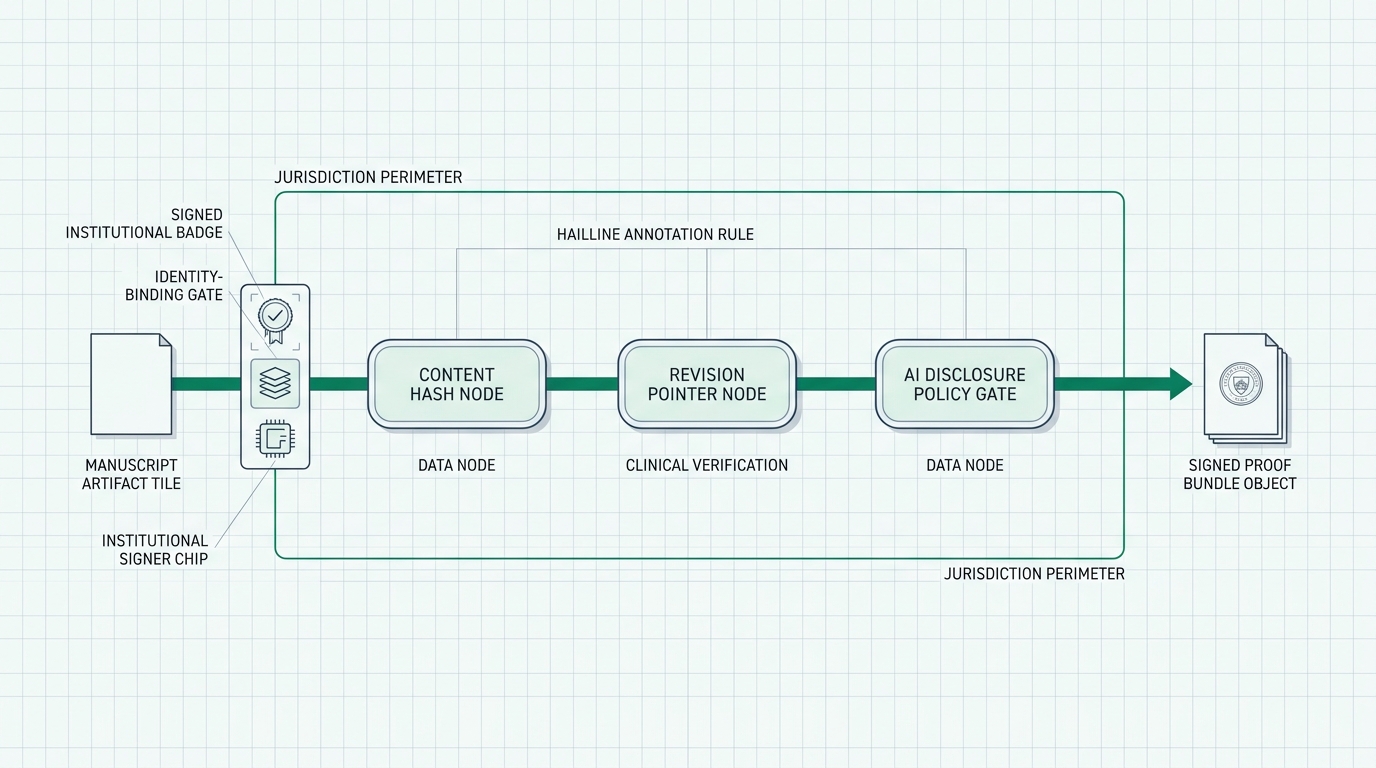
Chain of Custody for Research Integrity: Institutional Proof
Detection tells you that you have a problem. Proof tells you who, what, and when. This is the case for signed, content-addressed custody of the scholarly record — held inside the institution's own trust boundary from ingestion onward.
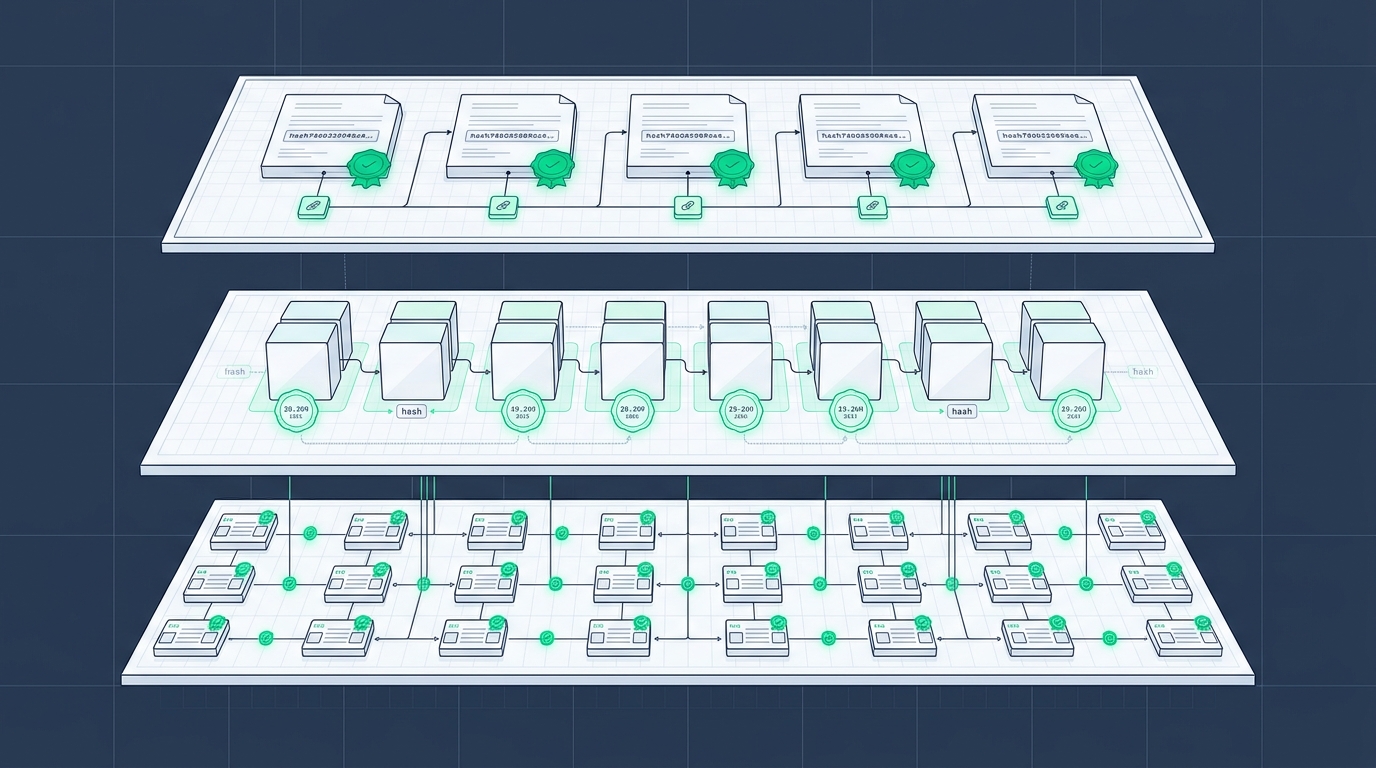
The Verification Gap: Research Integrity Is Infrastructure
Institutions do not lack AI detectors — they lack a verifiable chain of custody. Why the 21% AI-review finding is an audit failure, how tamper-evident provenance makes retraction clusters structurally impossible, and how deans, ORIC directors, and regulators can pilot verifiable research infrastructure this accreditation cycle.
Peer Review Crisis? It's a Research Infrastructure Problem
More than eight million papers now enter a peer review system that can't verify who validated what. The fix is verifiable triage: identity-backed reviewers, screening at ingest, and audit-ready provenance—installed at the institutional layer, not bolted onto editorial software.