August 18, 2026
Provable Integrity for Federal Reproducibility Mandates
Federal reproducibility mandates have turned 'trust us' into a compliance violation. Audit-ready research infrastructure must now capture tamper-evident lineage, AI attribution, and graph-level fraud signals.
The Integrity Stack: Why Federal Reproducibility Mandates Made "Trust Us" a Compliance Violation
By DecentraSec Team
The era of integrity-by-assertion is over. On May 23, 2025, Executive Order 14303 ("Restoring Gold Standard Science") converted reproducibility, transparency, falsifiability, unbiased peer review, and explicit uncertainty communication from aspirational adjectives into federal obligations for every agency administering sponsored research. On September 12, 2025, the EU Data Act made data custody, portability, and cloud-switching legal obligations. In the same window, a cross-sectional study documented 2,051 paper-mill retractions across 142 journals for 2020–2022, while fake-peer-review cases grew 5.5× on average versus 1.2× for plagiarism. The question is no longer "Are our researchers ethical?" but "Can we prove it — under audit?" Policy memos and institutional goodwill are not audit-ready research infrastructure. Evidentiary proof is.
Compliance Shock: Reproducibility Mandates Trigger Institutional Audits
The cascade is already running: the Executive Order, OSTP implementation guidance, agency scientific-integrity policies, and NSF Important Notice No. 149, whose research-security requirements take effect December 2, 2025. Read these principles as audit triggers, not editorial preferences. Regulators will ask what you can demonstrate, not what you intended.
The EU Data Act adds a second front: data custody, portability, and cloud-switching are now legal obligations, so where research data lives is a compliance question, not an IT preference. This creates the institutional dilemma: produce audit-ready evidence without constraining faculty workflows. The tension dissolves only when you separate policy compliance — paperwork — from evidentiary compliance: tamper-evident records of who did what, when, and under whose authority. Sovereign control of those records is the precondition for everything that follows.
AI Attribution Gap: Making Machine-Assisted Peer Review Accountable
A 2026 audit of 111 AI/NLP conferences and medical journals found reviewer-facing AI policies fragmented across venues — and the resulting reviews, including at ICLR 2026 and Nature Communications, were fluent but overly positive, generic, and weakly grounded (arXiv:2608.03581). This is not a quality problem; it is an accountability gap. A fluent model holds no epistemic commitment to the claims it assesses, so editorial confidence in machine-assisted review is misplaced.
PROV-AGENT starts from the failure mode: agents can hallucinate or reason incorrectly, propagating errors when one agent's output becomes another's input (arXiv:2508.02866). Capture prompts, responses, and decisions — not merely final verdicts. Ask the question your ORIC will face: if a retraction traces to an AI-assisted review, who — or what — is on the record? Two futures exist. Ban AI and lose review velocity. Or make every machine contribution attested and auditable — Algorithmic Integrity as a structural property: bind each contribution to a model identifier or a human actor, record the binding in lineage, and require human attestation at the decision boundary. The system can attest which steps were machine-assisted; it cannot attest that a human did the thinking, which is why human sign-off remains the accountability anchor.
Paper Mills Are Networks: Graph-Level Fraud Detection for Research Integrity
The numbers demand structural reading: 2,051 paper-mill articles retracted across 142 journals (DOI: 10.1186/s41073-025-00177-9); more than 6,400 retractions attributed to fake peer review across 2024–2025 (arXiv:2511.21176); fake-peer-review cases growing 5.5× on average over the study window versus 1.2× for plagiarism (arXiv:2502.00673). Paper mills and review rings are coordinated networks — shared co-authors, recycled emails, synchronized review timelines, citation collusion. Single-paper screening sees isolated flags; coordinated fraud becomes legible only at graph resolution. Pakistan's elevated retraction rate per capita is the visible symptom of review infrastructure gamed at national scale.
COPE's September 2025 retraction-guideline shift explicitly targets paper mills and third-party interference. The message to research leadership: editorial policy alone is not enforcement. Detection must move from "flag this manuscript" to "see the pattern across the submission graph" — reviewer identity verification, reputation signals, and anomaly detection operating as one system.
Static Metadata Fails: Provenance Infrastructure for Reproducibility
The literature distinguishes sharply: repeatability means identical inputs yield identical outputs; reproducibility means the analytical lineage replays and verifies under re-execution (DOI: 10.1002/cpe.3035). Most systems fail because they store lineage as static metadata — a frozen snapshot that anyone can edit, lose, or assert. A snapshot is a claim about the past; it does not constrain the past.
Reproducibility is a graph-comparison problem. Every analytical step, revision, and reviewer action is a state transition; each must bind to its predecessor by a collision-resistant, content-derived hash commitment that an auditor can recompute. Agentic workflows make lineage dynamic, so capture prompts, responses, and intermediate decisions as first-class nodes in sequence (arXiv:2508.02866).
The decisive move is Decentralized Provenance: append-only lineage whose transitions carry hash commitments, with replicas held by independently operated nodes across institutions. Tampering is detectable because any change breaks the commitment chain and disagrees with the independent replicas; an auditor recomputes commitments locally and compares at least two copies. No single operator can silently rewrite the past — they can fork only their own copy, which fails cross-replica consistency.
Mathematical Validation makes that verification step explicit: confirm the lineage graph is acyclic, every transition hash binds to its declared predecessor, artifacts hash to their recorded values, and the chain is consistent across independently held replicas. These are checkable invariants. They do not prove the underlying science was correct; they prove the lineage is unaltered and internally consistent. That is the difference between a record and a claim.
Audit-Ready Blueprint: Institutional Infrastructure for Provable Integrity
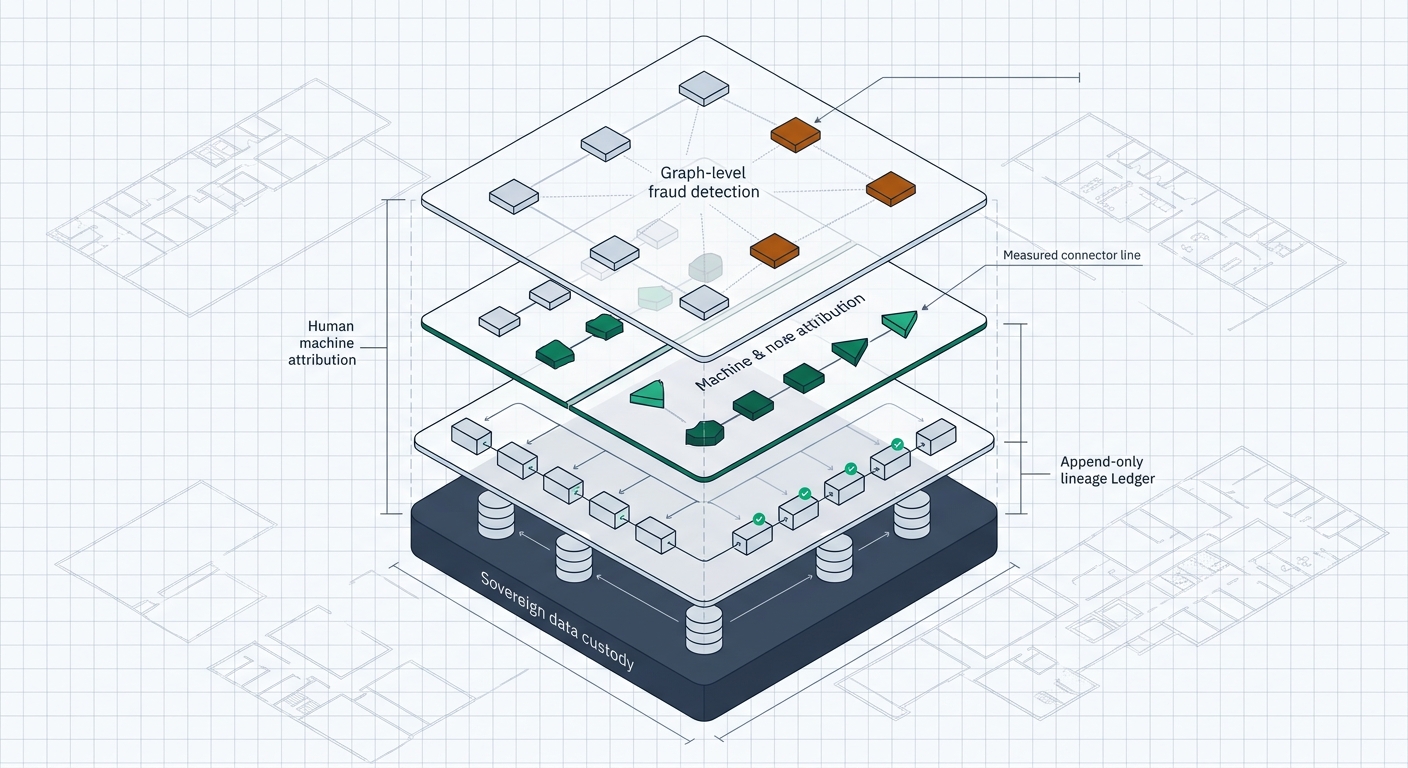
Audit-ready infrastructure demands four properties simultaneously: tamper-evident data lineage, attested human/machine attribution, network-level fraud detection, and sovereign data control. A point solution delivers none of them. Map each to an operational outcome: an IRB audit needs lineage that survives adversarial scrutiny; a funding compliance review needs attribution that distinguishes human from machine; an editorial integrity inquiry needs graph-level visibility into collusion; a data-sovereignty certification needs custody that never leaves institutional control.
The competitive case follows. Retraction scandals crater faculty recruitment and grant competitiveness, so provable integrity is a strategic asset, not a cost center. The implementation objection — "our researchers will not adopt this" — collapses when the compliance trigger is federal and the infrastructure sits beneath existing workflows. The difference between a detection plugin and institutional infrastructure is the difference between reacting to fraud and making silent falsification structurally detectable. Distributed Infrastructure must span campuses, journals, and funders so proof travels with the research.
Federal Mandate, Mathematical Proof: Institutional Pilot Grant
Apply for the Institutional Pilot Grant: a limited-cohort, co-design program for five to seven universities and federal labs. Deploy the full stack against one live compliance scenario — an NSF compliance trail, a journal's AI-review policy, or an ORIC fraud-audit pipeline. We provide dedicated architecture review, deployment support, and a published case study of your integrity posture before and after. We ask for candid feedback, real-world audit scenarios, and permission to document outcomes for the research-integrity community. For institutions needing budget runway before the next fiscal year, the Early Adopter Subsidy offers cost-shared participation.
The mandate is federal. The data is sovereign. The proof is mathematical.
Contact the Institutional Partnerships Desk — response within one week.
References
- Missier, P., Woodman, S., Hiden, H., Watson, P. "Provenance and data differencing for workflow reproducibility analysis." Concurrency and Computation: Practice and Experience. DOI: 10.1002/cpe.3035.
- "Identifying common patterns in journals that retracted papers from paper mills." Research Integrity and Peer Review. DOI: 10.1186/s41073-025-00177-9.
- Zhou, Z., Lou, Y., Shen, Z., Li, M. "Mapping Academic Integrity: Global Retraction Trends Explored through a Topic Lens." arXiv:2511.21176.
- Fichtl, A. M., Ellinger, L., Kelber, J., Olík, K., Groh, G. "AI-Assisted Peer Review Across Research Communities: From Reviewer AI Policies to LLM Review Quality." arXiv:2608.03581.
- Souza, R., Gueroudji, A., DeWitt, S., et al. "PROV-AGENT: Unified Provenance for Tracking AI Agent Interactions in Agentic Workflows." arXiv:2508.02866.
- Sharma, K., Khurana, P. "Retracted Citations and Self-citations in Retracted Publications: A Comparative Study of Plagiarism and Fake Peer Review." arXiv:2502.00673.
- COPE Council. "COPE Retraction Guidelines," September 2025.
- NSF Important Notice No. 149: Updates to NSF Research Security Requirements.
- Executive Order 14303, "Restoring Gold Standard Science," May 23, 2025; OSTP agency guidance, June 23, 2025.
- EU Data Act (Regulation (EU) 2023/2854), applicable September 12, 2025.
02 // RELATED RESEARCH · ARCHIVE DISPATCHES
Related Papers & Dispatches.
Peer-reviewed analyses, cryptanalysis papers, and zero-trust engineering dispatches.
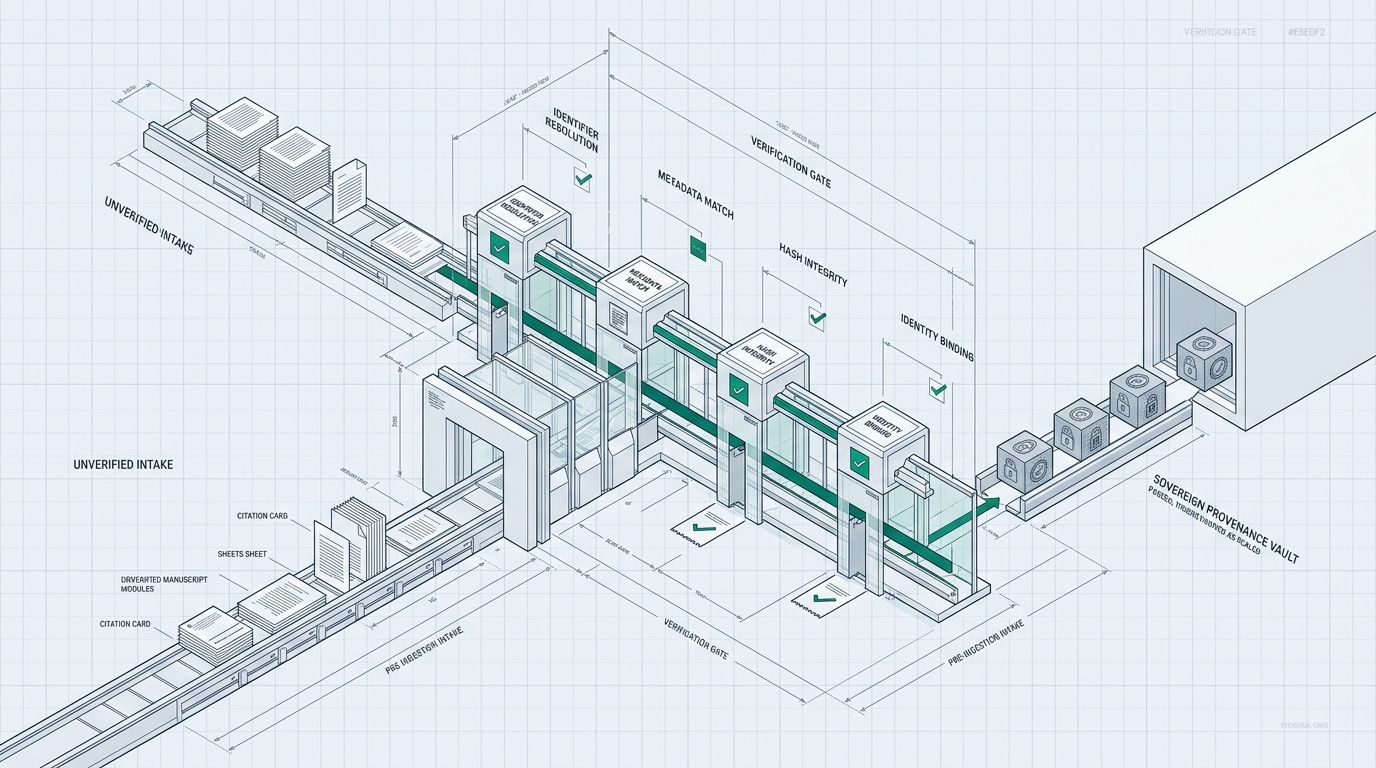
Research Integrity Infrastructure: Pre-Ingestion Checks
Research integrity failures are infrastructure failures. This post outlines pre-ingestion verification, appeal-aware records, and sovereign provenance for academic institutions.
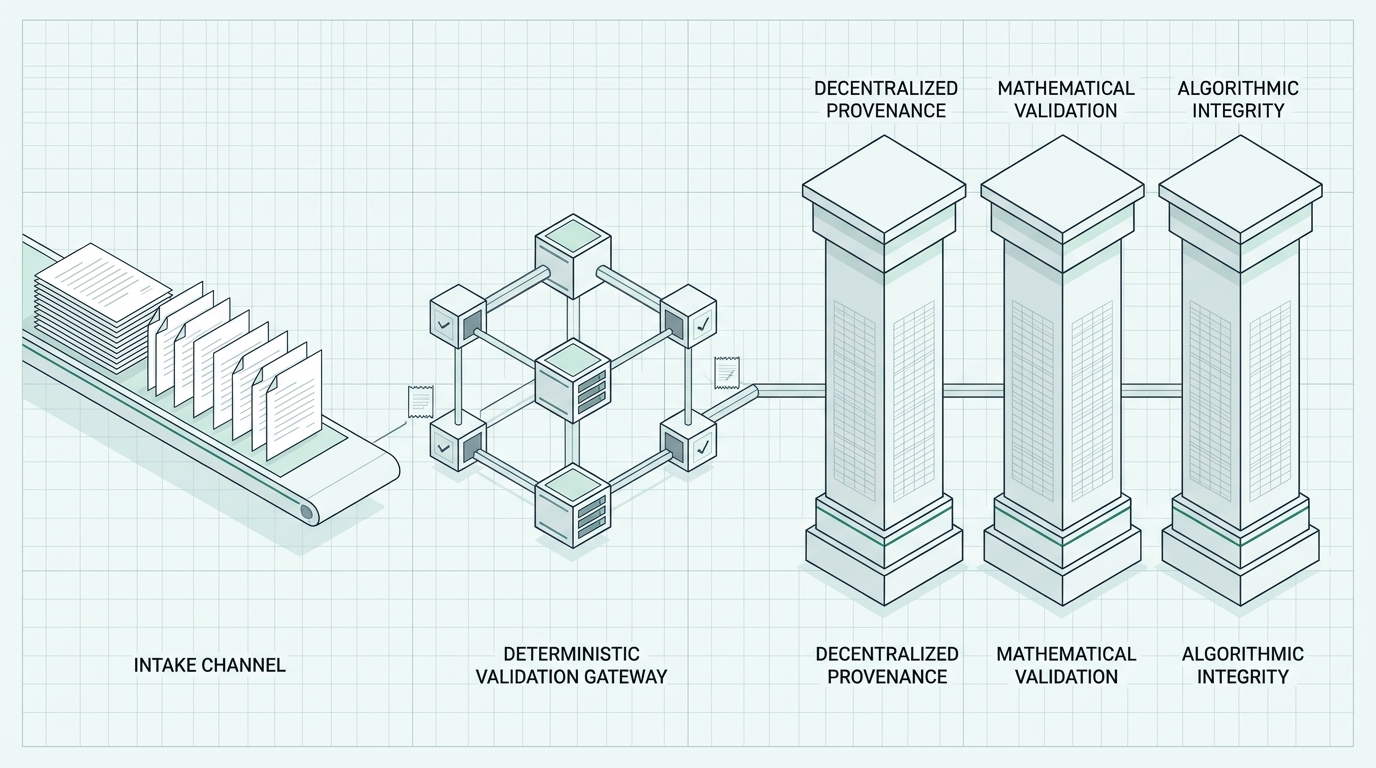
Research Integrity Infrastructure: Verify Before Publication
Scholarly integrity does not fail on ethics — it fails at intake. A structural look at pre-publication attestation, deterministic citation validation, and persistent provenance, and what a scoped institutional pilot actually returns.
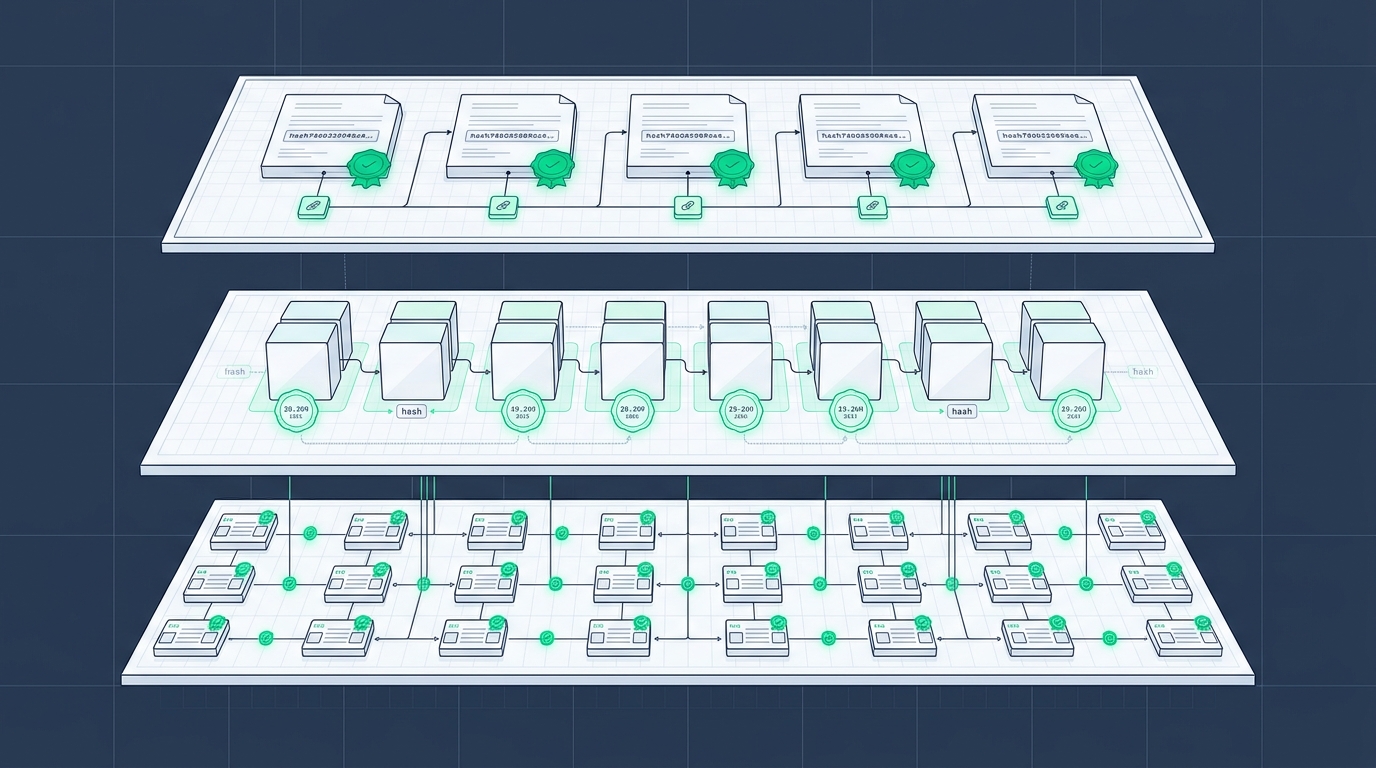
The Verification Gap: Research Integrity Is Infrastructure
Institutions do not lack AI detectors — they lack a verifiable chain of custody. Why the 21% AI-review finding is an audit failure, how tamper-evident provenance makes retraction clusters structurally impossible, and how deans, ORIC directors, and regulators can pilot verifiable research infrastructure this accreditation cycle.