August 10, 2026
Science's $2.5B Integrity Gap: Peer Review & Reproducibility Crisis
No verifiable provenance layer powers peer review, reproducibility, or data sovereignty. This is the integrity infrastructure gap every research institution must close.
Science's $2.5 Billion Integrity Gap: Peer Review, Reproducibility, and Data Sovereignty Are One Infrastructure Crisis
By DecentraSec Team
Five crises destabilize scientific gatekeeping — unpaid peer review, AI-generated reviews, industrialized paper mills, irreproducible results, and eroding data sovereignty. They converge on a single structural deficit: no cryptographically verifiable provenance layer exists for scientific contribution. Every downstream integrity mechanism — retraction, replication audit, tenure evaluation — operates without a tamper-evident record of who produced what, when, and under what conditions. The institution that deploys this infrastructure first sets the next decade's integrity standard; the one that waits inherits the liability.
Every promotion dossier rests on review labor no system can audit, credit, or prove a human wrote. Machine-generated text accounted for 21% of reviews at one of the world's leading AI conferences, yet this $2.5 billion annual unpaid labor pool appears on no balance sheet, tenure dossier, or funding assessment. Science never built the gatekeeping infrastructure it depends on; collapse is now a governance problem for every research institution.
The $2.5 Billion Peer Review Labor Economy No Institution Can Measure
Aczel et al. (Research Integrity and Peer Review, 2021) valued unpaid peer-review labor at $2.5 billion in 2020 across US, China, and UK reviewers alone; submission volumes have climbed since.
The deeper failure is structural invisibility. A researcher who reviews fifty papers for a flagship journal carries that labor nowhere — no verifiable record, no portable credential, no promotion weight. Deans and ORIC directors manage a workforce no system can count, verify, or reward. Reviewer fatigue is not a morale problem; it is systemic risk, and overworked reviewers are precisely the population outsourcing judgment to large language models.
The technical requirement is straightforward: a signed, timestamped review record whose integrity and attribution can be verified independently of the venue that collected it. Digital signatures bind reviewer identity to content; RFC 3161-compliant timestamp tokens anchor that content to a verifiable point in time; the resulting credential becomes portable across dossiers, funding applications, and institutional boundaries without requiring any central authority's ongoing cooperation.
That is the gap ScholarMark's GEAR Network fills — a verifiable, portable review credential built on cryptographically signed, independently timestamped review records that make review labor auditable across venues, dossiers, and funding applications.
The Verifiability Gap: Can Anyone Prove a Review Was Written by a Human?
Pangram Labs (November 2025) classified 21% of the 75,800 reviews in the ICLR 2026 cycle as fully machine-generated; more than half showed machine assistance. A 2026 detection study classified roughly 12% of Nature Communications reviews as AI-generated (Shen & Wang, arXiv:2602.00319). Each fully machine-generated review implies a confidentiality breach: a third-party model processed a proprietary manuscript outside the review contract.
The enforcement paradox is total. ICML and comparable venues prohibit generative-AI use in reviewing yet supply no enforcement mechanism — policy without infrastructure. And post-hoc detection faces a structural ceiling. Yu et al. (arXiv:2502.19614) benchmarked 18 detection algorithms against 788,984 machine-written and human-written reviews drawn from ICLR and NeurIPS cycles spanning eight years. Their central finding: no detector, including a context-aware method that leverages manuscript content, can reliably distinguish machine from human text at the individual-review level. The false-positive and false-negative rates at review-level granularity make detection alone an unsound basis for editorial sanctions.
This does not make the problem unsolvable; it relocates the solution. Detection operates probabilistically after the fact. Attestation operates deterministically at the moment of submission. A reviewer who cryptographically signs a review — asserting authorship under a known identity, at a verifiable time, with the artifact's hash bound to that signature — creates a non-repudiable record. The signature does not prove cognitive authorship; it creates legal and professional accountability for the claim of authorship. That accountability surface is what detection, operating post-hoc on anonymous text, cannot provide. The infrastructure question is not "can we detect AI text?" but "can we make the act of submission auditable?" ScholarMark's AI Integrity Layer answers with cryptographic binding of reviewer identity, submission timestamp, and artifact hash — a non-repudiable record at the creation boundary that shifts the audit surface from post-hoc probabilistic detection to ex-ante verifiable submission.
Paper Mills 2.0: Scientific Fraud That Outgrows Every Correction Mechanism
Suspected paper-mill output doubles every 1.5 years — ten times faster than legitimate research (Richardson et al., PNAS, 2025). Only 15–25% of these products ever face retraction; the rest persist indefinitely, contaminating citation networks, systematic reviews, and clinical guidance.
Fraud has migrated upstream. AI-rewritten "copycat" versions of legitimate research evade plagiarism detectors and reach peer-reviewed venues (Nature, September 2025). Nature's June 2025 investigation documented paper mills recruiting real researchers to attach their names to ghostwritten manuscripts — fraud has moved from content fabrication to identity laundering, rendering institutional reputations weaponizable. Every integrity check in common use — plagiarism detection, image forensics, post-publication peer review — operates downstream of publication, after contamination has entered the scholarly record.
The technical countermeasure is submission-stage identity and provenance binding. Before a manuscript reaches reviewers, the submitting author's identity must be cryptographically attested; the manuscript's hash must be anchored to a verifiable timestamp; and any prior-art or data-deposit claims must link to content-addressed artifacts whose integrity can be verified without trusting the submitting party. This does not prevent fraudulent submission — no technical mechanism can — but it eliminates the anonymity and audit-trail gaps that make industrial-scale fraud cheap.
The Reproducibility Mandate Is Now a Compliance Deadline for Institutions
Fewer than half of the studies in the 50-plus-team Brazilian replication coalition reproduced (Nature, April 2025). Freedman et al. (PLoS Biology, 2015) estimated that approximately $28 billion per year in US preclinical research spending produces results that cannot be reproduced — a figure scoped to one country, one research domain, and one year. On May 23, 2025, the White House Executive Order "Restoring Gold Standard Science" made transparency, reproducibility, and accuracy in federally funded research a compliance obligation, not an aspiration.
The infrastructure gap is specific and well-defined. Zenodo and OSF provide storage; GitHub provides versioning; neither proves that the deposited artifact is exactly what produced the reported result. Storage proves availability; versioning proves change history; neither proves computational correspondence.
Closing this gap requires two distinct integrity properties. The first — artifact integrity — is achievable today: cryptographic hashing of datasets, code, and computational environments, anchored to an independently verifiable timestamp, proves that the deposited artifact has not been altered since deposition. The second — computational reproducibility — is harder: it requires a verifiable execution record (e.g., a containerized runtime with a hash-chain linking input, code, environment, and output) proving that re-execution produces the claimed result. The first property makes data sharing auditable; the second makes results provable. Agencies will demand the second; most institutions cannot yet deliver the first. ScholarMark's Integritas Vault delivers the first today and is architecturally compatible with the second: content-addressed hashing, RFC 3161 timestamp anchoring, and cryptographically linked execution manifests transform "we shared our data" into a verifiable claim that can be audited without trusting the claimant.
Data Sovereignty: The Geopolitical Front of Science Gatekeeping
Research data is now a geopolitical asset. The European Open Science Cloud deploys sovereign infrastructure to keep European research data beyond the jurisdictional reach of US hyperscalers. Data on US infrastructure sits under the CLOUD Act; data on EU infrastructure sits under GDPR. The legal exposure is not hypothetical: these frameworks impose conflicting obligations on data custodians, and the institution that hosts research data on infrastructure governed by a foreign jurisdiction has effectively ceded control over who can access it and under what legal process.
Harvard, Ohio State, and Penn State rewrote research-data-management policies in 2025 to assert ownership and residency control. European AI groups report growing pressure to relocate compute and data from US hyperscalers to sovereign or regional cloud infrastructure to manage IP-protection and GDPR-compliance risk. The pattern will repeat across biomedicine and climate science, where datasets carry dual-use implications and national-security sensitivity.
The technical requirement is jurisdiction-aware custody: the institution — not the infrastructure provider — controls encryption keys, access policies, and data residency. Content-addressed storage combined with institutionally managed signing keys enables FAIR (Findable, Accessible, Interoperable, Reusable) sharing without forfeiting control: data can be verified as authentic and unaltered without the verifying party ever touching the infrastructure that stores it. Integritas Vault provides this with institutionally controlled encryption keys, jurisdiction-configurable data residency, and content-addressed integrity verification — enabling FAIR sharing without ceding legal custody to a foreign jurisdiction.
Research Integrity Infrastructure: The One Answer
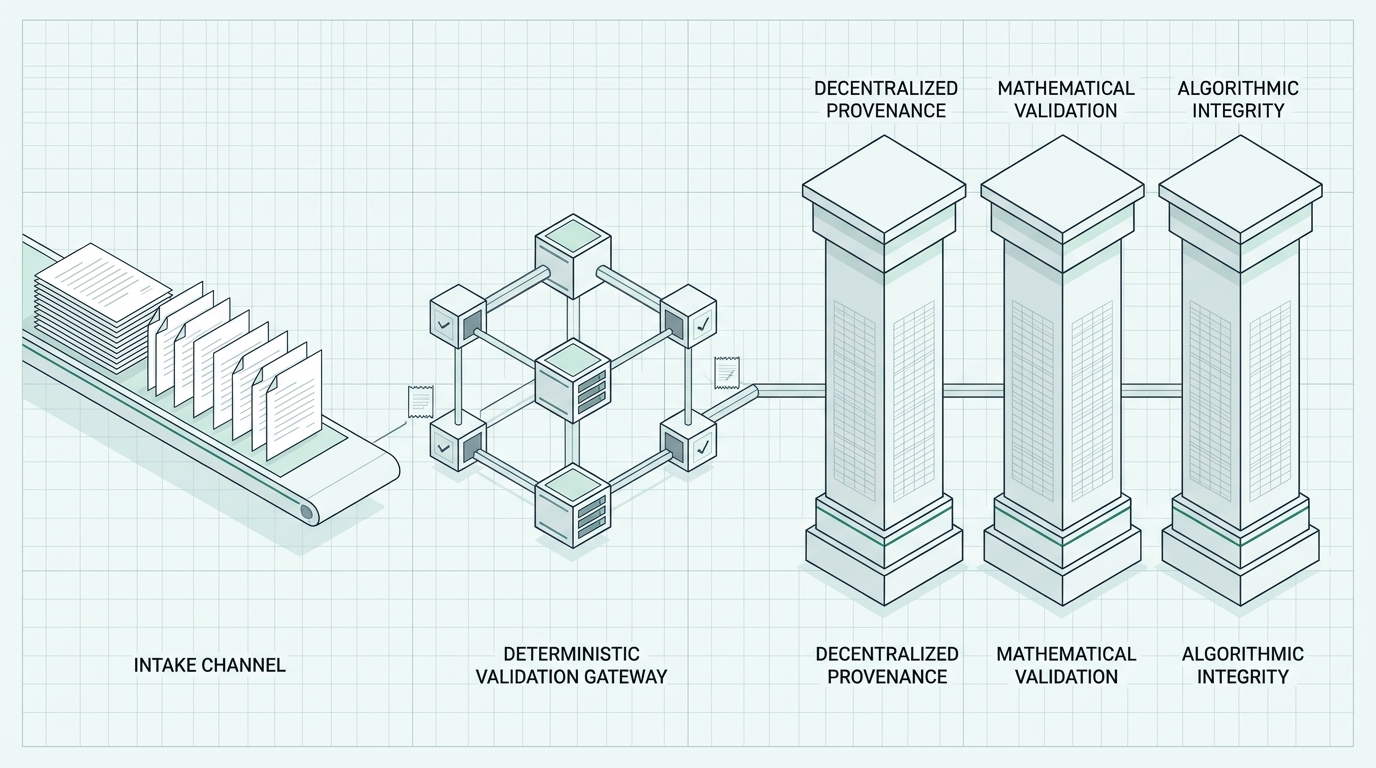
Each crisis is an accountability deficit: invisible labor, unverifiable authorship, unanchored artifacts, unprovable compliance, uncontrolled jurisdiction. All trace to one missing layer — a distributed provenance infrastructure — a unified Integrity Infrastructure with three capabilities, each grounded in specific, auditable technical primitives:
- GEAR Network — cryptographically signed, independently timestamped review records that convert peer-review labor into verifiable, portable academic capital. Underlying primitives: digital signatures (non-repudiation), RFC 3161 timestamp tokens (temporal anchoring), institutionally federated verification (no single operator controls the attestation log).
- AI Integrity Layer — submission-stage cryptographic binding of reviewer identity, artifact hash, and timestamp. Creates a non-repudiable accountability record that shifts the audit surface from post-hoc probabilistic detection to ex-ante verifiable submission. Does not claim to prove cognitive authorship; claims to make the assertion of authorship legally and professionally auditable.
- Integritas Vault — content-addressed artifact anchoring with jurisdiction-aware key management. Proves artifact integrity (the deposited file is the file being claimed) through cryptographic hashing and independent timestamp verification. Supports — and is architecturally compatible with — the stronger claim of computational reproducibility through verifiable execution manifests.
This is enterprise infrastructure for scholarly gatekeeping — managing integrity reactively versus owning it strategically. Institutions that deploy this distributed infrastructure now, built on verifiable cryptographic primitives rather than policy declarations, will define the standards their peers and partners must meet. This is not a software purchase; it is an institutional-risk and strategic-positioning decision with measurable compliance, funding, and reputation return.
The Institutional Pilot Grant: Co-Design Integrity Infrastructure
DecentraSec invites a limited cohort of research-intensive institutions to co-design a 12-month integrity pilot: deploying GEAR Network, AI Integrity Layer, and Integritas Vault against a live institutional use case — tenure-track review portability, submission-stage paper-mill screening, or Gold Standard compliance reporting. Selected institutions receive dedicated engineering support, a named researcher-integrity advisory seat, and a published joint case study for their senate or research board.
For institutions ready to move ahead of the pilot cohort, a structured Early Adopter Subsidy offsets first-year deployment costs across designated faculties. The next step is an executive brief and a 30-minute working session with the DecentraSec research-integrity team, tailored to your review workload, compliance exposure, and collaboration profile. This is an invitation to set the standard.
--- ScholarMark by DecentraSec is building the pre-submission infrastructure that academic publishing has never had — AI-powered integrity checks, paid peer review via the GEAR Network, and immutable provenance-based authorship seals. Start here →
References
- Aczel, B., et al. "A billion-dollar donation: estimating the cost of researchers' time spent on peer review." Research Integrity and Peer Review, 2021.
- Pangram Labs. "Pangram Predicts 21% of ICLR Reviews are AI-Generated." November 2025.
- Yu, S., et al. "Is Your Paper Being Reviewed by an LLM? Benchmarking AI Text Detection in Peer Review." arXiv:2502.19614, 2025. Dataset: 788,984 AI-written and human-written reviews; 18 detectors benchmarked; finding: no detector reliable at individual-review level.
- Shen, S. & Wang, K. "Detecting AI-Generated Content in Academic Peer Reviews." arXiv:2602.00319, 2026. Temporal emergence study: ~20% ICLR and ~12% Nature Communications reviews classified AI-generated by 2025.
- Richardson, R., et al. "The entities enabling scientific fraud at scale are large, resilient, and growing rapidly." PNAS, 2025. doi:10.1073/pnas.2420092122.
- Nature. "Huge reproducibility project fails to validate vast majority of Brazilian biomedical studies." April 25, 2025.
- The White House. "Restoring Gold Standard Science." Executive Order 14303, May 23, 2025.
- Nature. "Journals infiltrated with copycat papers that can be written by AI." September 23, 2025.
- Nature. "Authorship for sale: how paper mills work." June 9, 2025.
- Freedman, L.P., Cockburn, I.M., & Simcoe, T.S. "The Economics of Reproducibility in Preclinical Research." PLoS Biology, 2015. doi:10.1371/journal.pbio.1002165.
02 // RELATED RESEARCH · ARCHIVE DISPATCHES
Related Papers & Dispatches.
Peer-reviewed analyses, cryptanalysis papers, and zero-trust engineering dispatches.
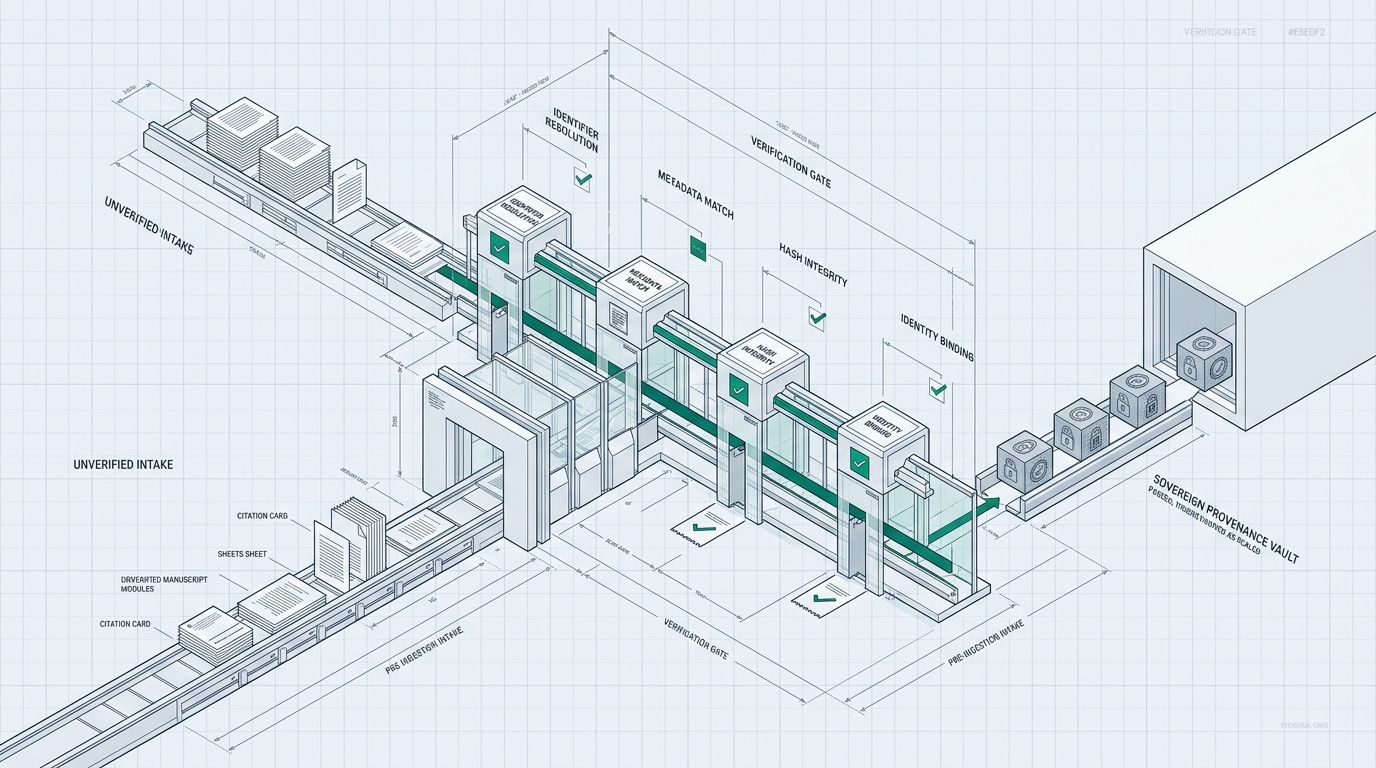
Research Integrity Infrastructure: Pre-Ingestion Checks
Research integrity failures are infrastructure failures. This post outlines pre-ingestion verification, appeal-aware records, and sovereign provenance for academic institutions.
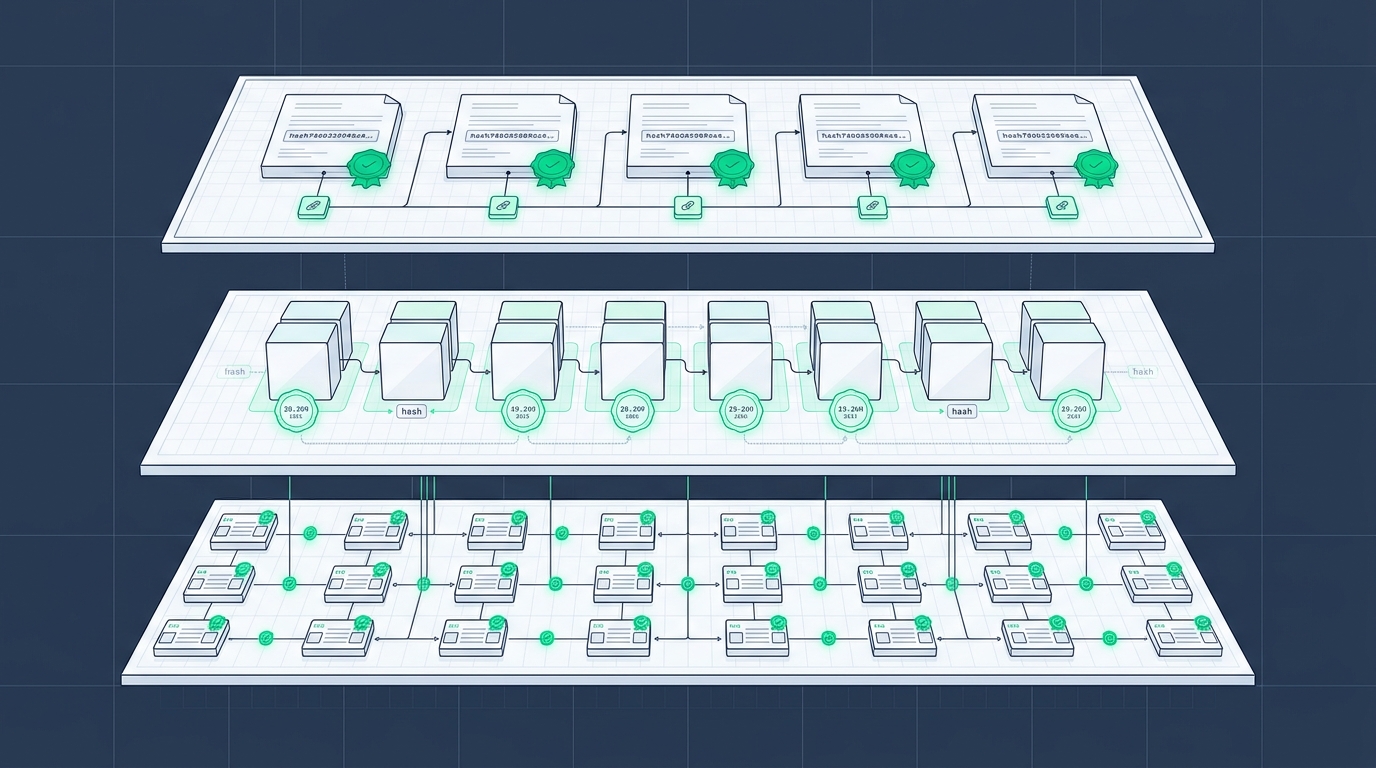
The Verification Gap: Research Integrity Is Infrastructure
Institutions do not lack AI detectors — they lack a verifiable chain of custody. Why the 21% AI-review finding is an audit failure, how tamper-evident provenance makes retraction clusters structurally impossible, and how deans, ORIC directors, and regulators can pilot verifiable research infrastructure this accreditation cycle.
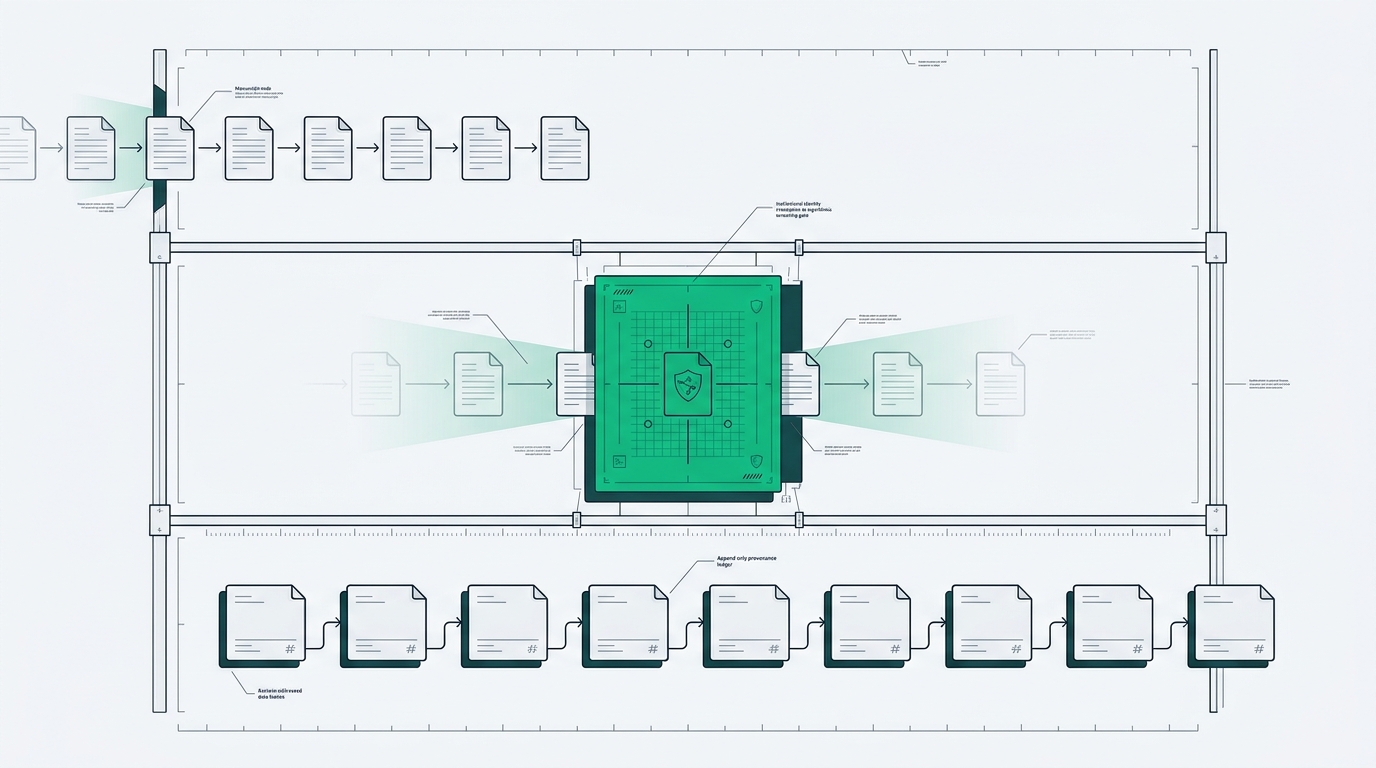
Peer Review Crisis? It's a Research Infrastructure Problem
More than eight million papers now enter a peer review system that can't verify who validated what. The fix is verifiable triage: identity-backed reviewers, screening at ingest, and audit-ready provenance—installed at the institutional layer, not bolted onto editorial software.