June 29, 2026
Research Integrity Crisis: Why It's One Architectural Failure
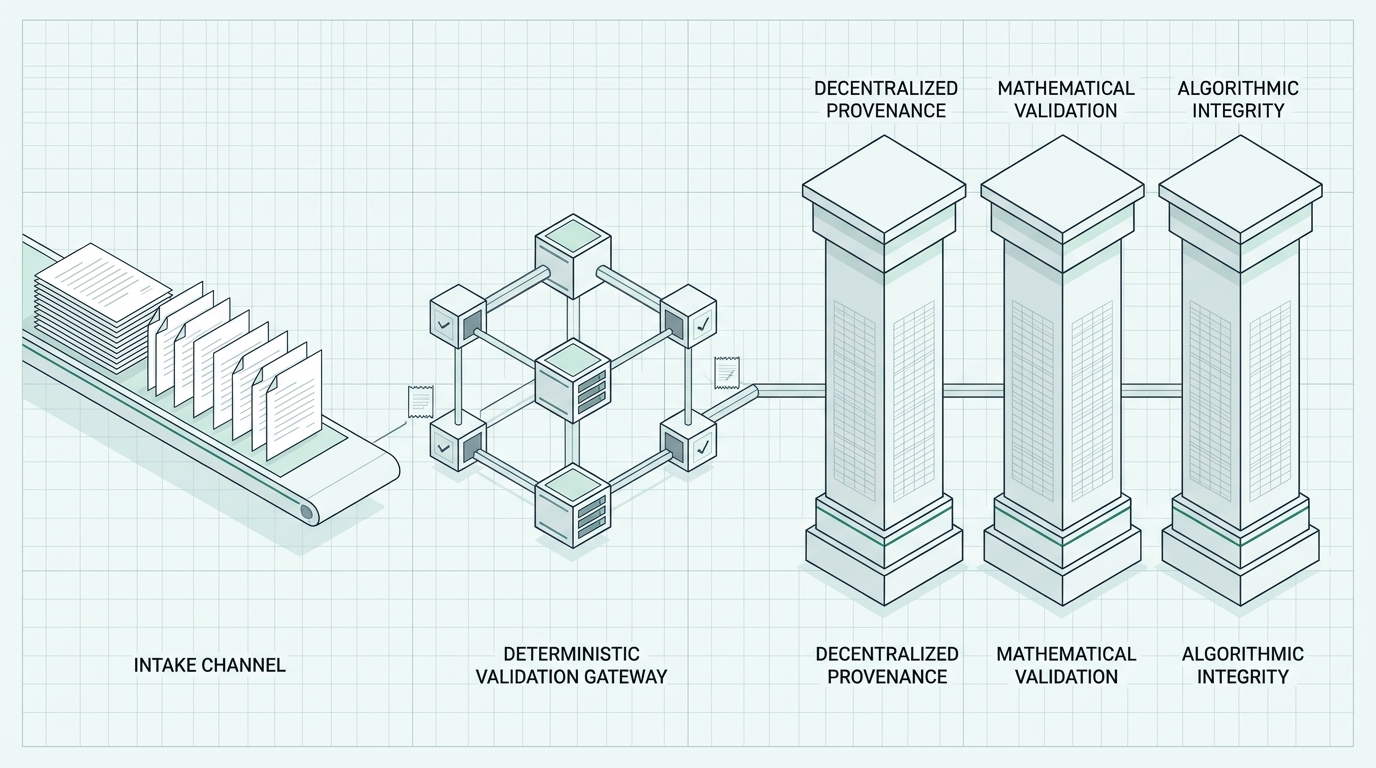
The scientific publishing ecosystem suffers from one architectural failure: the absence of mathematically validated data lineage and contributor attestation. Institutions that build Integrity Infrastructure will lead funding and reputation.

The Research Integrity Crisis Is Not Four Problems. It Is One Architectural Failure.
By DecentraSec Team
The scientific publishing ecosystem does not suffer from four separate integrity crises. It suffers from one architectural failure: the absence of mathematically validated data lineage and contributor attestation at every stage of the research lifecycle. Policies without enforcement infrastructure are not solutions. They are theater. The institution that builds its research workflow around verifiable provenance will leapfrog its peers in grant competitiveness, compliance readiness, and reputation preservation.
Your institution's research portfolio is almost certainly contaminated. Not possibly — demonstrably.
A 2025 PNAS study quantified what many suspected: paper mills now produce fraudulent manuscripts whose growth rate exceeds that of legitimate scientific output. A 2026 audit found at least 146,932 hallucinated citations — fabricated by large language models and undetected through multiple peer-review layers — already embedded in the indexed literature. More than half of peer reviewers now use undisclosed AI tools in direct violation of journal policies. arXiv has banned AI-generated submissions entirely after its moderation system collapsed under the synthetic flood.
These are not four separate problems. They are four symptoms of a single broken architecture: a research ecosystem that still operates on trust-based self-declaration at every gate — author honor pledges, reviewer honor codes, editorial confidence in data provenance — despite overwhelming evidence that this model has failed at scale.
The Nelson Memo deadline has taken legal effect. Federal funders now demand zero-embargo data access, and your researchers report they lack the Integrity Infrastructure to comply while protecting their intellectual property and patient privacy. The question is no longer whether the integrity model must change. The question is whether your institution will lead the transition — or face the next retraction wave.
Paper Mills: The Industrial Complex Behind Scientific Fraud
The evidence is no longer anecdotal. Richardson et al. (PNAS, August 2025) provided the first systematic quantification: fraudulent manuscript production networks are large, resilient, and growing faster than legitimate science. The study mapped implausible author–editor relationships, anomalous citation patterns, and image duplication at industrial scale. A March 2026 ScienceDaily investigation confirmed that fake research is "spreading faster than real science," with organized networks mass-producing fraudulent papers and selling authorships as a commercial service. A 2026 audit identified at least 146,932 hallucinated citations that entered the scientific literature in 2025 alone — fabricated by LLMs and undetected through multiple peer-review layers.
The infrastructure failure is stark: the current model relies exclusively on post-publication retraction, which trails fraud by years — after contaminated research has already influenced clinical practice, policy, and subsequent grant applications. As the PNAS commentary "Confronting the inevitable" (October 2025) argued, detection algorithms "can and should be baked into editorial pipelines, flagging suspect manuscripts before they reach PubMed or major indexes."
Your research portfolio faces reputation damage from retractions your office discovers after the fact. You need pre-submission integrity screening, not post-publication crisis management. ScholarMark's AI Integrity Layer provides verifiable attestation of human vs. AI contributions at the manuscript level, enabling pre-submission fraud flagging before content enters the review pipeline — exactly the infrastructure the PNAS authors call for.
Peer Review AI Violations: Why Policies Fail Without Enforcement
Prohibition-based AI policies are structurally ineffective. A Nature survey (December 2025) of ~1,600 academics found that more than 50% of researchers now use AI tools while peer reviewing manuscripts, often in direct violation of journal policies. A concurrent Frontiers survey of 1,645 active researchers confirmed the finding, with nearly one in four reporting increased AI use over the preceding year.
The most damning evidence comes from a study (arXiv:2512.06705, 2025) analyzing 5,114 JCR Q1 journals and 5.2 million papers from 2021 to mid-2025. Despite 70% of journals adopting AI disclosure policies, AI use in academic writing surged regardless. The study's conclusion is stark: "current policies have largely failed to promote transparency or restrain AI adoption." A separate JAMA Network Open study (December 2024) found that 78% of the top 100 medical journals issued AI guidance.
Policies without verifiable enforcement are not governance mechanisms. They are liability shields for publishers. The absence of Mathematical Validation means every journal flies blind.
Your faculty review manuscripts with undisclosed AI assistance, exposing your institution to integrity violations at journals you cannot monitor. You need technical enforceability, not aspirational policy. ScholarMark's mathematical contributor attestation enables journals to enforce AI policies through verifiable compliance — moving from honor-system to mathematically verifiable enforcement.
Preprint Integrity Collapse: The Unfiltered Injection Vector
The democratization that accelerated COVID science now constitutes the most vulnerable attack surface in the pipeline. Nature (August 2025) reported that preprint moderators are fighting a "flood" of AI-generated and paper-mill submissions. arXiv estimates that roughly 2% of submissions are rejected as AI or paper-mill products — but detection capabilities remain primitive, meaning the true rate is likely higher. In late 2025, arXiv banned AI-generated survey papers and position pieces entirely after its discretionary moderation system "broke under the weight" of synthetic submissions.
The structural vulnerability: the preprint ecosystem that democratized science during COVID is now the most vulnerable attack surface. Without pre-submission integrity checks, preprints function as an unfiltered injection vector for fraudulent content into the scientific record — contaminated content then propagates citations, influences policy, and enters the formal literature downstream. Human moderators cannot scale against automated submission pipelines. The math is unwinnable.
Your researchers' preprints — hosted on institutional repositories and preprint servers — are increasingly indistinguishable from synthetic content. Your institution's reputation is tied to content you do not currently screen. The GEAR Network establishes decentralized reviewer identity and reputation attestation, providing pre-submission screening that can flag likely AI-generated or paper-mill content before it burdens human moderators — addressing the preprint crisis at its point of entry, not after contamination.
Data Sovereignty Compliance Cliff: Mandates Without Infrastructure
The OSTP Nelson Memo's December 31, 2025 deadline for zero-embargo public access to federally funded research and underlying data has taken legal effect across ALL U.S. federal agencies — NIH, NSF, NASA, and others. Yet the Springer Nature State of Open Data 2025 report — the definitive longitudinal survey — reveals that researcher support for data sharing has collapsed to approximately 40%, down from 80% in 2020.
The reason is not philosophical opposition. Researchers cite a structural absence — mandates arrived without the infrastructure needed to satisfy them while protecting IP, patient privacy, and data integrity. Current compliance approaches rely on uploading data to generic repositories with no Decentralized Provenance, no contributor attestation, and no audit trail. This exposes institutions to compliance failures, data integrity disputes, and downstream retractions. The federal push is accelerating: agencies now audit compliance, and non-compliant grantees risk funding discontinuation.
Your Tier-1 researchers hold NIH, NSF, and NASA grants with active data-sharing obligations they cannot satisfy with existing infrastructure. This constitutes an existential compliance and funding risk. The Integritas Vault provides persistent, mathematically verifiable storage that simultaneously satisfies NIH DMS Policy, NSF data management requirements, NASA public access mandates, and FAIR principles — embedding algorithmic integrity that makes fabrication detectable at source rather than years later through retraction.
The Architectural Answer: From Detection to Mathematical Prevention
Each of the four crises shares a common root: the research ecosystem operates on trust-based declarations at every stage — author self-attestation of AI use, reviewer honor-system compliance, editorial confidence in data provenance, institutional reliance on post-hoc retraction. This model empirically fails at scale. The evidence resides in PNAS, Nature, arXiv, and longitudinal surveys.
The emerging academic consensus points toward Decentralized Provenance infrastructure as the necessary architectural layer. Guitton et al. (2024, arXiv:2407.14390) introduced "Honest Computing" — demonstrable data lineage through confidential computing, distributed architectures, and mathematical attestation — migrating compliance "from principle-based approaches to rule-based ones." On hallucinated citations, Glynn (2025, arXiv:2503.19848) proposed full-text reference deposit as a technical immunization strategy, noting that institutional Integrity Infrastructure to implement such a requirement does not yet exist at scale.
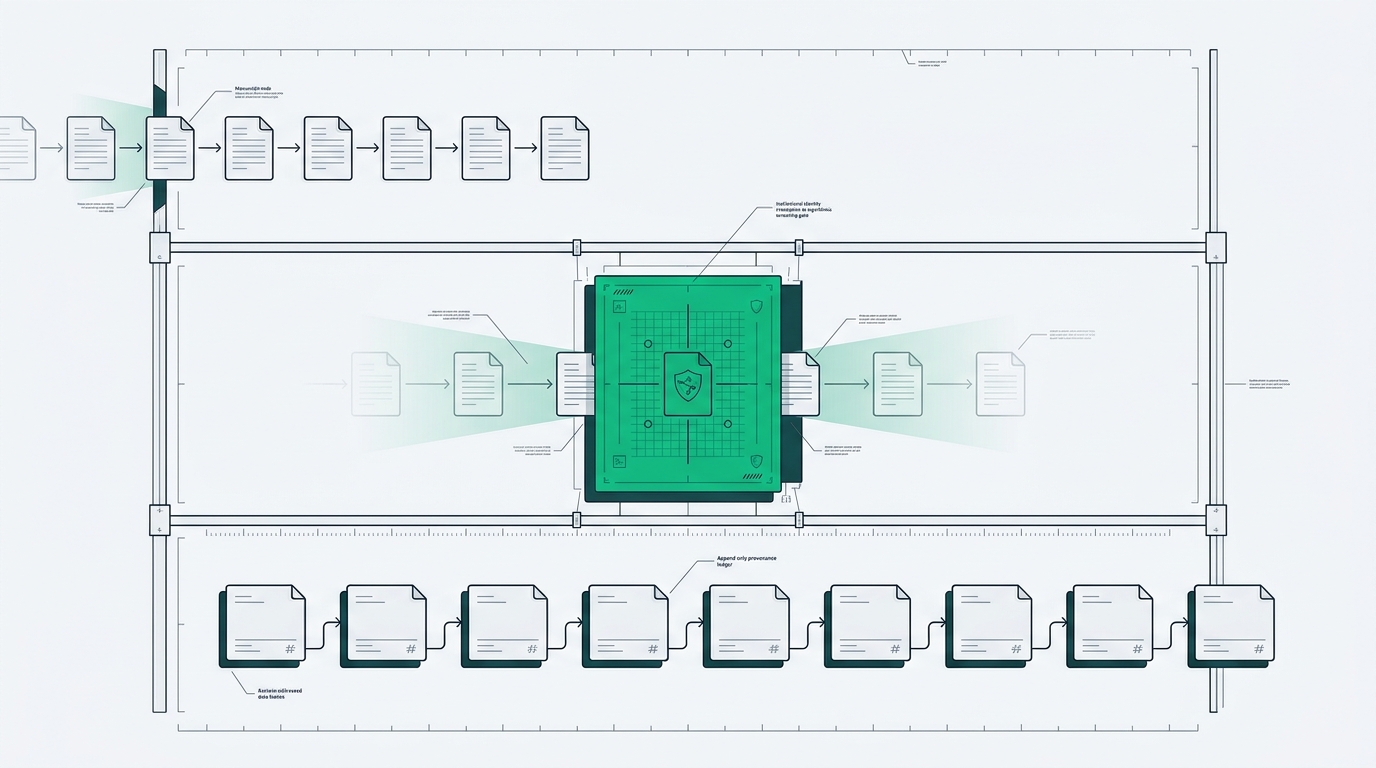
ScholarMark occupies precisely this institutional-grade infrastructure layer — three integrated capabilities that address all four crises simultaneously:
Integritas Vault → Persistent verifiable storage for data sovereignty compliance
AI Integrity Layer → Mathematical attestation of human vs. AI contribution
GEAR Network → Decentralized reviewer identity and pre-submission screening
This is not a tool for individual labs. This is infrastructure you deploy at the institutional level — the way a university deploys a library subscription or a research computing cluster. It elevates your entire research portfolio's integrity signal. ScholarMark is the first integrated platform to implement the Honest Computing framework at institutional scale — addressing all four crises from a single architectural layer, not disconnected point solutions.
The institutions that will dominate the next decade of research funding are not those with the largest labs or the highest publication counts. They are the institutions that can demonstrate, with mathematical certainty, that their research output is trustworthy.
The four crises above will not resolve themselves. Paper mills will not disappear. AI peer-review violations will not self-correct. The preprint flood will not recede. Federal compliance mandates will only tighten.
The question for your institution is straightforward: Will you build the Integrity Infrastructure now — while your competitors are still writing another policy document?
ScholarMark is now accepting applications for its Institutional Pilot Grant — a structured program for research-intensive universities to deploy the full ScholarMark stack (Integritas Vault, AI Integrity Layer, and GEAR Network) across a defined cohort of Tier-1 research groups. Participating institutions will receive dedicated implementation support, integration with existing institutional repository and grant management workflows, and a direct line to the product team for feature prioritization.
Additionally, a limited number of Early Adopter Subsidy placements are available for the first five institutions that commit to a formal pilot — reducing the institutional investment barrier while providing full platform access.
[Apply for the Institutional Pilot Grant] [Request Early Adopter Subsidy Details]
The era of trust-based research integrity is demonstrably over. The era of verifiable research integrity has begun. The question is whether your institution will lead it — or be led by it.
References
Richardson et al. (2025). "The entities enabling scientific fraud at scale are large, resilient, and growing rapidly." Proceedings of the National Academy of Sciences, 122(34). doi:10.1073/pnas.2420092122
ScienceDaily (March 2026). "Scientists warn fake research is spreading faster than real science."
LLM hallucinations audit (2026). arXiv:2605.07723. Cornell, UCLA, UC Berkeley, Tsinghua University.
Singer, P. (2025). "Confronting the inevitable: Harnessing technology to contain systemic scientific fraud." PNAS, 122(44). doi:10.1073/pnas.2521606122
Nature Survey (December 2025). "More than half of researchers now use AI for peer review." doi:10.1038/d41586-025-04066-5
Frontiers Survey (2025). "Most peer reviewers now use AI, and publishing policy must keep pace."
arXiv:2512.06705 (2025). "Academic journals' AI policies fail to curb the surge in AI-assisted academic writing."
Li et al. (2024). "Use of Artificial Intelligence in Peer Review Among Top 100 Medical Journals." JAMA Network Open. doi:10.1001/jamanetworkopen.2024.48609
Guitton et al. (2024). "Honest Computing: Achieving demonstrable data lineage and provenance." arXiv:2407.14390.
Glynn, A. (2025). "Guarding against AI–hallucinated citations: The case for full-text reference deposit." arXiv:2503.19848.
Springer Nature (2025). State of Open Data 2025.
Watson, C. (2025). "AI content is tainting preprints: how moderators are fighting back." Nature, 644(8077). doi:10.1038/d41586-025-02469-y
02 // RELATED RESEARCH · ARCHIVE DISPATCHES
Related Papers & Dispatches.
Peer-reviewed analyses, cryptanalysis papers, and zero-trust engineering dispatches.
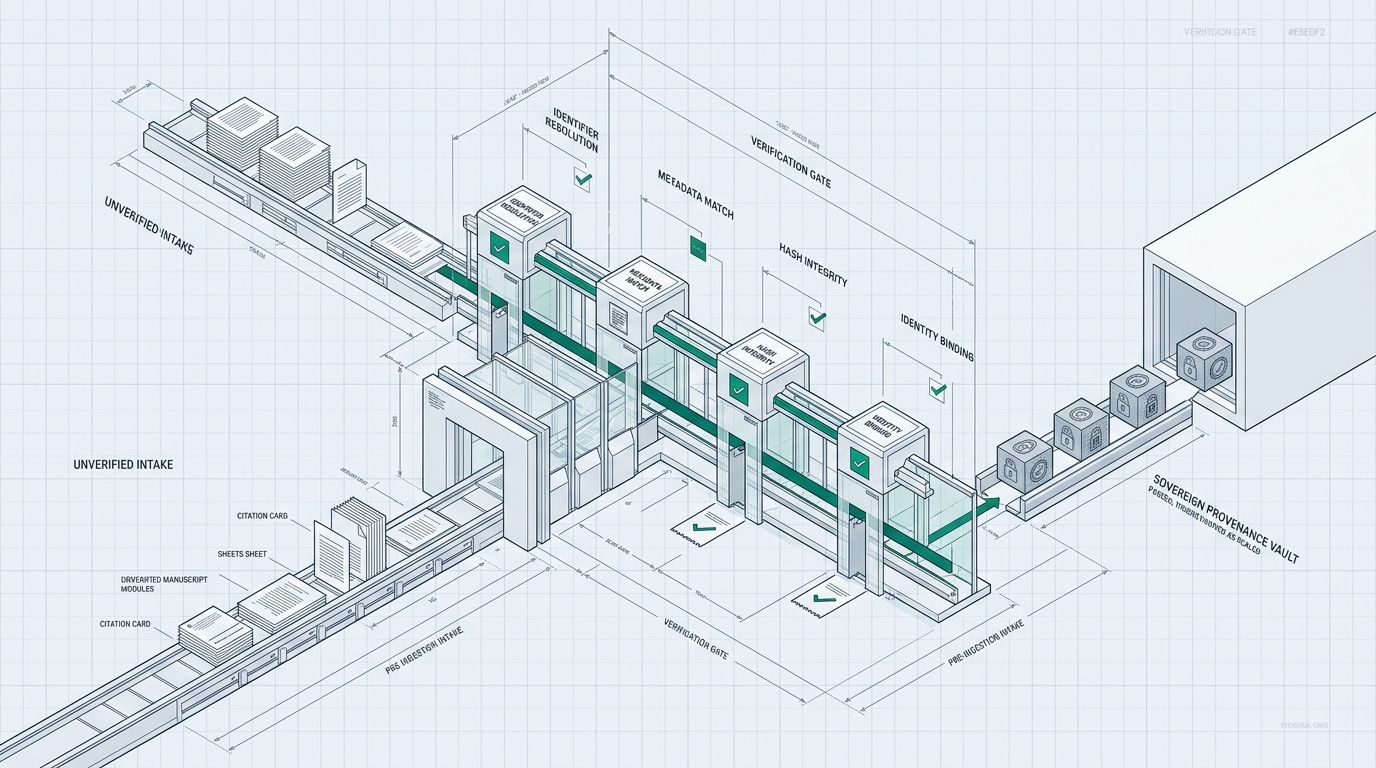
Research Integrity Infrastructure: Pre-Ingestion Checks
Research integrity failures are infrastructure failures. This post outlines pre-ingestion verification, appeal-aware records, and sovereign provenance for academic institutions.
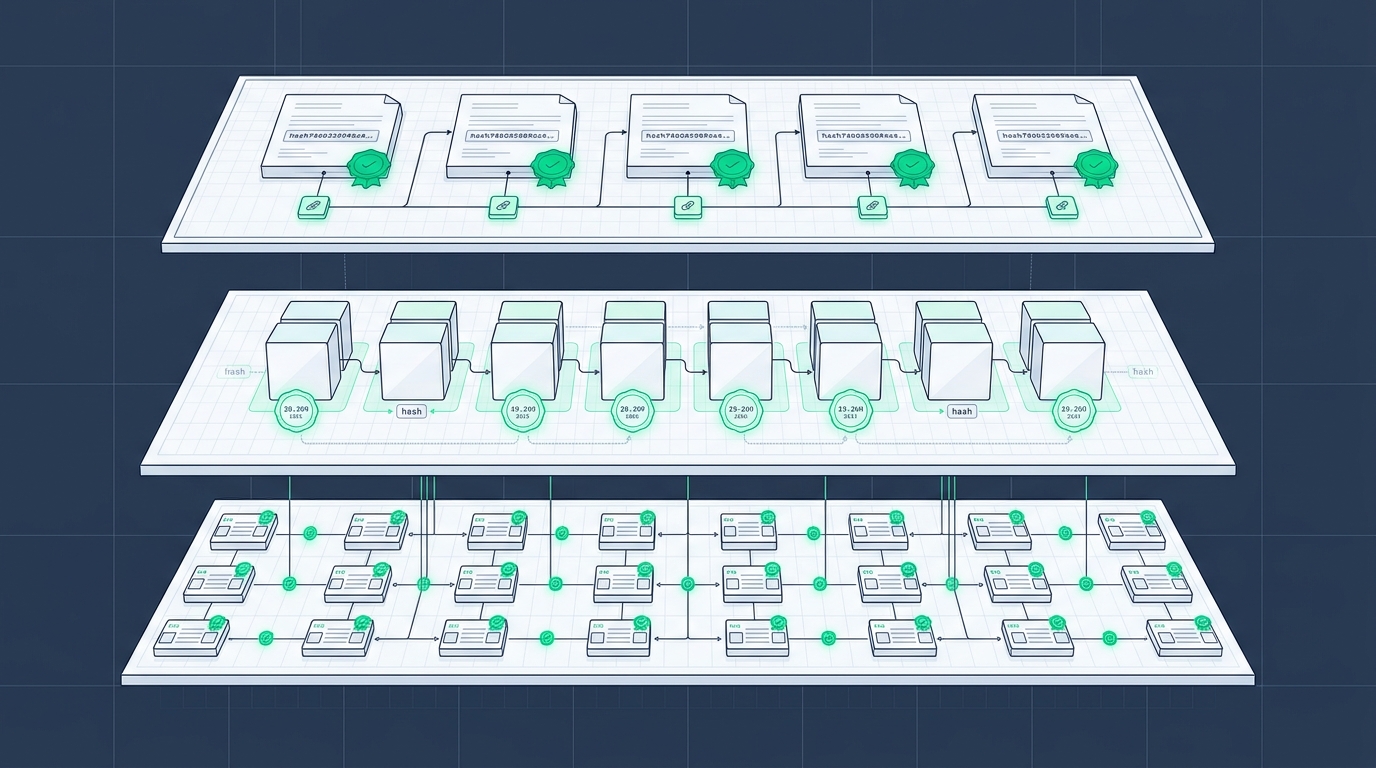
The Verification Gap: Research Integrity Is Infrastructure
Institutions do not lack AI detectors — they lack a verifiable chain of custody. Why the 21% AI-review finding is an audit failure, how tamper-evident provenance makes retraction clusters structurally impossible, and how deans, ORIC directors, and regulators can pilot verifiable research infrastructure this accreditation cycle.
Peer Review Crisis? It's a Research Infrastructure Problem
More than eight million papers now enter a peer review system that can't verify who validated what. The fix is verifiable triage: identity-backed reviewers, screening at ingest, and audit-ready provenance—installed at the institutional layer, not bolted onto editorial software.